


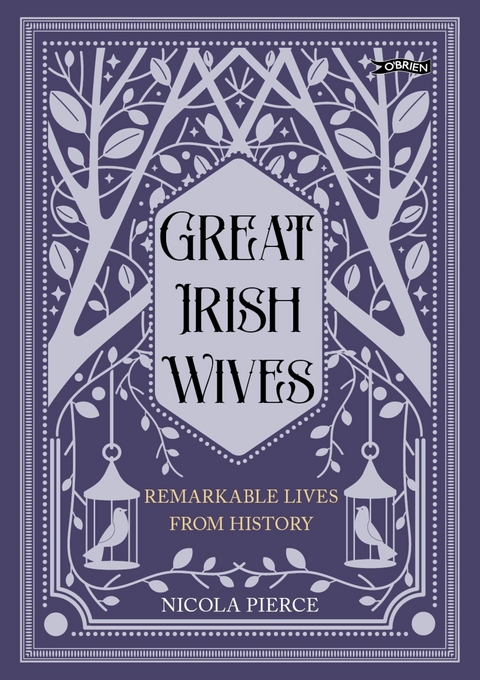
Great Irish Wives (eBook)
304 Seiten
The O'Brien Press (Verlag)
978-1-78849-624-7 (ISBN)
Nicola Pierce published her first book for children, Spirit of the Titanic, to rave reviews and five printings within its first twelve months. City of Fate, her second book, transported the reader deep into the Russian city of Stalingrad during World War II. The novel was shortlisted for the Warwickshire School Library Service Award, 2014. Nicola went on to bring seventeenth-century Ireland vividly to life in Behind the Walls (2015), a rich emotional novel set in the besieged city of Derry in 1689, followed by Kings of the Boyne (2016), a moving and gritty account capturing the Battle of the Boyne (1690), which was shortlisted for the Literacy Association of Ireland (LAI) awards. In 2018 Nicola delved in to the true stories of the passengers, crew and the legacy of the fated ship Titanic, in her illustrated book of the same name. To read more about Nicola, go to her Facebook page, www.facebook.com/NicolaPierce-Author and on Twitter @NicolaPierce3.
WINNER History Book of the Year, An Post Irish Book Awards. Throughout history, the stories of women's lives and work have been overshadowed by those of men. Wives, especially, disappear, unacknowledged as patrons and champions of their husband's work, as collaborators, muses, carers and managers of the family domain. Great Irish Wives shines a spotlight on ten such wives: Matilda Tone, Mary O'Connell, Constance Wilde, Charlotte Shaw, Emily Shackleton, Annette Carson, Sinead de Valera, Margaret Clarke, George Yeats and Beatrice Behan. The men in this book are household names, from Wolfe Tone and Daniel O'Connell to Oscar Wilde and BrendanBehan, and they all have one thing in common: they married women who enabled them to pursue their dreams,even if that meant courting death or outrage. Nicola Pierce tells the stories of these truly remarkable women.
Mary O’Connell, painting in Derrynane House, Caherdaniel, County Kerry.
If this book is an attempt to pull the wives of Ireland’s famous men out from behind their husbands’ shadows, the story of Mary O’Connell shows a courtship entirely carried out in the shadows for the sake of a promised inheritance.
There is only one surviving image of Mary O’Connell; the c.1817 portrait by Limerick man John Gubbins that hangs today in O’Connell’s Derrynane House in County Kerry. Thirty-nine-year-old Mary chooses to be shown adorned by her seventh surviving child, toddler Daniel (1816–1897), who shares his mother’s blue eyes and pale, smooth skin. Mary is presenting herself in what was possibly her second favourite role, that of a doting mother, whilst the quantity and apparent quality of her jewellery, the delicate hat that crowns her perfectly round ringlets of hair, along with the billowing white dress with its fine lace sleeves surely pay homage to her role as the wife of a successful lawyer turned ambitious politician who believed in the importance of appearances. For instance, in 1809, Daniel ignored his wife’s protest and bought a stately Georgian house they could ill afford in Dublin’s Merrion Square, number 58, because he believed that such a grand home would enhance his reputation.
If one discerns a hint of sadness in Mary’s gaze, then today’s viewer should know that between 1812 and 1816 she gave birth to five children, of whom only young Daniel survived. Furthermore, those four infants were not the only ones that she lost.
Mary was born in Tralee on 25 September 1778 into a branch of the O’Connell family. The family raised their children in two different faiths. Mary and her sisters were brought up in their mother Ellen Tuohy’s Catholic faith, whilst her brothers were raised in their father’s Church of Ireland faith. The widowed Thomas O’Connell was a physician and father-of-three when he met and married his second wife, Ellen. They had eight children and not much else is known about Mary’s childhood other than the fact of Doctor O’Connell’s untimely death in 1785, a family tragedy which left Ellen and the eleven children in financial straits, the most pressing consequence being that his daughters would not have dowries, a potential impediment to making a successful marriage. This lack of dowry would sorely impact Mary’s entire life after she fell in love with Daniel O’Connell, a distant cousin who was both a friend and colleague of her brother-in-law James O’Connor.
One wonders when and how Mary and Daniel first met. He was a busy young lawyer from Derrynane, in Kerry, who travelled to wherever he was needed throughout the province of Munster and would have had cause to visit Tralee. Perhaps the couple met at a social function or, maybe, Mary simply encountered him in her sister Betsey’s house as he worked on a case with James. In any case, in 1800, Mary and Daniel struck up a secret correspondence, shortly after which he proposed to her. Her acceptance was, initially, for his eyes and ears only.
The reason for the secrecy was money. Daniel stood to inherit a fortune from wealthy Uncle Maurice (1728–1825), known in the family as Hunting Cap, for whom a dowry-less bride would have been unacceptable, and who was capable of punishing a wayward nephew by disinheriting him. While Daniel was determined to marry the woman he loved, he was equally determined not to forfeit the riches that would someday be his.
In Daniel’s earliest surviving letter to Mary, he wrote: ‘You know as well as I do how much we have at stake in keeping the business secret. I have certainly more at stake than ever I had before, or I really believe if I fail at present I shall ever have again. Secrecy is therefore a favour I earnestly beg of you.’
Of course, nothing could be achieved without Mary’s full cooperation and, so, she said yes to all.
For the next two years, their mutual friend, another Daniel O’Connell, nicknamed Splinter, was charged with sending letters between the couple, but Splinter sometimes went missing just when he was needed. Also, Mary’s brother Rickard grew concerned over the number of letters his unmarried sister was receiving from Splinter and felt morally obliged to open one whereupon he discovered the existence of another Daniel O’Connell entirely. We can assume that Rickard kicked up a patriarchal fuss about impropriety until Ellen, his mother, told him that she had read all the letters and found nothing untoward in them. His mother was lying out of loyalty to Daniel who had confessed all to her in a letter. Whilst appreciating being included in the secret, Ellen urged Daniel to stop writing to Mary as it was causing trouble with her brother but this he could not do. Instead, he changed tack and sent Mary an impersonal letter about a lottery ticket – and nothing else – enabling her to read it aloud without causing Rickard any discomfort.
In want of a better courier, Daniel told his friend, James, Mary’s brother-in-law, about their engagement and entrusted him with sending their letters. This meant that Mary would receive letters from Daniel in an envelope addressed by James, which was well and good until one was delivered while his wife was visiting her sister. Recognising the familiar handwriting, Betsey imagined that her husband must be hiding a serious illness from her, thus forcing Mary to confess all. Now there were four who knew of the clandestine relationship. Since the whole point of all of this was to keep his uncle in the dark, it must have been worrying as the number of people who knew of the couple’s attachment increased, but Daniel obviously felt it was worth the risk. In any case, it ended in marriage, albeit a secret one.
The earliest biography about Daniel, published in 1872, was by the Republican Nun of Kenmare, Sister Mary Francis Cusack (1829–1899), who dates the wedding as being Wednesday, 23 June 1802; however, it is believed that it took place on Saturday, 24 July 1802. The venue was Betsey and James O’Connor’s house in Dame Street, in Dublin, with at least two of Daniel’s brothers and Reverend Finn, the parish priest of Irishtown, making up the wedding party.
A few days later, Mary returned to Tralee, while Daniel continued a bachelor existence, commuting for work between Dublin, the Munster circuit and Derrynane. Those stolen days after the wedding proved fruitful when Mary discovered that she was pregnant, thus complicating an otherwise simple plan to keep quiet about the marriage until Daniel worked up the courage to tell his uncle. Impending fatherhood could not be denied unless Mary was willing to hide herself away, and then what? Also, what if there were problems with the pregnancy and a doctor needed to be called?
As the months tumbled by, Mary grew lonely for her husband but could not make any demands on him until the situation with his uncle was resolved. The fearless Daniel who would take on Britain almost single-handedly and address a million people at the Hill of Tara clearly feared one person as, in the end, Daniel had his brother John confess on his behalf to Uncle Maurice that he had married a financially insecure prospect and there was a baby on its way. The pronouncement was not well received. His uncle was outraged, but for the next year no one knew what repercussions this would have for Daniel and his inheritance. One might also wonder if some of Maurice’s rage was due to having been told about the marriage so long after the fact and so close to the arrival of a baby.
Meanwhile, Mary suffered at being the cause of such trouble but chose to focus on what was more important than money in a letter to her husband: ‘We will yet, love, be happy together. Depend on it.’ She was doing her best to reassure herself as much as her husband as her mood dipped due to their stressful situation which, in turn, affected her well-being. Daniel wrote, urging her to look after herself. She replied, ‘It was not your fortune but yourself, my dearest heart, that I married. If you were possessed of but fifty pounds a year, I would be happy.’
However, money became an immediate problem following a couple of months of solitary house hunting in Dublin, whereby Daniel had to accept that they could not yet afford one.
When their first child was born in June 1803, in a probable attempt to appease his namesake, he was called Maurice. Mary and the baby exchanged her parents’ home for her in-laws’ modest farmhouse in Cahersiveen. Her moving in with Daniel’s parents probably coincided with her first introduction to them. Maybe Daniel worried about their reaction to his wife as a letter from his brother John tells him that Mary is welcome but that ‘father disapproves of your marriage only as far as he thinks it will hurt you with your uncle.’
And for a while, Mary was happy, but it could not last. Daniel was away most of the time and as the memories of their wedding day faded, she was no closer to living with her husband. Letters continued to be the...
| Erscheint lt. Verlag | 8.9.2025 |
|---|---|
| Sprache | englisch |
| Themenwelt | Literatur ► Biografien / Erfahrungsberichte |
| Schlagworte | Herstory • reclaiming irish women • rediscovered history |
| ISBN-10 | 1-78849-624-8 / 1788496248 |
| ISBN-13 | 978-1-78849-624-7 / 9781788496247 |
| Informationen gemäß Produktsicherheitsverordnung (GPSR) | |
| Haben Sie eine Frage zum Produkt? |
 EPUB (Wasserzeichen)
DRM: Digitales Wasserzeichen
Dieses eBook enthält ein digitales Wasserzeichen und ist damit für Sie personalisiert. Bei einer missbräuchlichen Weitergabe des eBooks an Dritte ist eine Rückverfolgung an die Quelle möglich.
Dateiformat: EPUB (Electronic Publication)
EPUB ist ein offener Standard für eBooks und eignet sich besonders zur Darstellung von Belletristik und Sachbüchern. Der Fließtext wird dynamisch an die Display- und Schriftgröße angepasst. Auch für mobile Lesegeräte ist EPUB daher gut geeignet.
Systemvoraussetzungen:
PC/Mac: Mit einem PC oder Mac können Sie dieses eBook lesen. Sie benötigen dafür die kostenlose Software Adobe Digital Editions.
eReader: Dieses eBook kann mit (fast) allen eBook-Readern gelesen werden. Mit dem amazon-Kindle ist es aber nicht kompatibel.
Smartphone/Tablet: Egal ob Apple oder Android, dieses eBook können Sie lesen. Sie benötigen dafür eine kostenlose App.
Geräteliste und zusätzliche Hinweise
Buying eBooks from abroad
For tax law reasons we can sell eBooks just within Germany and Switzerland. Regrettably we cannot fulfill eBook-orders from other countries.
aus dem Bereich


