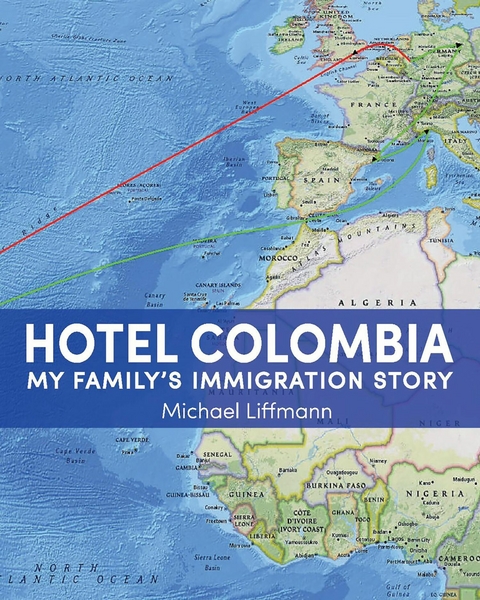
Hotel Colombia (eBook)
210 Seiten
Bookbaby (Verlag)
979-8-3178-0260-8 (ISBN)
Mike was born and raised in Colombia and, as a foreign student, came to the United States in 1965. He and his Brazilian-born wife, Christy, and most of his closest relatives now live in Baton Rouge, Louisiana. 'Hotel Colombia' was written because it's important that future generations of Liffmanns know as much about their heritage as possible. Our family's story-where we come from, what we've been through, the values we've carried forward-shapes who we are today. Preserving and passing down this history isn't just about remembering the past; it's about giving future Liffmanns a deeper sense of identity, belonging, and pride. When we understand our roots, we gain perspective, resilience, and a stronger connection to one another. Heritage is a living legacy, and it's up to us to ensure it continues to grow with each generation.
"e;Hotel Colombia"e; traces the Liffmann/Harf and Gottschalk/Hess lineage from Germany's Rhineland to Colombia where I was born and raised. Our ancestors were modest farmers and small town merchants that seldom ventured far beyond their communities. Several dozen family members tragically perished during the Holocaust but a few, including my parents, were fortunate and emigrated in 1937-38 to Cali and Bogota. I was motivated to write this book because it's essential that future generations of Liffmanns especially those living in the United States, Colombia, Israel, and Australia develop a deep understanding of their heritage. Our family's journey, the challenges we've faced, and the values that have guided us all contribute to the identity we share today.
Wickrathberg plays a prominent role in the Liffmann family history, so let’s begin there with a history of the Wickrathberg Synagogue and the Kristallnacht Riots to set the scene before introducing the Liffmann lineage beginning with my great-grandparents, Marcus (Mayer) Liffmann and Magdalena (Amalie) Katz.
In 1918, tiny Beckrath had 41 Jewish residents and they along with Jews from Wickrathberg and Herrath, belonged to the Wickrathberg synagogue. Erckens wrote (Volume 1, p. 315) that in 1900, Jews from Wickrath belonged to a lower social status (“unteren socialen schicht”) than other residents. The Jewish children attended the (Christian) Evangelical School and got religious education on Wednesday afternoons and Sunday mornings. It appears that our family moved to the Wickrath/Beckrath area after 1808 from elsewhere in the Mönchengladbach region.
The Encyclopedia of Jewish Life Before and During the Holocaust refers to Wickrathberg as the religious center for Jews who had been living in the surrounding villages since about 1600. The synagogue had about 75 members in 1808 and 240 in 1885. A new synagogue and accompanying cemetery were founded in 1860. In 1933, the synagogue community numbered 94 individuals and, in 1935, 118.
The Wickrathberg synagogue was burned down during the infamous Kristallnacht riots of November 9-10, 1938. Much has been written about this tragic event, and movies depicting the Nazi crimes against Jews feature images or reenactments of this sad moment in contemporary history. That evening (“nacht”), throughout Germany, paramilitaries and anti-Semitic civilians conducted well-planned and coordinated attacks that left the streets covered with broken glass (hence the word “kristall”) from the windows of Jewish-owned stores, buildings, and synagogues. At least 91 Jews were killed in the attacks and another 30,000 arrested and incarcerated in concentration camps (although the camps did not become official until after 1939 when Germany invaded Poland). Jewish homes, hospitals, and schools were ransacked during the day-long attacks on innocent civilians. Over 1,000 synagogues were burned and over 7,000 Jewish businesses destroyed or damaged.
Following Kristallnacht, most Jews in the area were arrested and deported to the Dachau concentration camp. For some unknown reason, Grandfather Max and the family members that had not fled to Colombia somehow did not immediately meet the same fate. Why?
Much has been written about the unfortunate circumstances that allowed the Nazis to rise to power and take over in 1933: the terrible terms given to the country as part of the 1918 Treaty of Versailles settlement that ended World War I; the worldwide depression that began in 1929, ensuing poverty and hunger among millions in Germany and elsewhere; and the fact that German masses were eager to have scapegoats for their unfortunate fate during those dark years. Not unlike other times in human history, Jews were blamed.
It is important to point out that while the so-called “final solution,” the euphemistic term given to Hitler’s genocide, did not become official until 1942, persecution began in the early 1930s and picked up steam. When the Nazis took over in 1933, not-so-subtle economic and workplace pressures such as business boycotts took place, and job firings were not just a matter of policy but also law. The boycotts had repercussions for our ancestors although accounts in Erckens show that the impact in Wickrath was not as damaging as in nearby Mönchengladbach and Rheydt. This probably tended to give the modest, relatively isolated Wickrath folks an unhealthy sense of comfort for their personal safety. Hitler had, after all, come to power as Germany’s chancellor (equivalent of president) and (so far) they had been largely spared. Too, in our family’s case, my Grandfather Max had been a sergeant in the German Army during World War I and had received medals and other hero-like accolades. Surely, or so the thinking went, a national hero was not going to suffer.
One Jewish family’s connections to the Nazis may also explain why Wickrath Jews might not have been as affected by the boycott and other pressures to self-deport. The Spier family owned Wickrath Lederfabrik (leather factory), the area’s largest employer, which somehow continued to operate normally during this period of unrest elsewhere in the country. The Lederfabrik was the largest Jewish-owned enterprise in the region, and many Jews had moved nearby after the factory opened in 1885. Our family sold or handled cattle hides for the factory, and I recall the Spier family being held in high regard by my dad.
A flood of visa applications followed Kristallnacht. Even though finding a relocation destination proved quite difficult, about 38,000 German Jews left in 1938. That figure more than doubled to 77,000 in 1939, and by the end of that year, half of Germany’s 500,000 Jews had left the country.
My dad and his siblings left before Kristallnacht although I do not know the exact date. Max, Selma, Herta, her husband, and three children died as part of the “final solution.” Max and Selma were deported from Düsseldorf to the Riga (Latvia) Ghetto6 on December 11, 1941 and died there on March 26, 1942. Information from Yad Vashem7 provides some gut-wrenching, eyewitness accounts of the December 11 train trip they were on:
At least in the case of the December 11, 1941 transport from Düsseldorf, the train was composed of third-class passenger cars for the Jews and a second-class passenger car for the guards. Reportedly, efforts were made to keep the train heated. A rail car on another transport to Riga from Vienna was reported not to have been heated, which resulted in at least one person having frostbit feet, which later turned gangrenous and had to be amputated in cold weather, the people were taken to the ghetto on the same day they arrived, without any property of any kind other than what they were wearing or carrying, under the guard of SS Death's Head troops. They were given no food of any kind and had to live from whatever they could find in the vacated sector of the large ghetto to which they'd been assigned.
Some of Selma’s relatives were more fortunate. Four Harfs—Johanna, Sigmund, Emma (neé Zander), and Hilde Winter (neé Zander)—survived the Riga ordeal and made it to Cali in 1945. Detailed information on their odyssey appears in the Unión Cultural Israelita’s (UCI) files. The UCI or Jewish Cultural Union had as it original mission to help German Jewish refugees, displaced by the Nazis and their allies, rebuild their lives in Cali. It remains active and its current leader, Julio Werthheimer, was a childhood acquaintance. Their account translated from German in 1946, is as follows:
In 1941, we along with others from the Mönchengladbach area (including our family), were sent to Düsseldorf and from there deported to the Riga Ghetto. For 2.5 years we remained in that hell and what we experienced cannot be described. Of the thousands that arrived, only 120 men and 180 women survived. On February 18, 1945 (as the end of the war neared), we were taken by ship to the Fuhlsbüttel jail (and concentration camp close to Hamburg, Germany). On April 4, we were marched to Kiel-Hassee (an estimated distance of 60 miles) and on May 1 rescued by Sweden and transported to a refugee camp in Holsbybrunn. From Sweden, we left to be with relatives in Cali and arrived on December 13, 1945.
I’m sure they felt lucky to have survived, but you can’t help but wonder about the hardships and psychological damage that had been done. The inhumanity of it all seems unfathomable. No caring. No compassion. Just hate. Nothing that any of us would want to experience, even for a minute.
So why had my grandparents stayed in Germany in the first place? After all, three of the children and their spouses had left for Colombia. I distinctly recall my dad pointing out the difficulty of moving a large family on relatively short notice and little money. Exit permits had to be obtained from German authorities, and immigration visas had to be issued by host countries. That involved proper connections, time, and money—and bribery was essential. The Levens and my grandparents had plans to eventually emigrate. There is correspondence about the family wanting to eventually reunite in Palestine.
A 2015 journal article by Lina María Leal Villamizar, “La Cuestión Judía en la Prensa Colombiana” (1933-1939), points out that by, September 1938, the Colombian government had succumbed to pressure from right-wing conservatives and fascists and restricted the immigration of German Jews to Colombia (Decree 1752) effective 1939. Leal Villamizar estimates that the Colombian Ministry of Foreign Relations rejected 15,000 immigration applications.
Marcus Liffmann and Magdalena Katz
My knowledge about my great-grandparents is scant. I know that Marcus (Mayer) Liffmann lived from October 25, 1837, to November 16, 1886. By profession, he was a salesman from Stessen, Germany. Magdalena Katz, also known as Amalie, lived from March 4, 1844, to March 8, 1921.
Although I do not have their place of birth, I know that both Marcus and Magdalena are buried in the Wickrathberg Cemetery.
Max Liffmann and Selma Harf
Max & Selma Liffmann (L) and Selma (R), paternal grandparents
Max and Selma Liffmann were my paternal grandparents. Max Liffmann was born in Wickrath, Germany, on May 27, 1881. Selma Harf was also born in Wickrath on July 5, 1880. Her parents were Salomon Harf (1841) and Sibila Blech (1842).
Max Liffmann was a cattle trader, a...
| Erscheint lt. Verlag | 2.6.2025 |
|---|---|
| Sprache | englisch |
| Themenwelt | Literatur ► Romane / Erzählungen |
| ISBN-13 | 979-8-3178-0260-8 / 9798317802608 |
| Informationen gemäß Produktsicherheitsverordnung (GPSR) | |
| Haben Sie eine Frage zum Produkt? |
 EPUB (Ohne DRM)
Größe: 20,5 MB
Digital Rights Management: ohne DRM
Dieses eBook enthält kein DRM oder Kopierschutz. Eine Weitergabe an Dritte ist jedoch rechtlich nicht zulässig, weil Sie beim Kauf nur die Rechte an der persönlichen Nutzung erwerben.
Dateiformat: EPUB (Electronic Publication)
EPUB ist ein offener Standard für eBooks und eignet sich besonders zur Darstellung von Belletristik und Sachbüchern. Der Fließtext wird dynamisch an die Display- und Schriftgröße angepasst. Auch für mobile Lesegeräte ist EPUB daher gut geeignet.
Systemvoraussetzungen:
PC/Mac: Mit einem PC oder Mac können Sie dieses eBook lesen. Sie benötigen dafür die kostenlose Software Adobe Digital Editions.
eReader: Dieses eBook kann mit (fast) allen eBook-Readern gelesen werden. Mit dem amazon-Kindle ist es aber nicht kompatibel.
Smartphone/Tablet: Egal ob Apple oder Android, dieses eBook können Sie lesen. Sie benötigen dafür eine kostenlose App.
Geräteliste und zusätzliche Hinweise
Buying eBooks from abroad
For tax law reasons we can sell eBooks just within Germany and Switzerland. Regrettably we cannot fulfill eBook-orders from other countries.
aus dem Bereich