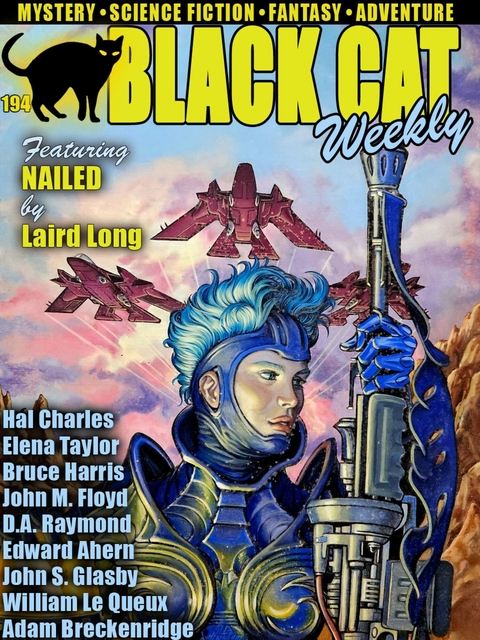
Black Cat Weekly #194 (eBook)
378 Seiten
Black Cat Weekly (Verlag)
978-0-00-080270-5 (ISBN)
This issue, we have quite a variety of stories, ranging from historical suspense (see William Le Queux's novel), to financial auditing (see Laird Long's original mystery) to a missing child to a sinister gargoyle. We even have the El Dorado's secret revealed! Read on to find your next favorite read in this issue's lineup.
Here's the complete list-
Cover Art: Steve Hickman
NOVELS
The House of Evil, by William Le Queux
A diplomat's friend is dead-are sinister forces at work?
SOLVE-IT-YOURSELF MYSTERY
'The Loss of Fortune,' by Hal Charles
Can you solve the mystery before the detective? All the clues are there!
SHORT STORIES
'Nailed,' by Laird Long [Michael Bracken Presents short story]
An audit reveals more than financials-can a rookie accountant catch a crook?
'Thursday's Child,' by John M. Floyd [Barb Goffman Presents short story]
When a runaway boy vanishes again, a stranger's past may hold the key...
'Murder at the Mall,' by Bruce Harris
Someone killed Darrell Leonard-can a security guard solve the case?
'Blood,' by Elena Taylor
A missing man, a barn owl, and blood in the hay-what is June hiding?
'The Dream of a Doll,' by Adam Breckenridge
A boy's creation reshapes the world-can love bloom in vine and rust?
'The Honesty Policy,' by Edward Ahern
A junk hauler uncovers a gruesome secret hidden in a historic house...
'City of Gold,' by David Alden Raymond
He claims he found El Dorado. Is the gold real or madness?
'Something About Gargoyles,' by John S. Glasby
A man falls ill under strange conditions-is a gargoyle to blame?
Barb Goffman Presents showcases modern
mystery and crime stories, selected by one of
the most acclaimed authors and editors
in the mystery field, Barb Goffman.
THURSDAY’S CHILD,
by John M. Floyd
Artie Tillman paused at the door to the bank and looked at his watch: 1:15. He felt the flutter of butterflies in his stomach, but that was nothing new. He always had a mild case of nerves, at this point. After a few long, deep breaths, he glanced behind him at the street, then turned again and opened the door. As he stepped inside the cool lobby, he pulled a pistol from underneath his shirt.
* * * *
Four blocks away from the bank where he worked, Tom Fetterman sat on a sunlit bench in Union Square, his face titled toward the midday sun. It felt good, that and the lunch he’d just finished at the McDonald’s across the street. He couldn’t have said, later, what made him think about the time, but he did. He checked his watch—and sat up straight.
One thirty. He was late again.
Tom jumped to his feet, gulped the last of the cookies his mother had tucked into his pocket this morning, and headed north on Powell.
Mr. Lindamood would be furious. The third time in two weeks, and Tom had already been warned. Why couldn’t he remember to look at his watch? For the hundredth time, Tom wished he could think, and plan, and recall things the way other people did.
He knew the only reason he had the job at the bank (he ran errands, stocked the supply shelves, etc.) was because his mother was the sister of the CEO.
“And it doesn’t matter if they don’t respect you yet,” she had told Tom a few weeks ago. “You’ll convince them. You’re a Thursday’s child, Thomas—you have far to go.”
But Tom wondered about that as he mulled over the words from the nursery rhyme. Did she mean he would go far in life or that it would take him a long time to do it?
He thought he knew the answer. After all, he was thirty years old, unmarried, slow-witted, and living with his wealthy mother. How much more pathetic could he be? Because of her and her resources, he even had an electronic “leash”—a monitoring device he kept on his person that would alert the police to his whereabouts in case he should wander too far afield. It had already been put to use, in fact. Twice. In both cases, his embarrassment at being picked up and escorted home had been erased—well, mostly erased—by the pure love on his mother’s face at his safe arrival. And afterward, he had vowed to try even harder to make her proud of him.
But here he was, in trouble again. In his frustration he kicked at a rock on the sidewalk, and realized too late it was a piece of the cement. He hurt his foot and stumbled. Behind him, he heard someone snicker.
Tom felt the beginnings of tears in his eyes.
Finally the bank was in sight, an old-fashioned gray building set back fifty feet from the street. Tom wiped his eyes with a shirtsleeve, quickened his pace—and stopped short. Something about the bank was different.
So dense about some things, Tom was oddly perceptive about others. He stood there a moment, looking around. A string of cars and a KCY-TV Action News van were parked at the curb, an old lady trudged along near the shops beside the bank, and half a dozen pigeons flapped and pranced around the windswept shrubbery that bordered the sidewalk.
Nothing wrong here, folks. Tom relaxed and kept going.
Then it struck him.
The glass door of the bank lobby was closed and shaded. It should have opened at one o’clock.
At that moment, a short man carrying a briefcase and a gun burst through the bank’s door. He backed a few steps toward the street, then fired a shot at another man who came through after him. As Tom watched, stunned, the second man winced and grabbed his chest like an actor in an old Western. He fell heavily to the sidewalk just outside the door.
The gunman turned and bolted for the street—and straight toward Tom Fetterman, who had jumped behind a tall shrub between the building and the curb.
The robber—that assumption seemed a safe one—was twenty feet away and closing fast. One thought locked itself in Tom’s mind: If he stayed hidden, the gunman would pass right by without seeing him.
But he suddenly knew he couldn’t do that. All his life he’d wanted to prove his worth, to rise above his handicap, to earn the respect of others.
Here was his chance.
Quickly, before he could think about it, he stuck out his right foot. The gunman tripped over it, went airborne, gasped a common but descriptive four-letter word during his flight, and crashed headfirst into the cold steel post of a parking meter beside the curb. The gun clattered to the ground.
With a trembling hand Tom grabbed the pistol and aimed it at the robber. He appeared to be out cold. The briefcase, Tom saw, was belted to the man’s wrist. Four feet above his sprawled form, inside the glass face of the parking meter, a tiny red flag said VIOLATION.
As if from a great distance, Tom heard the alarm go off inside the bank. About time, he thought. He felt good, cocky almost, but still he couldn’t stop shaking.
Where was everybody? Then he understood: The gunman must’ve warned those inside not to look out the door. The bank had no front windows.
“Somebody call the police,” Tom shouted. Just in case they weren’t coming already, because of the alarm.
Not that he really needed them.
Tom blinked. For the first time his mind grasped the full significance of what had happened.
He was a hero. A hero. Soon the bank employees would realize the danger was past and rush outside to investigate. Tom could see it now: Afternoon, Mr. Lindamood. No, everything’s under control—here’s your thief, and there’s your money. All in a day’s work.
His head was spinning. He could picture himself in the newspapers and on TV. A promotion, probably.
Then he frowned. Something about that bothered him.
TV. That was it—the TV van. What was it doing here?
Tom saw movement from the corner of his eye. As if triggered by his question, someone was running toward him from the Action News van, waving his arms like a man possessed.
“What the hell are you doing?” the guy yelled. He was big and red-faced, with some kind of video equipment on a strap over his shoulder.
Tom just looked at him and continued to point the gun at the robber, who was now holding his head and moaning.
“Who’re you?” Tom asked. Something was definitely wrong here.
The big man stopped and put his hands on his knees, gasping for air.
“Frank Morris, from KCY. Do you realize what you’ve done?” He focused on Tom for the first time. “You really don’t,” he said in amazement.
Tom stared at him.
“We’re doing a crime segment here,” Morris said. “It’s been running a month now. Don’t you watch the news?” He paused to catch his breath. “You know what a dramatization is? There are two cameras on you right now from that building across the street.” He turned and signaled to someone, watched for a moment, then set his equipment down and faced Tom again. “Come on, help me with this man.”
Together, they eased the robber to his feet. He had a blue goose egg above his right eye.
“Steady there, pardner,” Morris said. He glanced at Tom. “We should get him to a hospital.”
“But the guy who was shot... ”
Morris gave Tom a tired look. “The guy with the ketchup on his shirt? That’s Jack Cunningham. He’s been told to lie there until we wrap the scene. He doesn’t even know you’ve blown everything. Give me a hand here.”
In a daze, Tom helped load the injured man into a green Ford parked near the news van. Frank Morris went around and opened the driver’s door, then turned to Tom.
“See if you can do something right,” he said. “Go tell Cunningham and the inside camera crew what happened.” With a final shake of his head, Morris got in, started the Ford’s motor, and pulled out into traffic.
Tom Fetterman looked around. A crowd was gathering now on the sidewalk, and familiar faces were poking through the shaded door of the bank.
Tom just sighed. A hero, indeed.
* * * *
“You okay, Artie?” the driver said. He crossed Market, downshifted, hung a left. The gray warehouses of Mission Street flashed by outside.
The man in the passenger seat groaned. “I guess. Least I still have the money.” He touched his forehead. “What happened back there?”
The driver blew out a lungful of air and checked the mirror. They’d stopped only once, minutes ago, to switch cars.
“I was watching when you came out,” he said. “I saw the guy trip you. The window of the TV van sitting next to us was open, so I grabbed some camera stuff and came running. Lucky break.”
“You did good.” Artie Tillman grimaced, squeezed his eyes shut, and leaned back against the headrest. “Tell me something: Who’s Frank Morris?”
The driver accelerated through a yellow light. The traffic was thinning a bit now. He looked at his passenger and grinned.
“Ever see Escape from Alcatraz? Clint Eastwood?”
“No.”
“Well, Frank Lee Morris led the only group ever to make it off the island.”
Tillman opened one eye. “Where’d they catch him?”
The driver looped onto the Bayshore Freeway and pointed the car south.
“They didn’t,” he said.
* * *...
| Erscheint lt. Verlag | 18.5.2025 |
|---|---|
| Sprache | englisch |
| Themenwelt | Literatur ► Romane / Erzählungen |
| ISBN-10 | 0-00-080270-0 / 0000802700 |
| ISBN-13 | 978-0-00-080270-5 / 9780000802705 |
| Informationen gemäß Produktsicherheitsverordnung (GPSR) | |
| Haben Sie eine Frage zum Produkt? |
 EPUB (Adobe DRM)
Größe: 1,1 MB
Kopierschutz: Adobe-DRM
Adobe-DRM ist ein Kopierschutz, der das eBook vor Mißbrauch schützen soll. Dabei wird das eBook bereits beim Download auf Ihre persönliche Adobe-ID autorisiert. Lesen können Sie das eBook dann nur auf den Geräten, welche ebenfalls auf Ihre Adobe-ID registriert sind.
Details zum Adobe-DRM
Dateiformat: EPUB (Electronic Publication)
EPUB ist ein offener Standard für eBooks und eignet sich besonders zur Darstellung von Belletristik und Sachbüchern. Der Fließtext wird dynamisch an die Display- und Schriftgröße angepasst. Auch für mobile Lesegeräte ist EPUB daher gut geeignet.
Systemvoraussetzungen:
PC/Mac: Mit einem PC oder Mac können Sie dieses eBook lesen. Sie benötigen eine
eReader: Dieses eBook kann mit (fast) allen eBook-Readern gelesen werden. Mit dem amazon-Kindle ist es aber nicht kompatibel.
Smartphone/Tablet: Egal ob Apple oder Android, dieses eBook können Sie lesen. Sie benötigen eine
Geräteliste und zusätzliche Hinweise
Buying eBooks from abroad
For tax law reasons we can sell eBooks just within Germany and Switzerland. Regrettably we cannot fulfill eBook-orders from other countries.
aus dem Bereich