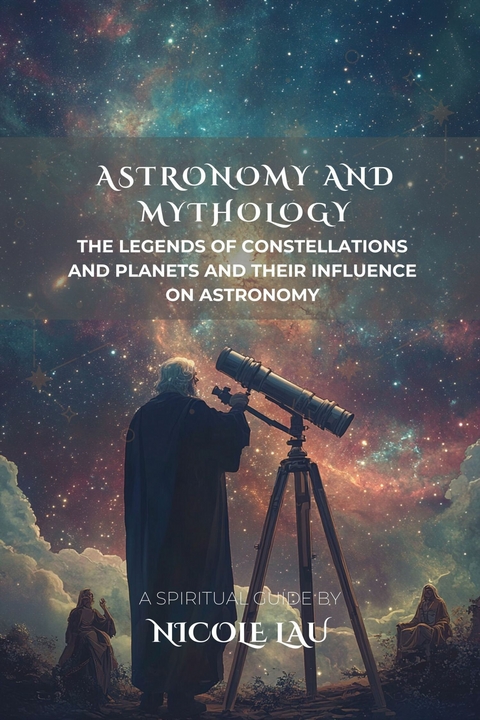
Astronomy and Mythology (eBook)
500 Seiten
Publishdrive (Verlag)
978-0-00-077692-1 (ISBN)
Where science meets story, the stars come alive.
Astronomy and Mythology invites you into a world where ancient legends illuminate the night sky, and mythology becomes the gateway to early astronomical understanding.
Preface
In the vast history, astronomy and mythology, these two bright pearls that seem to belong to different fields, are actually closely connected by a thin thread, together drawing a breathtaking picture of the universe. Since ancient times, human beings' infinite yearning and exploration of the starry sky have not only promoted the rapid development of science and technology, but also bred rich and colorful myths and legends with profound meanings. These myths are not only the ignorant guesses of the ancients about the mysteries of the universe, but also the concentrated embodiment of their culture, beliefs and imagination. In-depth exploration of the relationship between astronomy and mythology can not only help us cross the barriers of time and space and touch the sparks of ancient human wisdom, but also inspire us to think about the inextricable connection between science and culture.
As an ancient science, astronomy has been full of explorations of the unknown universe and interpretations of mysterious celestial phenomena throughout its development. Mythology is a way of explaining natural phenomena and cosmic order in early human civilization. In ancient times, due to the limitations of science and technology, people could not use scientific methods to explain astronomical phenomena such as solar eclipses, lunar eclipses, and comets. So they used their imagination and creativity to weave symbolic stories. These stories not only left a valuable cultural heritage for future generations, but also reflected the religious beliefs and philosophical thoughts of the society at that time.
For example, Apollo, the sun god in ancient Greek mythology, symbolizes light and wisdom. His story is closely related to the movement of the sun, reflecting the ancient people's worship of the sun and pursuit of light. In ancient Chinese mythology, the story of Chang'e flying to the moon reflects people's mystery about the moon and their yearning for immortality. Although these myths lack scientific basis, they record human perception and understanding of the universe in a unique way.
With the advancement of science, astronomy has gradually freed itself from the constraints of mythology and become a rigorous natural science. However, the connection between mythology and astronomy has not been broken. When studying the universe, modern astronomers still draw inspiration from ancient mythology and explore the ancients' understanding of the universe. At the same time, mythological stories have also become an important tool for popularizing astronomical knowledge and helping people better understand complex astronomical concepts.
Therefore, the relationship between astronomy and mythology is not just a historical coincidence, but also an inevitable development of human wisdom. They are intertwined and influence each other, and together constitute the rich connotation of human civilization. By deeply studying the connection between the two, we can not only have a deeper understanding of ancient civilization, but also a more comprehensive understanding of the interaction and integration between science and culture.
Background
In the vast arena of astronomy, constellations and planets are undoubtedly two important roles. Constellations, this ancient and mysterious concept, originated from the careful division of the stars in the night sky by ancient astronomers. They gave these areas specific names and symbolic meanings according to the arrangement, shape and position of the stars. These constellations, nourished by different cultures, bloom with their own unique charm and colors. Orion and Gemini in ancient Greece, with their vivid storylines and distinctive image characteristics, have become the treasures of Western constellation culture; while China's 28 Mansions, carrying a profound cultural heritage and long historical heritage, are closely linked to the legendary stories of ancient emperors and sages. Not only that, constellations are also closely related to human activities such as navigation and agriculture. In the long river of history, they not only guide the direction, but also entrust people's hopes and dreams. Planets, as bright spots moving in the night sky, their orbits and laws were regarded as mysterious natural phenomena in ancient times. They are intertwined with many mythological stories, giving these celestial bodies rich symbolic meanings and profound cultural connotations. For example, Venus represents the goddess of love and beauty in Roman mythology, while Mars symbolizes the god of war, Ares. The names of these planets and the mythological characters they represent provide unlimited material for human imagination. Over time, astronomers gradually unveiled the mystery of planetary motion through precise observations and calculations, and discovered the laws of their orbits around the sun, thus promoting the progress of the scientific revolution. In addition, the study of constellations and planets is not limited to ancient times, they still play an important role in modern astronomy. Through modern telescopes and space probes, we can have a deeper understanding of the physical properties and chemical composition of these celestial bodies, and even explore their possible signs of life. Astronomers use advanced technology to continuously refresh our understanding of the universe, making our understanding of constellations and planets more accurate and comprehensive. The accumulation of this knowledge not only enriches the scientific treasure house of mankind, but also inspires people's curiosity and desire to explore the unknown world.
Cultural Background
In the cultural soil of all parts of the world, the myths of constellations and planets present a variety of styles. Take ancient Greece as an example. This ancient civilization that gave birth to countless myths and heroes, the naming and legends of its constellations and planets are often inseparable from the legendary stories of gods and heroes. For example, each of the twelve great deeds of Hercules has an indissoluble bond with a constellation or planet. These stories not only cast a mysterious veil on the constellations and planets of ancient Greece, but also have a profound impact on the formation and development of Western culture. Poseidon's huge waves, symbolizing the power of the ocean, are also closely related to the legends of certain constellations, reflecting the ancient Greeks' awe and worship of natural forces. In the distant East, ancient China also had its own unique constellation and planetary mythology system. These stories are often closely linked to the legendary experiences of emperors, generals, and literati, such as the majesty of the Emperor of Heaven and the wisdom of Emperor Jun. These ancient legends not only enriched the astronomical culture of ancient China, but also left a valuable cultural heritage for future generations. Ancient Chinese astronomers combined astronomical phenomena with human affairs by observing the movement of stars, forming a unique theory of astrology. In addition to ancient Greece and ancient China, other ancient civilizations such as Maya, India and ancient Egypt also have their own unique astronomical mythology systems. The astronomy of the Mayan civilization is closely linked to the calendar, and their observations and records of Venus have reached amazing accuracy. The constellation and planetary stories in Indian culture are closely linked to religious beliefs and philosophical thoughts, reflecting the Indians' deep understanding of the universe and the nature of life. The ancient Egyptian civilization combined the myths of constellations and planets with the power of the pharaoh and the concept of eternal life, reflecting their belief in the order of the universe and the afterlife. These ancient civilizations expressed their understanding and awe of the universe through their unique mythological stories, and also reflected human curiosity and spirit of exploration of the unknown world. Whether it is the heroic legends of ancient Greece, the emperors' astrology of ancient China, or the mysterious cosmology of other civilizations, these stories have become an indispensable part of human cultural heritage and still attract us to explore and learn.
The Interweaving of Mythology and Astronomy
In ancient times, astronomers often incorporated myths into their scientific observations. They used the power of myths to explain the laws of motion of celestial bodies and the mysteries of the universe, and also used the power of science to verify the various conjectures and predictions in myths. This fusion and symbiosis of science and myth not only provided rich ideological resources and sources of inspiration for the development of ancient astronomy, but also left countless precious cultural heritage and spiritual wealth for future generations. For example, ancient Greek astronomers used myths to explain the retrograde phenomenon of planets and the causes of solar and lunar eclipses; they told stories about gods such as Zeus, Apollo and Athena, and combined these stories with the laws of celestial motion, making astronomical discoveries easier for people at that time to accept and understand. Ancient Chinese astronomers compiled calendars and predicted farming seasons by observing the changes in constellations. Based on the legends of constellations such as the Big Dipper and the Cowherd and the Weaver Girl, they closely linked the movement of these constellations with seasonal changes and agricultural production, making the formulation of the calendar and the arrangement of agricultural activities more in line with the laws of nature. These myths not only provided strong support and promotion for the development of ancient astronomy, but also provided...
| Erscheint lt. Verlag | 19.4.2025 |
|---|---|
| Sprache | englisch |
| Themenwelt | Literatur ► Romane / Erzählungen |
| ISBN-10 | 0-00-077692-0 / 0000776920 |
| ISBN-13 | 978-0-00-077692-1 / 9780000776921 |
| Informationen gemäß Produktsicherheitsverordnung (GPSR) | |
| Haben Sie eine Frage zum Produkt? |
 EPUB (Adobe DRM)
Größe: 1,2 MB
Kopierschutz: Adobe-DRM
Adobe-DRM ist ein Kopierschutz, der das eBook vor Mißbrauch schützen soll. Dabei wird das eBook bereits beim Download auf Ihre persönliche Adobe-ID autorisiert. Lesen können Sie das eBook dann nur auf den Geräten, welche ebenfalls auf Ihre Adobe-ID registriert sind.
Details zum Adobe-DRM
Dateiformat: EPUB (Electronic Publication)
EPUB ist ein offener Standard für eBooks und eignet sich besonders zur Darstellung von Belletristik und Sachbüchern. Der Fließtext wird dynamisch an die Display- und Schriftgröße angepasst. Auch für mobile Lesegeräte ist EPUB daher gut geeignet.
Systemvoraussetzungen:
PC/Mac: Mit einem PC oder Mac können Sie dieses eBook lesen. Sie benötigen eine
eReader: Dieses eBook kann mit (fast) allen eBook-Readern gelesen werden. Mit dem amazon-Kindle ist es aber nicht kompatibel.
Smartphone/Tablet: Egal ob Apple oder Android, dieses eBook können Sie lesen. Sie benötigen eine
Geräteliste und zusätzliche Hinweise
Buying eBooks from abroad
For tax law reasons we can sell eBooks just within Germany and Switzerland. Regrettably we cannot fulfill eBook-orders from other countries.
aus dem Bereich