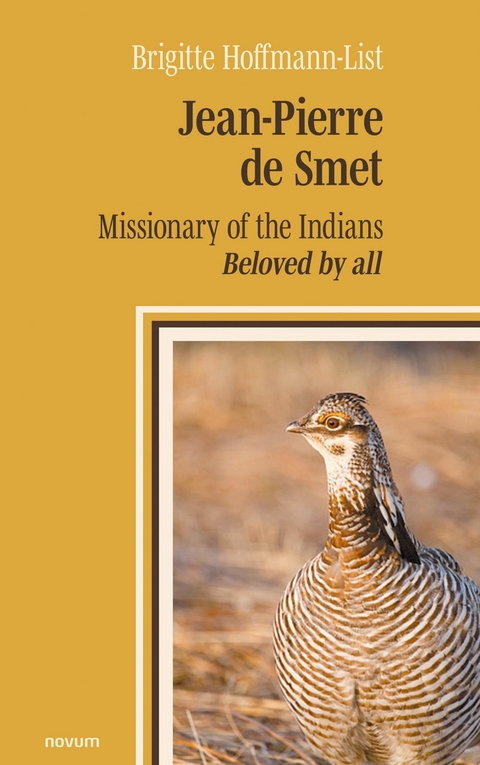
Jean-Pierre de Smet (eBook)
98 Seiten
novum publishing (Verlag)
978-3-7116-0218-3 (ISBN)
A Call in the Night
They had just sat down to supper. The wind was howling and hissing around the house, but it could not get inside. The wind and the cold were stuck outside. Ma stood and put another log into the oven. Inside, it was cozy and warm, but outside, it seemed to Kathie, all hell had been unleashed.
Suddenly, they heard a noise that stood out from the sounds of the wind. It sounded like a call and the snort of a horse. Susan, the little black cat, hid herself away in the farthest corner of the room. Pa stood up, grabbed his rifle, and opened the door. At first, they couldn’t see anything in the blackness and the swirling snow flurries, and the new arrival probably felt the same way because he stared into the room as if he first had to remember where he was.
“Come in, come in!” said Pa, pulling the stranger into the room and closing the door behind him. The man leaned against the wooden wall and took a deep breath:
“Praise be to Jesus!”
“Forever and ever, amen!” said Ma, and helped him to a chair. “Please, take off your coat, I will dry it by the fire.”
“Yes, thank you,” said the man, listlessly, and unbuttoned his thick coat made from buffalo hide. Around his neck he wore a ribbon with a silver crucifix hanging from it.
“De Smet!” Pa cried out, surprised. “Father De Smet!”
“How do you know who I am?” asked De Smet.
“Your crucifix, of course; and I have seen you before as well.”
“Where?” asked De Smet.
“In Oswego.”
“Oh, my goodness – Lizette!” shouted De Smet and jumped up. “I can’t leave the poor animal outside in the cold! Would you happen to have some room in your stable?”
“Of course! We have one horse and one cow, there is surely room for a third animal, too.” They both went out into the night with the roaring storm and returned a few minutes later.
“So, now Lizette is taken care of, just like me,” he said thankfully. “You cannot imagine how happy I was to come across a house with light shining through the cracks! An inhabited house! My journey was supposed to end in Independence, but it is another 14 miles to ride.”
Ma brought hot tea with brown sugar and quickly made some sandwiches filled with cold game. “Please, strengthen yourself,” she said, “and drink some tea. You must be half-frozen!” He took a couple of sips and then said:
“Ah, that feels good! I am finally beginning to thaw out!”
Kathie looked at his strangely beautiful face, his brown hair that hung down to his shoulders, and his shining eyes that kept gliding over the family as he eagerly ate his snack.
“It has been a long time since I have had something this good to eat!” he confessed.
“It is fresh game,” said Ma. “My husband shot it just a few days ago.”
“You probably don’t get to eat regularly on your travels, do you?” said Ma.
“No, not usually. But I always have some provisions with me, and when I pass by an Indian village, they are always very welcoming. You are invited to eat, and the more you eat, the more they like you. It would be an insult not to eat, but they do not pester you to do so. Anything you cannot finish, you may take with you. Once I was invited to eat with a family. They placed a dish in front of me, and it looked like some disgusting kind of broth. I had to steel myself to try it. And then – I was quite astounded, how good it tasted! It was a stew made of buffalo tongue with herbs and potatoes.”
De Smet had finished his meal and looked at the family hopefully. He wanted to learn more about them and their circumstances.
“Don’t the Indians get in your way when you are hunting?” he asked.
“No,” said Pa, “at least, not until now.”
“You must be very brave, to settle here …”
“We have neighbors,” said Pa, “three families, with whom we have good contact. We are secretly hoping that a town will grow up here, with a church, a school, a little store …”
“This is Indian country,” said De Smet.
“The land belongs to whoever builds on it,” Ma argued, “that is just common sense!”
“Well, it is not quite as simple as that,” said De Smet gently. “The Indians have been living here for centuries. The land feeds them. They live from hunting and fishing. The buffalo gives them everything that they need. Furs for their clothing. Leather for their tepees, meat – everything, really. And they only kill as much as they need. When the whites invade here, they kill everything out of sheer hunting lust. And, of course, with the ulterior motive of depriving the Indians of their livelihood.”
“How can we solve this problem?” asked Pa. “What do you think?”
“I think about it day and night, but I don’t know either. But there is a faint glimmer of hope, for me, when the Indians send their children to school. There they learn to read and write. They learn everything about working the land, the different working techniques and maybe, one day, they can be integrated into the United States. That is the only way to save them. That would be humane and just. I hope and pray that that will come to pass one day. I often imagine how this fertile land will be populated. Here, there is everything that the farmer needs. Farms with orchards, herds of sheep, cattle, …”
“And a lot of chickens,” reminded Kathie, who loved chickens above all.
“Chickens, of course!” De Smet smiled at her. “Towns will grow up, the farmers will provide them with everything. But what about my Indians? Will they be able to keep up? I am so afraid that they will be driven from the land where their fathers and forefathers were buried.”
They were all silent for a while. Each one lost in their own thoughts.
Then De Smet spoke once more:
“The most wonderful thing I ever heard on this subject was from an Indian. His name is Red Jacket.”
“The Indians give speeches?” asked Ma, surprised.
“Yes,” said De Smet, “and they have a very poetic way of expressing themselves. May I repeat the speech to you, as far as I can remember it?”
“Please do,” said Pa.
“There was a time when our forefathers owned this great island. Their feats extended from the rising to the setting of the sun. The Great Spirit had made it for the use of the Indians. He had created the buffalo, the deer, and other animals for food. He had made the bear and the beaver. Their skins served us for clothing. He had scattered them over the country and taught us how to take them. He had caused the earth to produce corn for bread. All this he had done for his red children because he loved them. But an evil day came upon us. The white man came. Their numbers were small. They asked for a small seat. We took pity on them, we granted their request, and they sat down among us. We gave them corn and meat. In return, they gave us poison – fire water. The white people had now found our country. More and more came amongst us. Yet we did not fear them. We took them to be friends. At length, their numbers had greatly increased. They wanted more land; they wanted our country.
You have now become a great people, and we have scarcely a place to spread our blankets. You have got our country but are not satisfied; you want to force your religion upon us.
We understand that your religion is written in a book. If this was intended for us as well as you, why has not the Great Spirit given it to us? How shall we know when to believe, being so often deceived by the white people? – You say there is but one way to worship and serve the Great Spirit. If there is but one religion, why do you white people differ so much about it?
We also have a religion, which was given to our forefathers, and has been handed down to us, their children. We never quarrel about religion. – The Great Spirit has made us all, but he has made a great difference between his white and red children. Since he has made so great a difference in some things, why may we not conclude that he has given us a different religion according to our understanding? The Great Spirit does right. He knows what is best for his children.
We do not wish to destroy your religion or take it from you. We only want to enjoy our own.”
“How wonderful!” whispered Kathie.
“Yes, it is wonderful,” said Father De Smet, “but it is aimed directly at me. In plain language it means: we do not want your religion.”
He leaned back and closed his eyes. It had grown dark in the room, only the fire still burned and threw shadows up the walls. Ma and Pa were also moved.
“I can’t believe that this text came from an Indian,” said Ma. “When I think of the Indians, I just think of the atrocities that they commit.”
“Because they have no other choice,” said De Smet, “they take...
| Erscheint lt. Verlag | 20.5.2025 |
|---|---|
| Sprache | englisch |
| Themenwelt | Literatur ► Romane / Erzählungen |
| Schlagworte | Biografie • Brigitte Hoffmann-List • Geschichte |
| ISBN-10 | 3-7116-0218-5 / 3711602185 |
| ISBN-13 | 978-3-7116-0218-3 / 9783711602183 |
| Informationen gemäß Produktsicherheitsverordnung (GPSR) | |
| Haben Sie eine Frage zum Produkt? |
 EPUB (Wasserzeichen)
DRM: Digitales Wasserzeichen
Dieses eBook enthält ein digitales Wasserzeichen und ist damit für Sie personalisiert. Bei einer missbräuchlichen Weitergabe des eBooks an Dritte ist eine Rückverfolgung an die Quelle möglich.
Dateiformat: EPUB (Electronic Publication)
EPUB ist ein offener Standard für eBooks und eignet sich besonders zur Darstellung von Belletristik und Sachbüchern. Der Fließtext wird dynamisch an die Display- und Schriftgröße angepasst. Auch für mobile Lesegeräte ist EPUB daher gut geeignet.
Systemvoraussetzungen:
PC/Mac: Mit einem PC oder Mac können Sie dieses eBook lesen. Sie benötigen dafür die kostenlose Software Adobe Digital Editions.
eReader: Dieses eBook kann mit (fast) allen eBook-Readern gelesen werden. Mit dem amazon-Kindle ist es aber nicht kompatibel.
Smartphone/Tablet: Egal ob Apple oder Android, dieses eBook können Sie lesen. Sie benötigen dafür eine kostenlose App.
Geräteliste und zusätzliche Hinweise
Buying eBooks from abroad
For tax law reasons we can sell eBooks just within Germany and Switzerland. Regrettably we cannot fulfill eBook-orders from other countries.
aus dem Bereich