


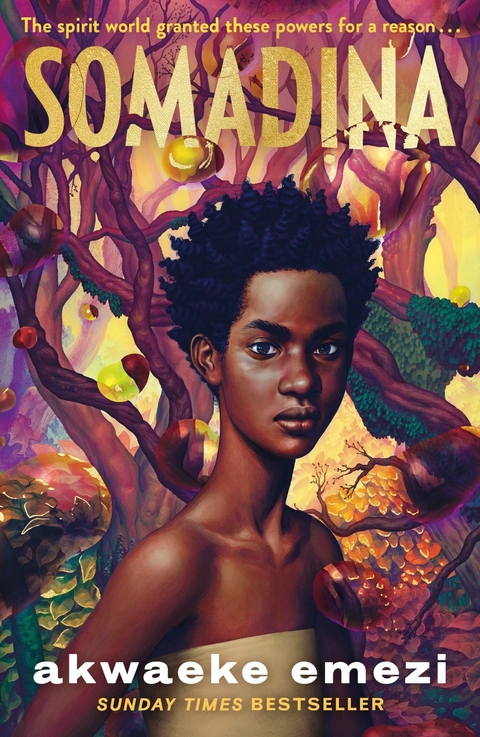
Somadina (eBook)
304 Seiten
Faber & Faber (Verlag)
978-0-571-38304-7 (ISBN)
Akwaeke Emezi (they/them) is the author of the memoir Dear Senthuran; New York Times bestseller The Death of Vivek Oji, which was longlisted for the Dylan Thomas Prize; Pet, a finalist for the National Book Award for Young People's Literature; and Freshwater, which was named a New York Times Notable Book, longlisted for both the Wellcome Book Prize and the Women's Prize for Fiction and shortlisted for the PEN/Hemingway Award, the New York Public Library Young Lions Fiction Award, the Lambda Literary Award, and the Center for Fiction's First Novel Prize. Selected as a 5 Under 35 honoree by the National Book Foundation, they are based in liminal spaces.
We had done and survived unimaginable things. Our world was so much bigger than our town, the river full of crocodiles, and these forests we'd grown up in. There was an entire sea out there to prove it. Somadina and her twin brother, Jayaike, are practically the same person: they finish each other's sentences and make each other whole. When the twins come of age, their magical gifts begin to develop, but while Jayaike's powers enchant, Somadina's cause fear to ripple through her town. Always an outsider, Somadina now faces blatant - and dangerous - hostility. And things go from bad to worse when her brother, the one person she trusted, vanishes. Somadina knows that no matter the dangers, she must track him down. Even if it means entering the Sacred Forest. Even if it means gruelling, otherworldly travel she may not survive. Even if it means finding the hidden places where those closest to the spirit world don't dare to go. Does Somadina have the strength - within both her body and her soul - for the trying journey ahead?Sunday Times bestseller Akwaeke Emezi masterfully weaves a tale of identity, family, and the power of the past, in a world where the extraordinary is ordinary.
MAMA ALWAYS SAID THAT EVERYTHING STARTED THE DAY THEY came for Nkadi, her firstborn, the golden leopard of our family. My twin, Jayaike, would disagree – he says it started before we were even born, that it started with the Split, the great breaking of the earth – that it started with the war. This was the kind of thing he said quietly, when we were lying in our bed with our legs thrown over each other, whispering under the heaviness of night. In our town, talking about the Split is not something you do when the sun has woken up, or in places where ears can hear you. In fact, left to me, I wouldn’t be talking about the Split at all. It’s so far away from us in time, what can it matter now? The past has happened; leave it alone.
Jayaike says I sound like Mama when I say things like that, as if I’m afraid of looking over my shoulder. Maybe he’s always been the brave twin – after all, he’s the one who used to catch our grandmother Ahụdi on the moonlit nights when he knew she wouldn’t refuse us stories. That’s when he’d ask her about the Split, and the Starvation War, and her husband, Kesandụ, our dead grandfather. Since Jayaike is one ear and I am the other, I always listened to the stories, even when some of them turned into streams from her eyes, even when they hurt her. Jayaike would press his mouth to Ahụdi’s hand when this happened, but I could have told him he didn’t have to worry. Our grandmother never stopped a story just because it was breaking her heart.
Ahụdi told us things they refused to teach us in school, things that Papa pretends not to hear when you ask him, things that Mama will slap you for even bringing up. I’m not the only one who doesn’t like to talk about the past – I learned it from somewhere, but my twin challenges the silence I want. Jayaike and I can’t tell other people the things Ahụdi tells us, that’s how heavy they are. I tried it once with one of our teachers, when I thought I could be brave like my brother. I told the teacher that she was wrong, that war was never necessary and it was certainly not noble, not when so many people died. The teacher didn’t even allow me to finish class. She sent me home immediately with a warning, and Mama shouted at me, told me I shouldn’t be contradicting my elders. This was part of how I learned to be quiet.
When I told Ahụdi, she just shook her head. ‘Some people don’t want to hear true things, Sọmadịna. You have to be careful which air you speak it into.’
In school, they tell us things as if they’re true. They tell us that nothing happens beyond the Split, the yawning chasm that breaks our islands away from any other part of the world. And even if it did, they add, it is impossible to cross the Split, so why disturb yourself with this nonsense? All we need to know, the teachers say, is that the Split ended the Starvation War, that we lost hundreds of dịbịas, and that we are now free because of it.
It was Ahụdi who told us about the decision the dịbịas made to create the Split, when too many children had swelled and died of hunger, when the war was a mad thing rampaging through our land. The dịbịas had always been our masters of medicine and spirit, our guides to the primordial mother, the deity Ala. She was the earth, the underworld, the sacred crocodile crawling up the banks of the river, and we were her children, two-legged and fumbling on land. The dịbịas were responsible for us; they could not fail. Our grandfather Ke sandụ had been one of them.
‘We tried to keep magic out of the war,’ my grandmother explained. ‘It is always too dangerous. One person brings their magic and another brings a more powerful one, and the next thing you know, there is no land left to even fight over and who is going to explain that to the deity?’ Ahụdi folded her legs on her mat, and in the hushed evening, our little fire threw sheets of light across her face. Jayaike and I were roasting cashews in the coals, our eyes wide as we ate our grandmother’s story.
‘Magic can remove everything,’ she told us. ‘It can remove everything you have ever loved or wanted or seen. Like that!’ She snapped her fingers sharply, and we jumped in alarm. The night felt wide and dark at my back. I tried to imagine our compound being removed, Mama and Papa gone like a snap, let alone the whole of our town, the thick forests that encircle us, the water past the forest. It was beyond the stretch of my mind, but I believed our grandmother. Jayaike and I always believed our grandmother. She told us that the war started because when we were all one land, our neighbors got greedy and tried to take our land from us. We fought back, but our enemies poisoned the waters of our rivers and destroyed our crops and livestock until our people were dying of hunger. That’s why it’s called the Starvation War, for the bodies of children floating black in our dead rivers. The crocodiles ate the corpses and blasphemy lived everywhere. The dịbịas decided that in order to save us, they would have to break the earth and invite in the sea to separate us from those who were killing.
‘What if we had all drowned?’ I once asked Ahụdi. ‘When the water came in.’
She had held my hands and smiled. ‘Then we would still be free,’ she replied. ‘We would still be free.’
The Split changed everything in our history, but to understand what our world became, you have to understand what our world was before. I wish I could imagine it, but all I had were fragments of stories from Ahụdi, whispers of truth in what they told us at school, and it wasn’t enough to put together a correct picture. What I know is that we were always a powerful people, some of us with gifts from the mother deity. That is what we called magic, when the deity touched you, when a piece of the spirit world found its way into your flesh and gave you an ability beyond what was normal, the tooth of the crocodile working its way under your skin. The Split changed all of that.
When the dịbịas broke the earth, one of the deity’s bodies, it caused a ripple of power beyond anything that had been seen before or since. The land shattered into islands, and our enemies fell into the water, where if they didn’t die in the crocodiles’ jaws, they drowned. Magic tore through the air, far too much of it, and it clawed its way through our towns and villages like a god’s rampaging anger. It was as if we had angered Ala by breaking the earth and in return she suffocated us with gifts, those abilities we used to pray for; she forced them down our throats. Not everyone can survive being touched by a god, and a person can only hold one gift at a time, except for the dịbịas, who can hold several. So, if you already had a gift before, either your body closed itself off to refuse the influx of magic, or you died.
If you didn’t have a gift and lacked the capacity to hold one, you died. It didn’t matter if you were young or old, sick or healthy, you died. Infants, elders, the strong and the weak – they were all reduced to one thing: if their spirit could handle the deity’s hand.
Ahụdi said this is what war did, it killed people from start to finish; it killed people in consequences that don’t pay attention to time. When the shock wave from the Split had passed, everyone on our island had gifts – at least, everyone who was still alive. I never knew if we used to be many more than we are now. I just knew that everyone in the world I was born into had a gift, a blessing bitten into us by the unforgiving jaw of a god, and it would never leave our lineage. It passed on through the blood, to the children, and their children, and in this way, we belonged wholly to the mother deity, the survivors scarred with her heavy favor. My grandmother was a healer, and she never forgot what that wave of magic did to our people, both those it killed and those who had the magic forced on them. She knew how a god’s touch can ravage your flesh, and she told my twin and me how no one goes near the Split till today. It lies somewhere beyond our sight, abandoned and unknown.
I was one of the children born in the generation after the Split. My parents were very young when it happened, and Ahụdi told me not to ask them what it was like to have the magic enter. ‘The crocodile may bless us,’ she said, ‘but its bite still hurts.’ She knew how true that proverb was. She’d known it since her husband, Kesandụ, died at the Split and left her to raise my father.
As for the magic, I knew what to expect, for myself and my twin. At some point, my body would start to change, just like my older sister, Nkadi’s, and then my gift would come in. When that happened, I’d go to our town elders so they could make a record of it. Our elders liked things to be in order, as if organization could erase the trauma of the war, as if that would keep us safe. They liked to know exactly what everyone in our town was capable of, but I never met anyone who turned their gift toward...
| Erscheint lt. Verlag | 6.5.2025 |
|---|---|
| Sprache | englisch |
| Themenwelt | Literatur ► Fantasy / Science Fiction ► Fantasy |
| ISBN-10 | 0-571-38304-1 / 0571383041 |
| ISBN-13 | 978-0-571-38304-7 / 9780571383047 |
| Informationen gemäß Produktsicherheitsverordnung (GPSR) | |
| Haben Sie eine Frage zum Produkt? |
 EPUB (Adobe DRM)
Kopierschutz: Adobe-DRM
Adobe-DRM ist ein Kopierschutz, der das eBook vor Mißbrauch schützen soll. Dabei wird das eBook bereits beim Download auf Ihre persönliche Adobe-ID autorisiert. Lesen können Sie das eBook dann nur auf den Geräten, welche ebenfalls auf Ihre Adobe-ID registriert sind.
Details zum Adobe-DRM
Dateiformat: EPUB (Electronic Publication)
EPUB ist ein offener Standard für eBooks und eignet sich besonders zur Darstellung von Belletristik und Sachbüchern. Der Fließtext wird dynamisch an die Display- und Schriftgröße angepasst. Auch für mobile Lesegeräte ist EPUB daher gut geeignet.
Systemvoraussetzungen:
PC/Mac: Mit einem PC oder Mac können Sie dieses eBook lesen. Sie benötigen eine
eReader: Dieses eBook kann mit (fast) allen eBook-Readern gelesen werden. Mit dem amazon-Kindle ist es aber nicht kompatibel.
Smartphone/Tablet: Egal ob Apple oder Android, dieses eBook können Sie lesen. Sie benötigen eine
Geräteliste und zusätzliche Hinweise
Buying eBooks from abroad
For tax law reasons we can sell eBooks just within Germany and Switzerland. Regrettably we cannot fulfill eBook-orders from other countries.
aus dem Bereich


