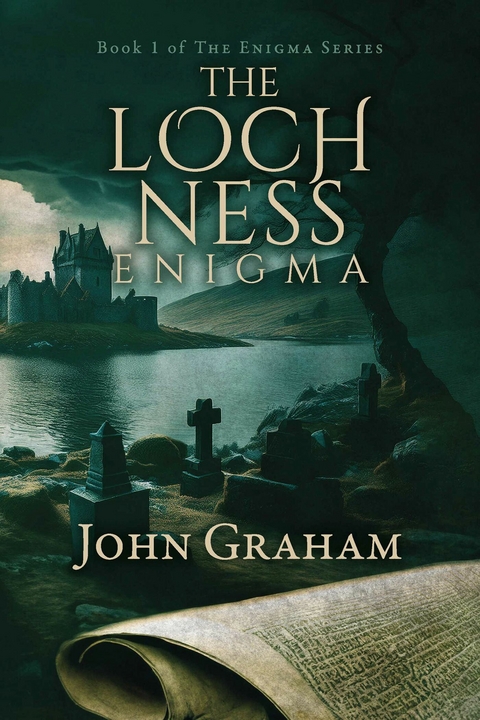
Loch Ness Enigma (eBook)
340 Seiten
Bookbaby (Verlag)
979-8-3509-9434-6 (ISBN)
A lifelong enthusiast of WWII and Medieval history, John enjoyed a 30-year career in corporate finance and entrepreneurship before taking early retirement to pursue his passion for writing historical fiction. He is best known as the author of The Enigma Series, an acclaimed 20-novel saga of WWII mystery thrillers that captivate readers with their complex plots, realistic settings, and vivid, memorable characters. His debut novel, The Loch Ness Enigma, has been praised as 'The Da Vinci Code* goes to war.' When not engrossed in his writing, John enjoys riding his motorcycle through the picturesque hills of Northern Illinois or working on detailed scale model ships from the Age of Sail. He and his wife split their time between their small-town home and a secluded lake house in Michigan's Upper Peninsula, where the quiet atmosphere of the Northwoods provides the perfect atmosphere for the development of his Enigma stories.
Ian McKnight thought he had left the horrors of war behind when he returned from the trenches of World War I. But his peaceful existence is shattered when Madeline Shaw, a brilliant cryptologist from Bletchley Park, arrives at his doorstep with a set of ancient parchments too compelling to dismiss. As a medieval scholar and linguistics expert, McKnight soon discovers that he alone holds the key to unlocking the secrets hidden within the 700-year-old texts. What begins as an intriguing academic challenge swiftly turns into a high-stakes mission, forcing the unlikely duo from the shadowy corridors of a medieval castle in the Scottish Highlands to the war-torn streets of London. Pursued by relentless Nazi agents determined to seize the parchments and eliminate them, McKnight and Shaw must rely on their ingenuity and each other if they hope to survive the escalating dangers. With each discovery, the parchments reveal long-buried secrets that point to a revelation powerful enough to change the course of the war. But to survive and fully unravel The Loch Ness Enigma McKnight and Shaw must face not only the mystery hidden within the ancient texts but also the dark pasts they've both struggled to leave behind.
Prologue
Death of a Lady
May 7, 1915
The Celtic Sea
Death was lurking.
The screams of the drowning hung on the horizon as the rogue predator hovered undetected beneath the waves, the frigid waters sliding silently past its steel skin. The periscope breached the surface, rising imperceptibly into the afternoon cold as Kapitänleutnant Walther Schwieger pressed his eye against the lens for the third time in the last ten minutes. She was still there—the biggest prize of the war—unaware of her impending fate.
He swept the sea in a full circle searching for British military escorts. She was alone. Fate had positioned the U-20 only seven hundred meters from the target, a near-perfect distance for an underwater attack. The liner’s speed and course remained unchanging, unusual for wartime, but simplified his computations. He would fire a single torpedo, aiming directly below the bridge, before diving.
Schwieger lowered the periscope, knowing he would take one last look before attacking. Caution was paramount. Detection now would mean diving to safety and letting his prey escape. The waiting game had begun.
Six days out from New York, the grand ocean liner sailed gracefully past the southern coast of Ireland, just as smoothly on her 202nd North Atlantic crossing as on her maiden voyage. Her colossal coal-fired boilers drove the powerful steam engines, propelling her ever eastward toward Liverpool, where she was set to arrive that afternoon. On board, two thousand passengers and crew went about their day—some savoring their last hours at sea while others prepared for the bustle of disembarkation. All were blissfully unaware that, in a matter of hours, more than half of them would be dead, victims of an unseen enemy.
Built by John Brown and Company of Clydebank, Scotland, for the Cunard Steamship Company Ltd., the 787-foot liner was purposefully designed to dominate the lucrative North Atlantic route. Sailing first-class to Europe or America was a prestigious social event—a rite of passage for some—as old-world money rubbed elbows with the nouveau riche. The aristocracy boarded with their retinue of valets, maids, and butlers. Entourages mirrored wealth, and wealth, coupled with a pedigree ancestry, determined one’s place in Edwardian society.
The Cunard lady catered to this elite market better than any other vessel afloat. Extravagant in every detail, she boasted the latest technology—lifts, wireless telegraphs, and electric lights. Her interiors were nothing short of palatial, with appointments that rivaled the finest European hotels, crafted with an unmatched attention to detail. Every aspect of the ship radiated luxury and refinement. She was not only a place where any passenger would feel secure, but also a ship that any officer would be proud to serve aboard.
Senior Third Officer John Idwal Lewis was such a man. Stationed on the starboard promenade, the lanky, twenty-nine-year-old Welshman cut a striking figure in his meticulously pressed blue uniform, accented with gold trim on the epaulets and cuffs. His black-billed cap perched smartly atop his head, while his neatly trimmed mustache and closely cropped brown hair added to the air of discipline he projected. Lewis was the picture of composure, a man who radiated control and calm, no matter the situation—qualities that endeared him to the ship’s passengers.
Striding effortlessly on his five-foot-six-inch frame, he walked to the railing and smiled inwardly. Inhaling a satisfying deep breath, the familiar smell of sea air filled his lungs and energized his body. It always did. Sailing was life, and life was very good for Third Officer Lewis.
Turning up his collar against the stiff breeze, he ascended a metal staircase and stepped onto the second-class promenade. The lone figure was sitting there, as he had been each day at this time, buried in a chaise lounge under several tartan wool blankets. The old man was writing again, putting his pencil down only to cover his mouth from a cough that never seemed to break.
“Good morning, Father,” Lewis shouted as he strode across the deck. He had come to cherish the chubby man sitting before him. He emitted a warm innocence that drew you in like a comfortable blanket and wrapped your soul in a sense of serenity. The two had formed a fast friendship since departing New York Harbor and enjoyed afternoon tea each day—a peaceful island amidst a sea of responsibilities.
Father Fingal MacGwyer looked up from his blanketed cocoon, closed his journal, and flashed a sheepish grin that had comforted souls in his native Edinburgh for more than sixty years. His cherub-like face sat under thinned, graying hair that sprouted from a well-worn tam o’shanter cap. It reminded Lewis of grass poking out from under a rock.
“Good day, my son,” the friar said with an eloquent Scottish accent, pulling the blanket over his chest. “Is it teatime already?”
“Our last one together. Shall we?” Lewis helped the portly priest up and held his arm as they strode across the deck to the electric lift, the ship gently rolling with the waves.
They rode the lift to the shelter deck and headed for the first-class dining saloon. Passing the grand staircase, they stepped through an elegant glass doorway and into another world. MacGwyer’s heart rate quickened as he absorbed the grandeur of the décor.
The ship’s first-class accommodations showcased a breathtaking array of historically elegant styles, but none more opulent than the grand dining saloon. Soaring two decks in height, the room was crowned by an ornate dome, spanning thirty feet across and allowing the afternoon sunlight to pour in, casting a warm glow over everything below. The pristine white walls, designed in the refined neoclassical style of Louis XVI, were accentuated by delicate Bromsgrove Guild trim. Richly detailed furnishings complemented the carved mahogany panels that were meticulously spaced between elaborately decorated columns. This was a world of rarefied luxury that few would ever experience.
MacGwyer, eyes wide with awe, followed Lewis to a corner table nestled against a pair of tall windows, the sheer ivory curtains drawn back. Placing the blankets on an adjacent chair, he set the leather-bound journal on the table and fell into the seat.
“Father,” Lewis began after their tea was served, “I keep meaning to ask about your journal. Every time we meet, your head is buried in it as if it were the good book itself. And the inscription: Friar Fingal MacGwyer, 1855.”
MacGwyer sipped his tea before speaking. “My sister gifted me this journal when I received my calling.” He ran his chubby fingers across the faded date on the cover. “Hard to believe that was sixty years ago. She’s a nun at the St. Joan of Arc convent near Chicago—Sister Margaret MacGwyer. A sweeter soul never walked the earth.”
Several first-class passengers entered the saloon and settled at tables near the center of the room, their glances filled with overt disapproval directed at the two men.
Lewis, noticing the stares, nodded in understanding. “Pardon my curiosity, Father, but what has kept you so engrossed on this voyage? You’ve been writing as if the end of days is approaching.”
The ship’s band struck up a lively tune, forcing MacGwyer to raise his voice as he responded. “I’ve spent the last three weeks with my sister trying to translate a set of medieval manuscripts I recently discovered hidden deep within my abbey. They’re written in an old dialect that . . . well, was far beyond my abilities to read. My sister, however, has an incredible gift for languages. She’s been invaluable in deciphering the texts.”
Lewis leaned forward in his chair, his curiosity piqued. “Were you successful?”
MacGwyer paused, his gaze drifting past Lewis as though seeing something far beyond the present moment, his mind wandering to another place, another time. After a long breath, he spoke again, his voice quieter but charged with significance. “Tell me, Mr. Lewis, have you ever been intrigued by the notion of searching for an ancient treasure?”
“Are you searching for one, Father?”
“Aye, but this one is more valuable in terms of its historical significance than monetary value.” The orchestra finished its first number and went into Tipperary, an Irish love song. “From what little I’ve been able to read of the parchments, it tells a tale of adventure and deception so fascinating I still find it hard to believe.”
Engrossed by the friar’s tale, Lewis almost missed the first sound. MacGwyer twitched as the deck rumbled underfoot. “What was that?”
Lewis cocked his head. There it was again, starboard side, although louder and closer than the first one—a thunderous clap that pierced the afternoon air. Passengers began scurrying onto the deck as several windows shattered and indiscernible chatter began to build. The smoke of confusion was about to erupt into flames of terror.
The young officer sprang into action as the reality of...
| Erscheint lt. Verlag | 8.7.2025 |
|---|---|
| Sprache | englisch |
| Themenwelt | Literatur ► Historische Romane |
| Literatur ► Krimi / Thriller / Horror | |
| ISBN-13 | 979-8-3509-9434-6 / 9798350994346 |
| Informationen gemäß Produktsicherheitsverordnung (GPSR) | |
| Haben Sie eine Frage zum Produkt? |
 EPUB (Ohne DRM)
Größe: 2,2 MB
Digital Rights Management: ohne DRM
Dieses eBook enthält kein DRM oder Kopierschutz. Eine Weitergabe an Dritte ist jedoch rechtlich nicht zulässig, weil Sie beim Kauf nur die Rechte an der persönlichen Nutzung erwerben.
Dateiformat: EPUB (Electronic Publication)
EPUB ist ein offener Standard für eBooks und eignet sich besonders zur Darstellung von Belletristik und Sachbüchern. Der Fließtext wird dynamisch an die Display- und Schriftgröße angepasst. Auch für mobile Lesegeräte ist EPUB daher gut geeignet.
Systemvoraussetzungen:
PC/Mac: Mit einem PC oder Mac können Sie dieses eBook lesen. Sie benötigen dafür die kostenlose Software Adobe Digital Editions.
eReader: Dieses eBook kann mit (fast) allen eBook-Readern gelesen werden. Mit dem amazon-Kindle ist es aber nicht kompatibel.
Smartphone/Tablet: Egal ob Apple oder Android, dieses eBook können Sie lesen. Sie benötigen dafür eine kostenlose App.
Geräteliste und zusätzliche Hinweise
Buying eBooks from abroad
For tax law reasons we can sell eBooks just within Germany and Switzerland. Regrettably we cannot fulfill eBook-orders from other countries.
aus dem Bereich