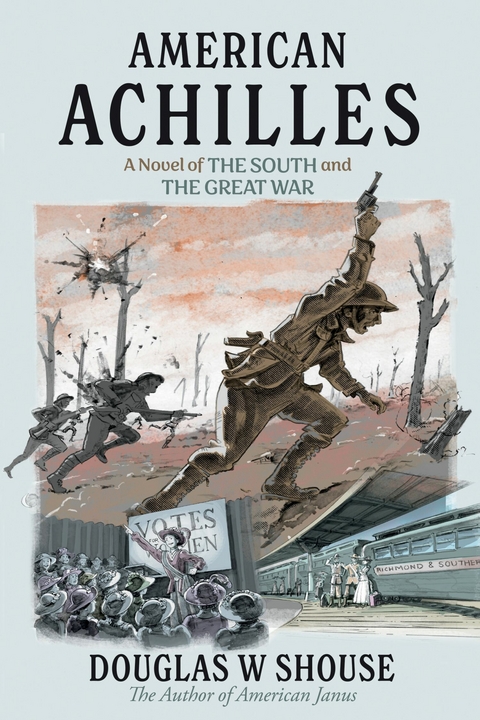
American Achilles (eBook)
260 Seiten
Bookbaby (Verlag)
979-8-3178-0160-1 (ISBN)
Keith Hobgood is a master illustrator with a host of graphic arts credits. He applies his skills at Out of Our Minds Studios and also teaches Illustration at the North Carolina Schools of the Arts.
The year is 1917. Europe's disastrous 3-year war has drawn America into its fiery vortex. The Clayton family, like many in the country is torn and at odds with the looming involvement. Discover this rich and moving portrayal of a Southern family during the tragic madness of WW1. American Achilles is the sequel to American Janus in the Southern Warrior Series. It continues the story of the Claytons, a proud, multi-generational North Carolina family. Follow their triumphs, trials and heartbreak during The Great War both at home and overseas on the Western Front. The story follows the lives of four individuals. Noah Clayton, a captain in the U.S. Army who must train and lead the next troops for deployment to Europe; Jefferson Silver, a Black man fleeing north who enlists in the Harlem Hellfighters upon his arrival in New York; Tee Moser, who follows in his father's footsteps and succumbs to the temptations of easy riches; and Emma Clayton, a passionate advocate for women's suffrage, is chosen as one of the 'Hello Girls' translating messages at the front between the U.S. and French armies. "e;American Achilles"e; is a rich and moving portrayal of a southern family during a momentous time in American history. It brings life to the tragic madness of the First World War and it horrific struggle in the trenches and infamous "e;no-man's land."e;
Chapter 3
Mid-Spring 1917: Recall for Duty
He had booked his own passage on the SS Isador, a Norwegian merchant ship making the trans-Atlantic journey from Oslo to New York. At the end of January, Germany had announced the resumption of “unrestricted” submarine warfare, and their U-boats were taking a devastating toll on combatant shipping and even some neutral vessels. Noah, on the orders from the US War Department, sought out the Norwegian freighter to ensure a less precarious journey home.
Within the month of the United States’ declaration of war on Germany, Captain Noah Clayton had been ordered back to Washington to report on what he had observed and interpreted on the Western Front. Noah wondered if he could adequately convey the abhorrent reality of trench warfare. He wondered if anyone in Washington truly wanted to hear that reality.
Nonetheless, he spent the two-week voyage in a cramped cabin refining the documentation of his almost year-long experience in France and Belgium. He recounted British tactics both offensively and defensively and same for the Germans, to the extent the Brits understood them. He described the dizzying schemes and systems of supply and rear echelon logistics. He even recorded his impressions of the front-line troops, specifically their capabilities and spirit after three years of war. One thing was certain. There was euphoria up and down the desperate British and French lines now that the Yanks were coming.
As the Isador steamed into upper New York harbor on a drizzly May morning, Noah felt a surge of emotion. The ship slowly moved past the Statue of Liberty. Her raised arm and torch still showed the damage from the munitions factory explosion on the close-by New Jersey shore earlier in the year. The young Carolinian turned to the New York City skyline and breathed deeply. He was overjoyed to be back in America.
Returning Home for Assignment
Thinking of his uncle Jacob’s entertaining stories of the city’s streets and sights made him want to spend a few days to explore. But that would have to wait for another time. The war office orders were clear –“Report immediately to the State, Army, and Navy offices in the northwest section of the district.”
Upon disembarking, he immediately hired a cab to Grand Central Terminal for the journey south. He felt lucky to secure one of the last second-class seats on the Baltimore & Ohio’s Royal Blue train from Grand Central to Union Station in the nation’s capital. A porter proceeded ahead with his large canvas duffel. Noah found his seat in the very rear car of the Royal Blue. The car was filled mostly with men, young and old, all apparently with business in Washington. Settling in, the young officer retrieved his notebook and began to review his written observations and insights once again. However, the rhythmic clickety-clack of the rocking train and his own travel exhaustion soon overtook him, and he fell into an unsettled sleep.
Fractured vignettes of the front line in Flanders disturbed his rest—boys cut to indistinguishable pieces by machine guns and a torrent of falling shells; bodies of the dead hanging in grotesque positions throughout the barbed wire across no-man’s land; the ashen, dazed faces of the senior officers in their rear echelon redoubts. It was a nightmare becoming too frequent and one shared by thousands of others that experienced firsthand the Western Front since August 1914.
Noah woke with a start to realize he had swung his legs in his sleep, kicking the fellow passenger adjacent him. “Oh, I-I am truly sorry, Sir,” Noah stammered.
“No worries. No harm done. You must have been having quite a nightmare,” the man responded sympathetically. He looked to be in his late thirties or early forties, with dark eyes and perfectly combed and oiled black hair. “George Creel’s the name,” he replied while offering his hand.
“Uh, Noah Clayton, at your service,” Noah replied, still embarrassed.
Noticing Noah’s two shoulder bars, Creel added, “If I may be so bold, I would wager you’re en route to Army headquarters in the capital. I’ve heard line officers from all over are being summoned since the war declaration.”
“Well, yes,” Noah admitted with some hesitation. “I am just returned from the Western Front.” Noah stopped there. He didn’t really know how much he should say about his orders—certainly not to a perfect stranger.
“I would like to hear more, Captain—that is, if you can speak freely. You see, I’m on my way to meet with President Wilson to take up my new post. He has asked me to head up the Committee on Public Information. Now that we are officially at war, the president knows there will be dishonest actors out there trying to distort the truth and cripple morale. We’re going to work with the newspapers and magazines, not censor them like some are suggesting. That way, the people can see the good in this war—as Wilson says, ‘making the world safe for democracy.’” Creel was excited, his intense eyes burning.
Not really having a strong feeling for this new committee, Noah admitted, “Mr. Creel, that sounds like a worthwhile effort,” abashed at this rather weak response.
“Please, call me George, Captain Clayton,” the older man instantly rejoined while smiling broadly.
Noah, ever cautious, proceeded to give Creel only the bare minimum about his orders and experience on the front lines in Belgium. The two chatted amiably for the remainder of the journey into Washington, agreeing to stay in contact.
The big engine of the Royal Blue chugged into Union Station at sunset with a loud, extended blast of steam. Noah swung the duffle over his shoulder and made his way to the cab stand. There, he hired a driver to the old Morrison Hotel in the central section of the district and only blocks from the State, War, and Navy (SWAN)* building at 17th Street and Pennsylvania Avenue.
The doorman at the Morrison was dressed in a snappy red uniform that made Noah chuckle to himself. The little man opened the door with a flourish and reached for Noah’s duffel bag in one smooth motion.
*Eisenhower Office Building today
“Welcome to the Morrison, Sir. Let me show you to the front desk.” Obviously noticing Noah’s army uniform, he continued, “Oh to be thirty years younger! I would sign up today for the coming fight . . . nothing more grand than to fight for one’s country. No greater service. Wouldn’t you say so, Sir?”
Noah hesitated, considering his response, and then replied, “Yes, doing our duty is right and honorable. I imagine most feel as you do.” He quickly thought of the front-line trenches and their horrors and said no more.
The little man was beaming, hands folded in front. Noah then realized he was waiting for a tip for his service. Noah reached into his pocket and produced a quarter. Handing it over, he then proceeded to the worn wooden counter to check in.
After another restless night, Noah rose early and quickly downed a light breakfast of buttered toast and coffee. He decided to walk the four blocks to the telegraph office and send a message to Jenny to reassure her he had made it safely back to the States. The Army offices were another several blocks, and he rehearsed his prepared remarks as he made his way there. A wave of anxiety washed over him as he wondered how those remarks would be received. The sun was rising over the Potomac, promising a glorious spring day. Goldfinches, cardinals, and other songbirds were well into practicing their daily arias in the budding trees.
The SWAN building was imposing—a seventeen-year project originally commissioned by President Grant and completed in 1888. Its 40,000 square meters (about ten acres) of floor space made it the largest office building in the world. An elaborate architectural design in the French Second Empire style presented a stark contrast to the neoclassical style of the White House, Capitol, and other federal buildings in the district. When completed, Mark Twain had famously proclaimed it to be “a monstrosity, the ugliest building in America.”
The young captain found his way to the army section of the building. Entering the large receiving room, a beefy sergeant humorously hunched over an undersized metal desk took his name and, looking at his clipboard, directed him to a conference room down the hall. Noah opened the large double doors and noticed a handful of other junior officers seated opposite a polished walnut table at the front of the room.
“Good morning,” he said to the assembled group, most who were smoking cigarettes. The room was already cloudy with smoke. He recognized Billy Emerson, a classmate at West Point. Emerson had just returned from western Europe as well by way of Spain.
“Mornin’, Sir. Guess you’re the other ‘watcher,’ eh?” came the immediate reply from a scrawny lieutenant with bright blond hair and a soft face that suggested little history with the razor. Noah noted the upper Midwest accent from his days at West Point. “Hanover’s the name. Erich Hanover from the great state of Minnesota.” Noah instantly liked the man. The other young officers looked on with curious stares.
“Noah Clayton, from North Carolina,” he responded, offering his hand. “Yeah, I suppose you could call me that. I ‘watched,’ and if you others were over there, I...
| Erscheint lt. Verlag | 27.6.2025 |
|---|---|
| Sprache | englisch |
| Themenwelt | Literatur ► Romane / Erzählungen |
| ISBN-13 | 979-8-3178-0160-1 / 9798317801601 |
| Informationen gemäß Produktsicherheitsverordnung (GPSR) | |
| Haben Sie eine Frage zum Produkt? |
 EPUB (Ohne DRM)
Größe: 5,8 MB
Digital Rights Management: ohne DRM
Dieses eBook enthält kein DRM oder Kopierschutz. Eine Weitergabe an Dritte ist jedoch rechtlich nicht zulässig, weil Sie beim Kauf nur die Rechte an der persönlichen Nutzung erwerben.
Dateiformat: EPUB (Electronic Publication)
EPUB ist ein offener Standard für eBooks und eignet sich besonders zur Darstellung von Belletristik und Sachbüchern. Der Fließtext wird dynamisch an die Display- und Schriftgröße angepasst. Auch für mobile Lesegeräte ist EPUB daher gut geeignet.
Systemvoraussetzungen:
PC/Mac: Mit einem PC oder Mac können Sie dieses eBook lesen. Sie benötigen dafür die kostenlose Software Adobe Digital Editions.
eReader: Dieses eBook kann mit (fast) allen eBook-Readern gelesen werden. Mit dem amazon-Kindle ist es aber nicht kompatibel.
Smartphone/Tablet: Egal ob Apple oder Android, dieses eBook können Sie lesen. Sie benötigen dafür eine kostenlose App.
Geräteliste und zusätzliche Hinweise
Buying eBooks from abroad
For tax law reasons we can sell eBooks just within Germany and Switzerland. Regrettably we cannot fulfill eBook-orders from other countries.
aus dem Bereich