


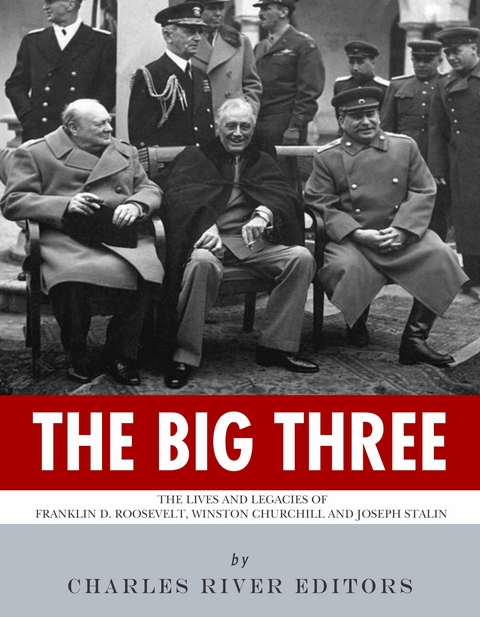
Big Three (eBook)
149 Seiten
Charles River Editors (Verlag)
978-1-4753-3330-5 (ISBN)
Was he 'the greatest human being ever to occupy 10 Downing Street'[1]? Or a man whose 'brilliant but unsound judgement resulted in detrimental consequences for Britain and for the world.'[2]? Nearly 50 years after his death, debate still rages over Sir Winston Churchill's contribution to history. Indeed, now that wartime nostalgia has mostly washed away, in Britain in particular the views on Churchill are more divergent than ever.
On one point though, the biographers and historians remain unanimous: Churchill led an astonishing life as a soldier, world statesman, historian and Noble Prize Laureate. When he died at 90 in 1965, one of the most important figures in modern history had left the stage. From providing some of the 20th century's greatest soundbytes to successfully navigating Great Britain to victory in World War II against great odds, Churchill was at the forefront of global events for decades, becoming one of the most influential Britons in history. In 2002, he was named the Greatest Briton of All Time, and 40 years earlier he was the first person to be made an Honorary Citizen of the United States.
Churchill will forever be most associated with World War II, but his life was far more adventurous and complex than that, and these other aspects of the man are often overlooked and overshadowed.
If Adolf Hitler had not inflicted the devastation of World War II upon Europe, it's quite likely that the West would consider Joseph Stalin (1878-1953) the 20th century's greatest tyrant. A Bolshevik revolutionary who played a crucial role in the Russian Revolution of 1917 and the establishment of the Soviet Union, Stalin was one of the Communist regime's earliest leaders and went about consolidating power after the death of Vladimir Lenin, whose final wishes were that Stalin be removed from his post as General Secretary of the Communist Party and not be given the ability to take power.
Of course, Stalin managed to do just that, modernizing the Soviet Union at a breakneck pace on the backs of millions of poor laborers and prisoners. Before World War II, Stalin consolidated his position by frequently purging party leaders (most famously Leon Trotsky) and Red Army leaders, executing hundreds of thousands of people at the least. In one of history's greatest textbook examples of the idea that the enemy of my enemy is my friend, Stalin's Soviet Union allied with Britain and the United States to defeat Hitler in Europe, with the worst of the war's carnage coming on the eastern front during Germany's invasion of Russia. Nevertheless, the victory in World War II established the Soviet Union as of the world's two superpowers for nearly 50 years, in addition to being the West's Cold War adversary.
Franklin Delano Roosevelt might be America's greatest 20th century president, but there's no question that he was the most unique. A well-connected relative of Theodore Roosevelt, FDR was groomed for greatness until he was struck down by polio. Nevertheless, he persevered, rising through New York politics to reach the White House just as the country faced its greatest challenge since the Civil War, beginning his presidency with one of the most iconic lines ever spoken during an inaugural address.
For over a decade, President Roosevelt threw everything he had at the Great Depression, and then threw everything the country had at the Axis powers during World War II. Ultimately, he succumbed to illness in the middle of his fourth term, just before the Allies won the war.
Was he "e;the greatest human being ever to occupy 10 Downing Street"e;[1]? Or a man whose "e;brilliant but unsound judgement resulted in detrimental consequences for Britain and for the world."e;[2]? Nearly 50 years after his death, debate still rages over Sir Winston Churchill's contribution to history. Indeed, now that wartime nostalgia has mostly washed away, in Britain in particular the views on Churchill are more divergent than ever. On one point though, the biographers and historians remain unanimous: Churchill led an astonishing life as a soldier, world statesman, historian and Noble Prize Laureate. When he died at 90 in 1965, one of the most important figures in modern history had left the stage. From providing some of the 20th century s greatest soundbytes to successfully navigating Great Britain to victory in World War II against great odds, Churchill was at the forefront of global events for decades, becoming one of the most influential Britons in history. In 2002, he was named the Greatest Briton of All Time, and 40 years earlier he was the first person to be made an Honorary Citizen of the United States. Churchill will forever be most associated with World War II, but his life was far more adventurous and complex than that, and these other aspects of the man are often overlooked and overshadowed.If Adolf Hitler had not inflicted the devastation of World War II upon Europe, it s quite likely that the West would consider Joseph Stalin (1878-1953) the 20th century s greatest tyrant. A Bolshevik revolutionary who played a crucial role in the Russian Revolution of 1917 and the establishment of the Soviet Union, Stalin was one of the Communist regime s earliest leaders and went about consolidating power after the death of Vladimir Lenin, whose final wishes were that Stalin be removed from his post as General Secretary of the Communist Party and not be given the ability to take power.Of course, Stalin managed to do just that, modernizing the Soviet Union at a breakneck pace on the backs of millions of poor laborers and prisoners. Before World War II, Stalin consolidated his position by frequently purging party leaders (most famously Leon Trotsky) and Red Army leaders, executing hundreds of thousands of people at the least. In one of history s greatest textbook examples of the idea that the enemy of my enemy is my friend, Stalin s Soviet Union allied with Britain and the United States to defeat Hitler in Europe, with the worst of the war s carnage coming on the eastern front during Germany s invasion of Russia. Nevertheless, the victory in World War II established the Soviet Union as of the world s two superpowers for nearly 50 years, in addition to being the West s Cold War adversary.Franklin Delano Roosevelt might be America s greatest 20th century president, but there s no question that he was the most unique. A well-connected relative of Theodore Roosevelt, FDR was groomed for greatness until he was struck down by polio. Nevertheless, he persevered, rising through New York politics to reach the White House just as the country faced its greatest challenge since the Civil War, beginning his presidency with one of the most iconic lines ever spoken during an inaugural address. For over a decade, President Roosevelt threw everything he had at the Great Depression, and then threw everything the country had at the Axis powers during World War II. Ultimately, he succumbed to illness in the middle of his fourth term, just before the Allies won the war.
| Erscheint lt. Verlag | 15.5.2025 |
|---|---|
| Sprache | englisch |
| Themenwelt | Literatur ► Biografien / Erfahrungsberichte |
| Schlagworte | Biography • Cold War • D-Day • Hitler • Nazi • Pearl Harbor • World War |
| ISBN-10 | 1-4753-3330-7 / 1475333307 |
| ISBN-13 | 978-1-4753-3330-5 / 9781475333305 |
| Informationen gemäß Produktsicherheitsverordnung (GPSR) | |
| Haben Sie eine Frage zum Produkt? |
 EPUB (Ohne DRM)
Digital Rights Management: ohne DRM
Dieses eBook enthält kein DRM oder Kopierschutz. Eine Weitergabe an Dritte ist jedoch rechtlich nicht zulässig, weil Sie beim Kauf nur die Rechte an der persönlichen Nutzung erwerben.
Dateiformat: EPUB (Electronic Publication)
EPUB ist ein offener Standard für eBooks und eignet sich besonders zur Darstellung von Belletristik und Sachbüchern. Der Fließtext wird dynamisch an die Display- und Schriftgröße angepasst. Auch für mobile Lesegeräte ist EPUB daher gut geeignet.
Systemvoraussetzungen:
PC/Mac: Mit einem PC oder Mac können Sie dieses eBook lesen. Sie benötigen dafür die kostenlose Software Adobe Digital Editions.
eReader: Dieses eBook kann mit (fast) allen eBook-Readern gelesen werden. Mit dem amazon-Kindle ist es aber nicht kompatibel.
Smartphone/Tablet: Egal ob Apple oder Android, dieses eBook können Sie lesen. Sie benötigen dafür eine kostenlose App.
Geräteliste und zusätzliche Hinweise
Buying eBooks from abroad
For tax law reasons we can sell eBooks just within Germany and Switzerland. Regrettably we cannot fulfill eBook-orders from other countries.
aus dem Bereich


