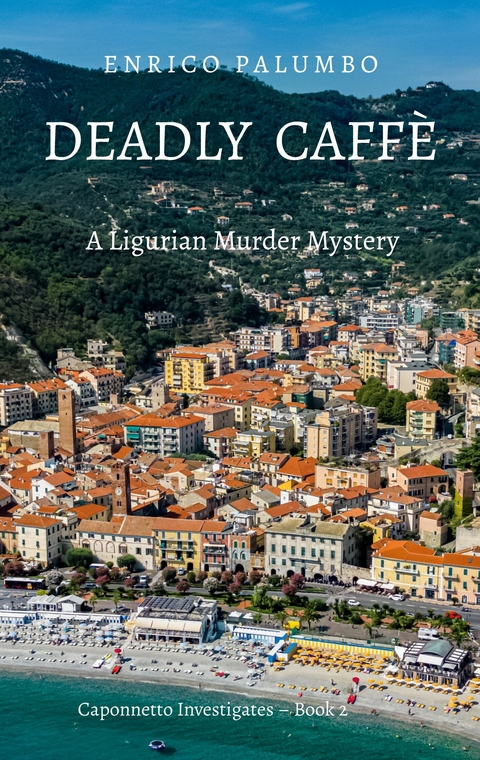
Deadly Caffè (eBook)
184 Seiten
Books on Demand (Verlag)
978-3-8192-3693-8 (ISBN)
Enrico Palumbo was born in 1972 in Karlsruhe, Germany, and studied in Munich and Venice. He started his career as a journalist for German and Italian news agencies and media before moving into business. After working in various places, such as Prague, Milan and Zurich, he returned to Karlsruhe, where he has been living since 2019. "Deadly Caffè" is his second novel in the murder mystery series about the retired Carabiniere Giuseppe Caponnetto.
I
Caponnetto was up early. He could hear the birds singing. The air smelled of spring.
If you don't live by the sea and only spend a few days there once in a while, you might not notice that the sea smells different in spring. It's fresh, invigorating, and less salty than in winter. Sometimes it even smells slightly earthy, with a sweet note reminiscent of flowers. This is due to the algae, which multiply as temperatures begin to rise, and to the spring breezes, which transport their different fragrances from the sea to the coast.
Spring is Caponnetto's time. It's the season when he has always felt particularly inspired, full of energy and drive.
Three weeks ago, he had got on his new sports bike early in the morning for the first time. Since then, he had been leaving his apartment at the port of Savona every day at around 8 am. This morning routine was good for him.
But today, he started his tour earlier than usual. That was the only reason the men in the black SUV missed him. They would wait for him – that was their job.
After his accident on the Via Aurelia eight months ago, Caponnetto had gone through various phases. At first, in hospital, he was in denial about how his injuries would affect his service with the Carabinieri. Then, with his artificial knee, came the certainty that things would never be the same again. And with this realisation came anger: 'Why me? Why now?'
Back then, he was convinced that he'd simply been in the wrong place at the wrong time. He wanted to believe that the collision on the coastal road between Finale Ligure and Noli had been a tragic hit-and-run accident.
During the rehabilitation phase, Caponnetto thought about how he could continue his work investigating the Agromafia despite his limited fitness for duty. He came to the conclusion that he didn't want to do things by halves and decided to quit altogether. Then, when his Zia Antonella died unexpectedly, his grief for his aunt eclipsed his grief for his old life.
On the very day of his retirement, Caponnetto had become involved in a new case with his friend Commissario Bonfatti. Together they had solved the murder of an old man. They hadn't expected to be showered with praise, but neither had they expected to be mired in controversy.
Caponnetto didn't want to find himself in such a situation again. Especially not now in spring. He had ideas, he had plans. His life was almost perfect – if it hadn't been for the matter with Stefania. But there was always something!
*
Commissario Bonfatti was sitting behind his desk on the third floor of the Questura in Savona, leafing through the local section of La Stampa in a leisurely fashion. There was currently no case of public interest in his jurisdiction. So today he hoped that his own face wouldn't be jumping out at him from the newspaper again. He usually found the photos of himself rather unflattering – not to mention the text accompanying them.
For several days after the 'Serra case', the local papers had gleefully exploited the story: The front page article 'Ex-Carabiniere saves failed police investigation' was followed by one with the headline 'Police solve murder case – thanks to the Carabinieri!' Finally, on the third day, they printed the question, 'Who's better: the police or the Carabinieri?' There were no facts in the article and the only quotes were from a street survey.
As if there wasn't already enough controversy about the cooperation between the Polizia di Stato and the Carabinieri!
Today, the local section was dominated by a report on the archaeological excavations in Albisola. The provincial administration had raised money from an EU fund to resume work at a country villa dating back to Roman times.
The villa was one of the archaeological remains from the Alba Docilia period. This ancient city stood on the site of the current municipality of Albisola Superiore and was located at an important junction of the roads connecting Rome with the Ligurian coast and later with southern Gaul. This strategic location made Alba Docilia an important centre for trade and transport. It was also during this time that the tradition of ceramics and pottery in the region had its origins. To this day, Albisola is an important centre for ceramics in Italy.
The city council and local businesses in Albisola hoped that the excavations would generate additional tourism from the other provinces of Liguria and Piedmont. Advertisements had been running for weeks, and both local and national media were reporting on the preparations for the excavations.
Somehow they even managed to lure a television team from RAI, Italy's state broadcasting company, to the small coastal town, who had even reported about it on their third program, before the ground-breaking ceremony, which was to be held today.
Malicious gossips claimed that the niece of one of the Albisola city council members had a friend whose brother-in-law played paddle in Rome with a man whose brother was a porter at RAI who knew an editor who worked for TG3, the regional news channel on the third Italian television channel. The editor then announced in a conference with the regional studios that he'd like to broadcast more indepth reports on Italy's ancient roots. This was how they managed to get the topic on the agenda of the TG3 regional editorial office in Genoa.
'They should go ahead and report more about cultural matters instead of focussing on murder and manslaughter,' thought Bonfatti. His mobile phone rang. The Commissario looked at the display and answered the call.
"Buon giorno, Dottore Hering," Bonfatti was glad that the Kriminalhauptkommissar or Detective Chief Superintendent of the Bavarian State Criminal Police spoke Italian so well, because his German was nonexistent and his English was more than a little rusty.
"Hello, old chap. How's our friend?"
"May I be frank?"
"Yes, please."
"He's gone back into his shell."
“And that means?”
“He pushed me away, just like he did with you. I’ve tried to talk to him several times since you called me, but he's stubborn. Caponnetto says he’s not interested in the matter, he wants to move on, blah blah blah ...”
“And what do you think?”
“I have no idea why he’s behaving like this. But although my hands are tied, I have, of course, tried to do something within my limited power.”
"I'm dying to know what it is," said Hering, leaning back in his chair and looking out of his Munich office window at the Marsstrasse.
"Well, as I said, unfortunately, my hands are tied. The reporting on our investigation into the murder case, ..." Bonfatti hesitated.
"Yes, I heard about it," said Hering dryly. "Caponnetto sent me a copy of the newspaper ..."
"The one with the photo where I look so stupid?" asked the Commissario.
Hering cleared his throat. "Yes, I believe there was a photo of you in the newspaper too."
"And it's now hanging on the wall in your office in Munich next to the one of your Minister-President?" asked Bonfatti, laughing.
"No, old chap, I passed the newspaper on. I understood the message that Caponnetto was sending me with it," replied Hering.
"You mean that he's getting more attention than he'd like and he wants to be left alone?" asked Bonfatti.
"Yes," retorted Hering. "Incidentally, I passed the newspaper on to Simone Noce."
Simone Noce, known as U Muto, 'The Mute', had been convicted several times in absentia and had been on the run for over ten years. But during cross-border investigations, U Muto had been unexpectedly caught by investigators from the Bavarian State Criminal Police Office a few weeks ago when an officer recognised him by his voice during a wiretapping operation. Noce had undergone thyroid surgery in his early 30s. The surgeon had inadvertently injured one of the muscles that control the larynx. Since then, Noce's voice had been impaired and he rarely spoke. Instead, he communicated with gestures or wrote small notes. When he did say something, his voice sounded like a whisper, sometimes like a croak.
The surgeon who had operated on Noce disappeared a few weeks after the surgery. A few days later, the doctor was found strangled in the trunk of his car – with his tongue cut out.
Noce's physical disability had not hindered his rise in the criminal organisation. On the contrary, U Muto had become the embodiment of a saying popular among Mafiosi: 'Those who know, do not speak; those who speak, do not know.'
"Two days ago I questioned Noce again when I brought him the newspaper," said Hering.
Bonfatti blinked. "And?" he asked, although he could guess the answer.
"Well, what do you think? He lived up to his nickname," replied Hering.
"Chi sa, non parla; chi parla, non sa," said the Commissario, quoting the saying in question.
"Yes, exactly," confirmed Hering, and told Bonfatti how, at the end of the interrogation, he had played Noce the phone call in which the assassination attempt on Caponnetto was mentioned: 'The Capitano has received our message. He won't cause us any more trouble, and if he does, we know where to find him.'
The words could be heard loud and clear. It wasn't Noce who had spoken, but a man whose identity the police didn't yet know. Hering had asked Noce about the identity of the man who had allegedly ordered the assassination of...
| Erscheint lt. Verlag | 14.5.2025 |
|---|---|
| Sprache | englisch |
| Themenwelt | Literatur ► Krimi / Thriller / Horror ► Krimi / Thriller |
| Schlagworte | Cozy Crime • détective • Italy • Mafia • vacation |
| ISBN-10 | 3-8192-3693-7 / 3819236937 |
| ISBN-13 | 978-3-8192-3693-8 / 9783819236938 |
| Informationen gemäß Produktsicherheitsverordnung (GPSR) | |
| Haben Sie eine Frage zum Produkt? |
 EPUB (Wasserzeichen)
DRM: Digitales Wasserzeichen
Dieses eBook enthält ein digitales Wasserzeichen und ist damit für Sie personalisiert. Bei einer missbräuchlichen Weitergabe des eBooks an Dritte ist eine Rückverfolgung an die Quelle möglich.
Dateiformat: EPUB (Electronic Publication)
EPUB ist ein offener Standard für eBooks und eignet sich besonders zur Darstellung von Belletristik und Sachbüchern. Der Fließtext wird dynamisch an die Display- und Schriftgröße angepasst. Auch für mobile Lesegeräte ist EPUB daher gut geeignet.
Systemvoraussetzungen:
PC/Mac: Mit einem PC oder Mac können Sie dieses eBook lesen. Sie benötigen dafür die kostenlose Software Adobe Digital Editions.
eReader: Dieses eBook kann mit (fast) allen eBook-Readern gelesen werden. Mit dem amazon-Kindle ist es aber nicht kompatibel.
Smartphone/Tablet: Egal ob Apple oder Android, dieses eBook können Sie lesen. Sie benötigen dafür eine kostenlose App.
Geräteliste und zusätzliche Hinweise
Buying eBooks from abroad
For tax law reasons we can sell eBooks just within Germany and Switzerland. Regrettably we cannot fulfill eBook-orders from other countries.
aus dem Bereich