


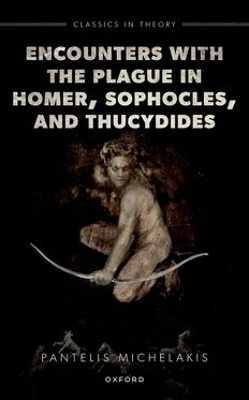
Encounters with the Plague in Homer, Sophocles, and Thucydides
Seiten
2025
Oxford University Press (Verlag)
978-0-19-884410-5 (ISBN)
Oxford University Press (Verlag)
978-0-19-884410-5 (ISBN)
Encounters with the Plague in Homer, Sophocles, and Thucydides explores three of the earliest, and most influential, accounts of plague visitations in Western literature: Homer's Iliad book 1 (1-487), Sophocles' Oedipus the King (esp. 1-215), and Thucydides' History of the Peloponnesian War book 2 (esp. 47.3-54).
The question at the core of this study is how a destructive force within narrative becomes a creative force for narrative itself: both in terms of the formation of narrative and in narrative's encounter with its readers and spectators as the hosts that will ensure its dissemination and its survival through time. The three accounts of plague visitations under discussion matter as examples of a particular type of narrative event associated with crisis. In all three of them, the plague spreads through seemingly disparate but closely interconnected social, material, and technical networks: different linguistic domains, structures of narrative space and time, routes of knowledge and affect, and biological and socio-political bodies. Thematically, the plague is a disruptive force that breaks down distinctions between and across such networks. At the same time, however, it is also a generative force that shows the capacity of narrative to expose the heterogeneous parts of such networks and the complex interconnections within and between them.
By emphasizing the disruptive, invasive force of such narratives, with their power to spread like epidemic disease, this book offers a way of thinking through the anxieties generated by exposure to technical and artistic skill.
The question at the core of this study is how a destructive force within narrative becomes a creative force for narrative itself: both in terms of the formation of narrative and in narrative's encounter with its readers and spectators as the hosts that will ensure its dissemination and its survival through time. The three accounts of plague visitations under discussion matter as examples of a particular type of narrative event associated with crisis. In all three of them, the plague spreads through seemingly disparate but closely interconnected social, material, and technical networks: different linguistic domains, structures of narrative space and time, routes of knowledge and affect, and biological and socio-political bodies. Thematically, the plague is a disruptive force that breaks down distinctions between and across such networks. At the same time, however, it is also a generative force that shows the capacity of narrative to expose the heterogeneous parts of such networks and the complex interconnections within and between them.
By emphasizing the disruptive, invasive force of such narratives, with their power to spread like epidemic disease, this book offers a way of thinking through the anxieties generated by exposure to technical and artistic skill.
Pantelis Michelakis is Director of The Archive of Performances of Greek and Roman Drama, Fellow of St Hilda's College, and Associate Professor of Classical Reception at the University of Oxford. He has previously held positions at the University of Bristol and Wolfson College Oxford. He is the author of Greek Tragedy on Screen (2013), Euripides' Iphigenia at Aulis (2006), and Achilles in Greek Tragedy (2002).
Introduction: Narrative, Contagion, Crisis
1: Language
2: Space
3: Time
4: Knowledge
5: Emotions
6: Politics
Afterword
| Erscheinungsdatum | 04.11.2025 |
|---|---|
| Reihe/Serie | Classics in Theory Series |
| Verlagsort | Oxford |
| Sprache | englisch |
| Maße | 144 x 222 mm |
| Gewicht | 454 g |
| Themenwelt | Literatur ► Klassiker / Moderne Klassiker |
| Geschichte ► Allgemeine Geschichte ► Vor- und Frühgeschichte | |
| Geschichte ► Allgemeine Geschichte ► Altertum / Antike | |
| Geisteswissenschaften ► Sprach- / Literaturwissenschaft ► Anglistik / Amerikanistik | |
| Geisteswissenschaften ► Sprach- / Literaturwissenschaft ► Literaturwissenschaft | |
| ISBN-10 | 0-19-884410-7 / 0198844107 |
| ISBN-13 | 978-0-19-884410-5 / 9780198844105 |
| Zustand | Neuware |
| Informationen gemäß Produktsicherheitsverordnung (GPSR) | |
| Haben Sie eine Frage zum Produkt? |
Mehr entdecken
aus dem Bereich



aus dem Bereich
auf den Spuren der frühen Zivilisationen
Buch | Hardcover (2023)
C.H.Beck (Verlag)
CHF 27,95
Konzepte – Methoden – Theorien
Buch | Softcover (2024)
UTB (Verlag)
CHF 55,85
die archäologische Wahrheit über die Bibel
Buch | Softcover (2023)
C.H.Beck (Verlag)
CHF 25,20


