


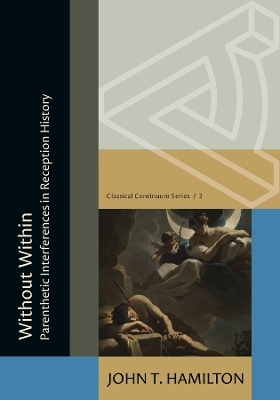
Without Within: Parenthetic Interferences in Reception History
Seiten
2025
Harvard University Press (Verlag)
978-0-674-30127-6 (ISBN)
Harvard University Press (Verlag)
978-0-674-30127-6 (ISBN)
Classical reception implies a parenthetical relationship where Antiquity appears to be inserted into while remaining alongside Modernity. By investigating exemplary instances of reception across several epochs, languages, and cultures, Without Within delineates and assesses the varying contours of Antiquity’s challenge to Modernity and vice versa.
Classical reception has always implied a parenthetical relationship insofar as Antiquity appears to be inserted into (en) while remaining alongside (para) Modernity. As in any parenthetical statement, the ancient source can be said to be a part of and apart from modern revisions and reworkings, recontextualizations and reorientations, belonging to a present discourse by maintaining its status beyond it. Through this rhetorical figure, Without Within broaches fresh questions and offers new lines of inquiry in the ever-growing and disparate field of Reception Studies, a field that itself continues to occupy an intriguingly ambivalent position within Classical Studies overall: simultaneously inside and outside, profane and sacred, an included exclusion.
As Quintilian defines it, a parenthesis is a figure of thought (figura sententiae) that occurs “when some thought in the middle interrupts [intervenit] the continuation of a discourse” (Inst. orat. 9, 3.23). In modern typography, this interruption or intervention is generally marked by brackets which introduce a further element of difference or heteronomy vis-à-vis the body of the text. As for specific cases of classical reception, a contrast is thereby staged between the essence of the ancient material and its modern purpose, between the what-is and the what-for. By investigating a series of exemplary instances of reception across several epochs, languages, and cultures, Hamilton aims to delineate and assess the varying contours of Antiquity’s challenge to Modernity and vice versa. What strategies of inclusion and exclusion are operative, and how might they be evaluated? What are the theoretical implications of considering the received past as both external and internal to the present day? How might we qualify the disruption and/or relevance of the past in modern contexts?
Classical reception has always implied a parenthetical relationship insofar as Antiquity appears to be inserted into (en) while remaining alongside (para) Modernity. As in any parenthetical statement, the ancient source can be said to be a part of and apart from modern revisions and reworkings, recontextualizations and reorientations, belonging to a present discourse by maintaining its status beyond it. Through this rhetorical figure, Without Within broaches fresh questions and offers new lines of inquiry in the ever-growing and disparate field of Reception Studies, a field that itself continues to occupy an intriguingly ambivalent position within Classical Studies overall: simultaneously inside and outside, profane and sacred, an included exclusion.
As Quintilian defines it, a parenthesis is a figure of thought (figura sententiae) that occurs “when some thought in the middle interrupts [intervenit] the continuation of a discourse” (Inst. orat. 9, 3.23). In modern typography, this interruption or intervention is generally marked by brackets which introduce a further element of difference or heteronomy vis-à-vis the body of the text. As for specific cases of classical reception, a contrast is thereby staged between the essence of the ancient material and its modern purpose, between the what-is and the what-for. By investigating a series of exemplary instances of reception across several epochs, languages, and cultures, Hamilton aims to delineate and assess the varying contours of Antiquity’s challenge to Modernity and vice versa. What strategies of inclusion and exclusion are operative, and how might they be evaluated? What are the theoretical implications of considering the received past as both external and internal to the present day? How might we qualify the disruption and/or relevance of the past in modern contexts?
John T. Hamilton is the William R. Kenan Professor of German and Comparative Literature at Harvard University.
| Erscheinungsdatum | 23.08.2025 |
|---|---|
| Reihe/Serie | Classical Continuum |
| Verlagsort | Cambridge, Mass |
| Sprache | englisch |
| Maße | 146 x 213 mm |
| Themenwelt | Literatur ► Klassiker / Moderne Klassiker |
| Geisteswissenschaften ► Sprach- / Literaturwissenschaft ► Anglistik / Amerikanistik | |
| Geisteswissenschaften ► Sprach- / Literaturwissenschaft ► Literaturwissenschaft | |
| ISBN-10 | 0-674-30127-7 / 0674301277 |
| ISBN-13 | 978-0-674-30127-6 / 9780674301276 |
| Zustand | Neuware |
| Informationen gemäß Produktsicherheitsverordnung (GPSR) | |
| Haben Sie eine Frage zum Produkt? |
Mehr entdecken
aus dem Bereich



aus dem Bereich
Paul Celans Poetik der Mehrsprachigkeit
Buch | Hardcover (2025)
De Gruyter (Verlag)
CHF 153,90


