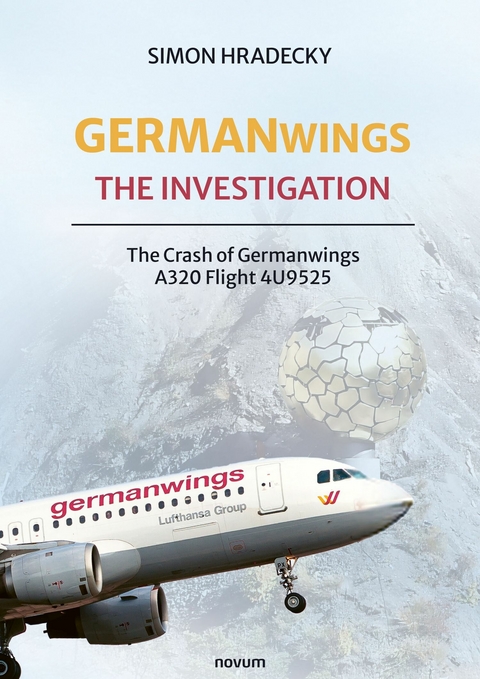
Germanwings: The Investigation (eBook)
720 Seiten
novum publishing GmbH (Verlag)
978-84-9072-804-8 (ISBN)
"e;Failure is not an option"e; - a principle long established in space exploration. Simon Hradecky now applies this motto to the investigation of the 2015 Germanwings disaster, challenging the official account of events. In his gripping book, Hradecky explores how technical malfunctions and other possible causes were systematically excluded from the investigation. The story of the crash is retold from a new perspective that goes far beyond the usual explanations. Through his own technical tests and extensive research, he demonstrates why the true reasons behind the crash remain hidden to this day. A must-read for anyone who wants to understand the full story behind this tragedy.
Chapter 1
The day of the crash
As I do every morning, I sat in my office around 9 a.m. on March 24, 2015, a Tuesday, and began to read and answer the many emails that had reached me overnight. In my e-mails, I expected to receive information about possible incidents in aviation, on the basis of which I would then initiate research to verify the information, shed light on the background and then write a corresponding report on "The Aviation Herald" (AVH). Later I would then check the websites of the civil aviation authorities and investigating authorities for news.
I had always been interested in commercial aircraft (airliners), had developed a mathematical model that allowed me to simulate flight behavior, engine behavior, aircraft controls and aircraft systems in real time, and had begun investigating commercial aircraft accidents and incidents about 13 years earlier to obtain data on aircraft behavior that I could use to validate my mathematical model. I already knew that the full flight simulators used by airlines for pilot training were no longer accurate enough outside of normal flight envelope. For example, when the Lauda Air Boeing 767 crashed in 1991, it became clear that the simulator was suggesting to pilots that thrust reverser extension on one engine during a climb was definitely controllable. However, this turned out to be wrong, because the simulator programming had not taken into account that the turbulence of the airflow caused by the reverse thrust would cause large parts of the wing to stall, causing the wing to lose lift and the aircraft to roll uncontrollably. During these 13 years, I had regularly reported such incidents to my friends and presented my findings. My friends thought that the reports were worth being seen by a wider readership, my best friend Urs Wildermuth started to really work on me from 2007 and finally convinced me to take the plunge. I founded AVH in April 2008, the website went online after programming on May 12, 2008 and exceeded all expectations within a very short time.
As always during my office/editorial day, a TV was on in the background, the sound was quiet but still audible. News channels were usually on, as I didn't want to miss any incidents and publish my own report as quickly as possible. This morning, however, one of the German state broadcasters was on in the background.
I had just noticed that the German Air Accident Investigation Bureau (BFU) had published its monthly bulletin for November 2014, and had discovered that the BFU had published important new details about a serious incident we had already reported on November 5, 2014, when my eyes fell on the TV set with a ticker tape running across its screen: "German plane missing". It was shortly after 11 a.m. local time (Central European Standard Time CET, 10:00Z).
I dropped everything. Which plane? I studied the radar data, watched pilot forums, then it became clear that a Germanwings A320 on a flight from Barcelona to Düsseldorf, flight 4U-9525, had started to descend and had disappeared from the radar over mountainous terrain in the south of France. This must have been the missing plane. In the meantime, the first indications had already arrived that the plane had crashed and had been located on the ground.
At 11:54L (10:54Z) I published our first report:
Crash: Germanwings A320 near Barcelonnette on Mar 24th 2015, lost height and impacted terrain
A Germanwings Airbus A320-200, registration D-AIPX performing flight 4U-9525 from Barcelona,SP (Spain) to Dusseldorf (Germany), was enroute at FL380 about 30nm southeast of Marseille (France) when the aircraft initiated a rapid descent. Contact with the aircraft was lost at about 6000 feet. French Police reported the aircraft was seen on the ground near Barcelonnette (France).
Radar data suggest the aircraft descended from FL380 through FL110 in 8 minutes (average rate of descent 3375 fpm).
The first confirmations arrived that helicopters had found the plane. In the meantime, many German radio stations had interrupted their programs and special broadcasts were made about the crash.
New reports arrived almost by the second on all channels, e-mail, forums, TV stations, radio, online media and official sources.
I had already extended our report to 12:09L (11:09Z):
Crash: Germanwings A320 near Barcelonnette on Mar 24th 2015, lost height and impacted terrain
A Germanwings Airbus A320-200, registration D-AIPX performing flight 4U-9525 from Barcelona,SP (Spain) to Dusseldorf (Germany) with 142 passengers and 6 crew, was enroute at FL380 about 30nm southeast of Marseille (France) when the aircraft initiated a rapid descent. Radar contact with the aircraft was lost at about 6800 feet at approx. 10:45L (09:45Z) about 12nm southwest of Barcelonnette (France).
French Police reported two helicopters spotted the remains of the aircraft on the ground near Barcelonnette (France).
The President of France reported, it does not appear there are any survivors.
Radar data suggest the aircraft had reached FL380 about 3 minutes prior to leaving FL380 and descended from FL380 through FL110 in 8 minutes (average rate of descent 3375 fpm). The aircraft appeared to have levelled off at FL068 for one minute while on a northeasterly heading of 26 degrees true, mountains rise up to 8600 feet about 1nm north of the last reported aircraft position.
I hate the phone. It always interrupts at the wrong moment, especially when you're working on highly concentrated research anyway, the devil is loose in the newsroom, and I'm trying to stay organized and prioritize incoming information for publication at top speed, verify as much as possible within such a "breaking news" situation, and complete the article. I hate the phone.
But it rang. There was no number on the display. I picked up the phone, a voice answered without introducing itself, no name. But I quickly understood that the call must have come directly from the Germanwings headquarters. The caller explained to me that the technical logbook (Techlog for short, in which all observations of technical faults and the steps taken to rectify them are recorded) of the crashed aircraft, which was supposed to be closed and no longer accessible to anyone, was still open to everyone within the company. The techlog had already been computerized, there was no longer a techlog on paper. This tech log contained an entry stating that the cockpit door keypad, which could be used to knock on the door from the cabin or to open the door in an emergency using a special emergency code, was recorded as defective and that the repair had been postponed until later in accordance with the Minimum Equipment List and the associated procedures.
The conversation was over and I was puzzled. What was that all about? What did this information mean? Why did I receive this information? From whom? But I didn't have time to think. Information continued to pour in from all sides and wanted to be processed and edited.
France's civil aviation authority DGAC declared that the plane had sent an emergency call (which later turned out to be false).
I found time to prepare a graphic of the radar track. Shortly before the lunch break, when I would go to my favorite pub opposite my office, our report read:
Crash: Germanwings A320 near Barcelonnette on Mar 24th 2015, lost height and impacted terrain
A Germanwings Airbus A320-200, registration D-AIPX performing flight 4U-9525 from Barcelona,SP (Spain) to Dusseldorf (Germany) with 142 passengers and 6 crew, was enroute at FL380 about 30nm southeast of Marseille (France) when the aircraft initiated a rapid descent. Radar contact with the aircraft was lost at about 6800 feet at approx. 10:45L (09:45Z) about 12nm southwest of Barcelonnette (France), 75nm northwest of Marseille.
French Police reported two helicopter spotted the remains of the aircraft on the ground between Prads-Haute-Bleone and Barcelonnette (France) at about 2700 meters elevation (8800 feet), about half way between the two cities there is a mountain ridge rising up to 8900 feet.
The President of France reported, it does not appear there are any survivors. The crash site is very difficult to reach.
France's DGAC reported the crew transmitted an emergency call just prior to the aircraft disappearing from radar near Bassinet.
Lufthansa, parent company of Germanwings, reported they do not yet know what happened to flight 4U-9525.
Radar data suggest the aircraft had reached FL380 about 3 minutes prior to leaving FL380 and descended from FL380 through FL110 in 8 minutes (average rate of descent 3375 fpm). The aircraft appeared to have levelled off at FL068 for one minute while on a northeasterly heading of 26 degrees true, mountains rise up to 8900 feet about 1nm north of the last reported aircraft position.
Radar Track (Graphics: AVH/Google Earth):
I left the newsroom and hurried into the pub. The innkeeper knew I was in a big hurry before I had even entered the pub, although he hadn't heard about the crash. He could almost see me running across the zebra crossing, an unusual sight. "I'm in a hurry," I pushed out as I dropped into the seat at my regular table. My thoughts revolved around the A320 as I wolfed down the menu - I've forgotten what I ate, I wonder if I was even consciously aware of it that day. Even before the final "crowning glory" of the lunch, a large brown (double espresso with cream and sugar), was served, I paid, downed the coffee and ran back to the office.
In the meantime, I had received a huge number of emails and messages. I sifted through the new information,...
| Erscheint lt. Verlag | 12.5.2025 |
|---|---|
| Sprache | englisch |
| Themenwelt | Literatur ► Romane / Erzählungen |
| Schlagworte | Belletristik • Krimi • Simon Hradecky • Spannung |
| ISBN-10 | 84-9072-804-6 / 8490728046 |
| ISBN-13 | 978-84-9072-804-8 / 9788490728048 |
| Informationen gemäß Produktsicherheitsverordnung (GPSR) | |
| Haben Sie eine Frage zum Produkt? |
 EPUB (Wasserzeichen)
DRM: Digitales Wasserzeichen
Dieses eBook enthält ein digitales Wasserzeichen und ist damit für Sie personalisiert. Bei einer missbräuchlichen Weitergabe des eBooks an Dritte ist eine Rückverfolgung an die Quelle möglich.
Dateiformat: EPUB (Electronic Publication)
EPUB ist ein offener Standard für eBooks und eignet sich besonders zur Darstellung von Belletristik und Sachbüchern. Der Fließtext wird dynamisch an die Display- und Schriftgröße angepasst. Auch für mobile Lesegeräte ist EPUB daher gut geeignet.
Systemvoraussetzungen:
PC/Mac: Mit einem PC oder Mac können Sie dieses eBook lesen. Sie benötigen dafür die kostenlose Software Adobe Digital Editions.
eReader: Dieses eBook kann mit (fast) allen eBook-Readern gelesen werden. Mit dem amazon-Kindle ist es aber nicht kompatibel.
Smartphone/Tablet: Egal ob Apple oder Android, dieses eBook können Sie lesen. Sie benötigen dafür eine kostenlose App.
Geräteliste und zusätzliche Hinweise
Buying eBooks from abroad
For tax law reasons we can sell eBooks just within Germany and Switzerland. Regrettably we cannot fulfill eBook-orders from other countries.
aus dem Bereich