


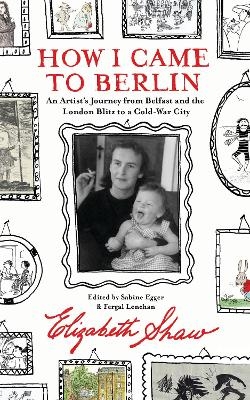
How I Came to Berlin
An Artist's Journey from Belfast and the London Blitz to a Cold-War City
Seiten
2025
The Lilliput Press Ltd (Verlag)
978-1-84351-952-2 (ISBN)
The Lilliput Press Ltd (Verlag)
978-1-84351-952-2 (ISBN)
This finely tuned memoir by one of Ireland’s great forgotten artists - now illustrated with many never-before-published illustrations, delves into the under-explored life of Elizabeth Shaw, exploring her relationship to Stalinism and the GDR after the Second World War.
Elizabeth Shaw, who has until now remained all but unknown in her native Ireland, was one of the most celebrated children’s authors in East Germany, producing a series of masterful children’s books that have stayed in print since her death in 1992. She was also a deeply complex, passionate woman, a brilliant author, and a gifted artist beyond the confines of Children’s literature.
Born in Belfast in 1920 to Irish parents, Shaw was a life-long outsider, sheltered from the poverty and violence of the city at the liberal, left-wing Royal Academy. At the age of 12, her family moved to Bedford in England, and she would eventally go on to attend the Chelsea School of Art, impressing her teachers and absorbing the social and political struggles of her time. In 1939, she was called up to the war effort and worked in the London telephone exchange.
Having published sketches in 1940 and contributed to the London left-wing magazines Our Time and Lilliput, she exhibited works in 1943 at the Artists’ International Association in London. In 1944l, she met the Swiss-born émigré artist and communist René Graetz. They married in 1946 and, like other German exiles opposed to National Socialism, decided to help build a better, socialist Germany. Deeply inflected by the politics of East Germany, she worked as a caricaturist with Neues Deutschland, the newspaper of East Germany’s ruling Socialist Unity Party, before going on to write 23 enromously successful books for children, making her a household name across Germany.
By times elusive, moving and deeply revealing, this is a finely tuned memoir by one of Ireland’s great forgotten artists - now illustrated with many never-before-published illustrations, and with an insightful and enligtening afterword by Fergal Lenehan and Sabine Egger which delves into the under-explored aspects of Shaw’s relationship to Stalinism, the GDR, and those around her.
Elizabeth Shaw, who has until now remained all but unknown in her native Ireland, was one of the most celebrated children’s authors in East Germany, producing a series of masterful children’s books that have stayed in print since her death in 1992. She was also a deeply complex, passionate woman, a brilliant author, and a gifted artist beyond the confines of Children’s literature.
Born in Belfast in 1920 to Irish parents, Shaw was a life-long outsider, sheltered from the poverty and violence of the city at the liberal, left-wing Royal Academy. At the age of 12, her family moved to Bedford in England, and she would eventally go on to attend the Chelsea School of Art, impressing her teachers and absorbing the social and political struggles of her time. In 1939, she was called up to the war effort and worked in the London telephone exchange.
Having published sketches in 1940 and contributed to the London left-wing magazines Our Time and Lilliput, she exhibited works in 1943 at the Artists’ International Association in London. In 1944l, she met the Swiss-born émigré artist and communist René Graetz. They married in 1946 and, like other German exiles opposed to National Socialism, decided to help build a better, socialist Germany. Deeply inflected by the politics of East Germany, she worked as a caricaturist with Neues Deutschland, the newspaper of East Germany’s ruling Socialist Unity Party, before going on to write 23 enromously successful books for children, making her a household name across Germany.
By times elusive, moving and deeply revealing, this is a finely tuned memoir by one of Ireland’s great forgotten artists - now illustrated with many never-before-published illustrations, and with an insightful and enligtening afterword by Fergal Lenehan and Sabine Egger which delves into the under-explored aspects of Shaw’s relationship to Stalinism, the GDR, and those around her.
Elizabeth Shaw was born in Belfast and lived most of her life in Berlin, where she moved after the Second World War. Lauded as one of Germany’s most popular children’s authros, she wrote and illustrated 23 books for children, many of which have been translated into several languages.
| Erscheinungsdatum | 20.09.2025 |
|---|---|
| Vorwort | Anne Schneider |
| Verlagsort | Dublin |
| Sprache | englisch |
| Maße | 135 x 216 mm |
| Gewicht | 500 g |
| Themenwelt | Literatur ► Biografien / Erfahrungsberichte |
| ISBN-10 | 1-84351-952-6 / 1843519526 |
| ISBN-13 | 978-1-84351-952-2 / 9781843519522 |
| Zustand | Neuware |
| Informationen gemäß Produktsicherheitsverordnung (GPSR) | |
| Haben Sie eine Frage zum Produkt? |
Mehr entdecken
aus dem Bereich


aus dem Bereich
unser Eingliederungsversuch in eine geschlossene Gesellschaft
Buch | Softcover (2025)
Knaur (Verlag)
CHF 25,20


