


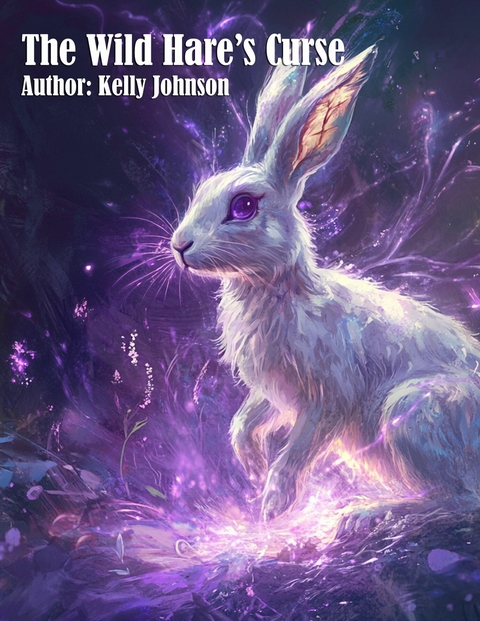
The Wild Hare's Curse (eBook)
154 Seiten
Kelly Johnson (Verlag)
978-3-69111-482-9 (ISBN)
Talented artist and writer that loves creating products people enjoy.
Talented artist and writer that loves creating products people enjoy.
Chapter 1: The Drowning Moon
Bramblehollow was a quiet village, wrapped in the dense arms of an ancient wood, the sort of place forgotten by maps and remembered only in the stories told at the hearth. The village was a place of shadows and whispers, where time seemed to slow its course and the world outside felt distant, almost foreign. The stone cottages, small and weatherworn, leaned against one another like gossiping old men, their chimneys curling smoke into the sky as if the very earth had decided to grow old with them. Ivy clung to the walls like secrets, creeping up the sides of homes and through the cracks in the stone, its tendrils weaving themselves into the very heart of the village. The trees—the great, ancient sentinels that surrounded the village on all sides—towered like giants, their gnarled branches reaching toward the sky, whispering things that only the wind and the earth could understand. They watched everything, their leaves trembling in the breeze as though they were in on a secret the villagers had yet to learn.
The village was quiet, too quiet. No laughter echoed in the streets, no cries of children or the hustle of market day. It was the kind of quiet that stretched long and thin, the kind that settled deep into your bones. It was a silence that came from the heart of the forest itself, where the trees held their breath and the world seemed to pause, as if waiting for something to happen.
And on that night, the night Elric was born, the earth itself seemed to hold its breath.
The moon rose heavy and red over the treetops, its swollen face casting an eerie light across the fields, staining everything it touched in a wash of blood-colored light. The village, bathed in that strange glow, felt as though it were holding onto something, a secret too ancient to speak. It was a night like no other, when the air itself was thick with an unsettling stillness. The elders called it The Drowning Moon—a rare celestial omen that had not graced their skies in over a hundred years. It was said that the moon’s light was a harbinger, a signal that something ancient and forgotten was stirring in the shadows. The air that night was thick with the smell of wet earth, damp and cloying, mingling with something fouler—something that could only be described as ash, a scent that clung to the lungs and left a bitter taste on the tongue.
Wolves did not howl that night, their mournful cries silenced by the weight of the air. Birds did not sing, their usual chorus of song replaced by an oppressive silence that pressed down on the land like a thick, suffocating blanket. Even the wind, which usually carried the sweet scent of the forest and the freshness of spring, turned sharp and sour, as if it carried a warning. The trees—those ancient giants—stood still, their branches hanging like heavy shadows, as if they, too, were waiting for something. And the hare goddess, who had been the protector of the village for as long as the villagers could remember, did not answer her shrine.
The shrine had stood at the edge of the forest for centuries, a stone altar covered in the green fuzz of moss and the tangled vines of creeping ivy. It was carved with intricate patterns of running hares and curling vines, a testament to the goddess’s presence in the village. The altar was a sacred place, where offerings were left with reverence and hope: garlands of primrose woven together by the village girls, bits of honeycomb gathered by the beekeepers, painted eggs crafted with care by the children. The villagers believed that these offerings would keep the goddess’s favor, ensuring their crops would grow strong, their families would prosper, and the seasons would turn with balance. They spoke of the goddess walking the woods in the form of a silver hare when the moon was right, a creature of grace and power, embodying both the untamed wilds of the forest and the deep fertility of the earth.
But that night, something was wrong. The shrine stood bare, the offering dish shattered at its base, its pieces scattered like forgotten fragments of some long-lost ritual. The wind, which should have been warm and fragrant with the scent of the earth’s awakening, was sharp and bitter, biting at the skin with an unnatural chill. The altar, usually a place of peace and reverence, now felt like a barren wasteland, its stones cold and unwelcoming. There was no sign of the goddess, no hint of the hare’s silvery form darting between the trees. The wind seemed to whisper of something lost, something forgotten, and it carried a sharp edge that made the hairs on the back of the villagers' necks stand on end.
The villagers felt it first—the sense that something was amiss, that the very fabric of the world had shifted. The elders, wise in their years but not immune to fear, gathered in hushed circles, muttering about omens and curses. They spoke of the Drowning Moon in hushed tones, of its dark red hue that stained the heavens and the earth, of the ancient rituals that had been lost to time. Some believed that the moon’s rise marked the return of a power older than the village itself, a force that had slumbered for centuries beneath the earth’s surface, waiting for the right moment to awaken.
And then, in the midst of that thick silence, Elric was born.
His first cry split the night, shattering the stillness that had hung so heavily over the village. The midwives, their hands trembling, whispered his name in reverence. They had known he would come, for there had been signs—whispers in the trees, shadows that moved without cause, strange omens in the sky. They knew that this child was not like the others. His birth had been marked long before his time, foretold in stories older than the village itself.
But no one, not even the wise elders, could have foreseen the darkness that would follow—the curse that would be unleashed on Bramblehollow. The villagers would come to know that the blood-red moon had not only marked Elric’s birth, but had also set into motion a chain of events that would unravel the very fabric of their existence.
In the midwife’s cottage at the village's edge, the child came screaming into the world. His mother—barely more than a girl herself—died minutes later, her eyes wide open and fixed on the ceiling. They said it was blood loss, but the midwife whispered otherwise.
“He took her breath,” she muttered. “The boy took it all.”
The child was named Elric, though few would speak it aloud in those first years. His name, like the mark upon his chest, felt heavy, as if it carried with it the weight of fate itself—a fate none were eager to understand. His name was a whisper, a murmur that passed between clenched teeth, too fraught with meaning to be spoken easily. And etched on the soft, pale skin over his heart was a mark that no one could explain—a perfect leaping hare, its form curling around itself in an elegant spiral, ink-black against the pale expanse of his flesh. It pulsed faintly in the moonlight, a rhythmic beat that seemed to echo the very heartbeat of the earth. The mark shimmered in the dark, like some forgotten sigil, carved not by human hands, but by some ancient, unseen force. And, as though this were not enough to stir the already uneasy villagers, the mark changed color when he cried. Red when he wept with sorrow, blue when he called out in hunger, and once—just once—gold when he laughed. It was as though the child was not entirely his own, as if he were an echo of something greater, something lost to time and legend.
Whispers began to bloom like mushrooms in dark corners. They took root in the cold, stone walls of the village inn, in the dim corners of the marketplace, in the quiet rooms where people gathered to speak in hushed voices. Some said he was a changeling, a child not born of the village but of something far darker—a creature sent to steal away the true child and replace it with a hollow, soulless thing. Others, those with more fire in their hearts, believed that Elric was the vessel of the lost goddess herself. The one who had disappeared on the night of the blood moon, her power vanishing like smoke in the wind. They whispered that the child carried within him the divine essence of the goddess, twisted now by the curse of the Hollow, and that the mark on his chest was proof of her connection to the child. But most of the villagers, those who clung to old superstitions more tightly than to their faith, simply believed that Elric was cursed. A child born the same night the moon turned red and the goddess vanished? There were no coincidences in Bramblehollow. The villagers were not a people prone to blind faith in the gods, but neither were they willing to ignore what their instincts told them: Elric was an omen, and the world that had been broken could never truly be fixed.
One evening, as the fog rolled in thick and heavy, the villagers gathered in the dim light of the cottage, drawn together by a force they did not fully understand. The fire crackled weakly in the hearth, its flames struggling against the weight of the damp air that pressed against the walls. The priest stood at the head of the room, a nervous man with too many rings on his fingers and too little faith in his heart. He was a man who had clung to his position in the village not because of wisdom, but because of fear—fear of the unknown, fear of what lay beyond the veil of their understanding. His hands shook as he held the heavy cross at his neck, the cold metal trembling in his grasp. His voice came out in a strained whisper, thick with the taste of fear and the sting of guilt.
"Bury him in the woods," he hissed, the words slipping from his lips like poison. His eyes darted nervously toward the infant in the midwife's arms,...
| Erscheint lt. Verlag | 16.5.2025 |
|---|---|
| Verlagsort | Vachendorf |
| Sprache | englisch |
| Themenwelt | Literatur ► Fantasy / Science Fiction ► Fantasy |
| Schlagworte | ancient fear • ancient power • ancient ritual • birth omen • blood-red moon • Bramblehollow • Curse • cursed lineage • Destiny • Divine Child • divine curse • divine reincarnation • eerie birth • eerie legend • eerie village • Elric • emotional magic • Emotional transformation • fear • Folklore • forgotten goddess • Forgotten Lore • haunting • leaping hare • magical realism • moon omen • mysterious mark • mystical birthmark • Myth • mythic return • Prophecy • Reincarnation • sacred force • shadowed past • spiritual awakening • Supernatural • terrifying destiny • tragic origin • unsettling truth • village superstition |
| ISBN-10 | 3-69111-482-2 / 3691114822 |
| ISBN-13 | 978-3-69111-482-9 / 9783691114829 |
| Informationen gemäß Produktsicherheitsverordnung (GPSR) | |
| Haben Sie eine Frage zum Produkt? |
 EPUB (Wasserzeichen)
DRM: Digitales Wasserzeichen
Dieses eBook enthält ein digitales Wasserzeichen und ist damit für Sie personalisiert. Bei einer missbräuchlichen Weitergabe des eBooks an Dritte ist eine Rückverfolgung an die Quelle möglich.
Dateiformat: EPUB (Electronic Publication)
EPUB ist ein offener Standard für eBooks und eignet sich besonders zur Darstellung von Belletristik und Sachbüchern. Der Fließtext wird dynamisch an die Display- und Schriftgröße angepasst. Auch für mobile Lesegeräte ist EPUB daher gut geeignet.
Systemvoraussetzungen:
PC/Mac: Mit einem PC oder Mac können Sie dieses eBook lesen. Sie benötigen dafür die kostenlose Software Adobe Digital Editions.
eReader: Dieses eBook kann mit (fast) allen eBook-Readern gelesen werden. Mit dem amazon-Kindle ist es aber nicht kompatibel.
Smartphone/Tablet: Egal ob Apple oder Android, dieses eBook können Sie lesen. Sie benötigen dafür eine kostenlose App.
Geräteliste und zusätzliche Hinweise
Buying eBooks from abroad
For tax law reasons we can sell eBooks just within Germany and Switzerland. Regrettably we cannot fulfill eBook-orders from other countries.
aus dem Bereich


