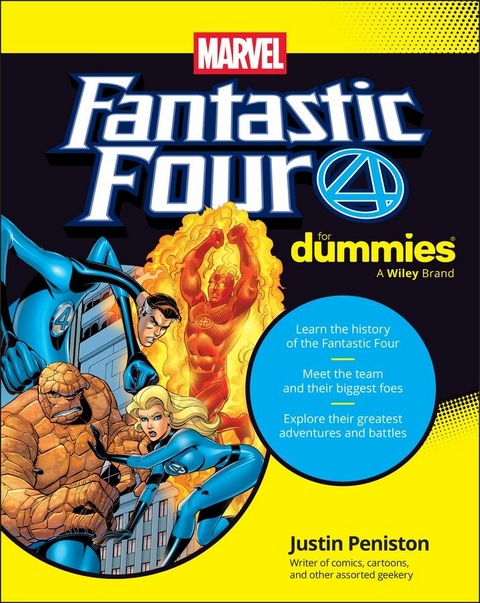
Discover Marvel's Founding Family!
Before the Avengers, the X-Men, or the Defenders, there was the Fantastic Four. This team of super heroes made their name through their dynamic origin, forced together by circumstance but bonded forever as family. Fantastic Four For Dummies introduces you to Marvel's First Family and the major villains that they've encountered, including the infamous Doctor Doom. Produced in partnership with Marvel Comics, this full-color guide features art taken directly from the Marvel Comics archives, giving readers all they need to know about this superhuman cast of characters. Discover their strengths and weaknesses and explore the essential comics to get up to speed on what makes this team so fantastic.
- Get to know the super heroes that make up the Fantastic Four and delve into their fateful origins
- Discover the supporting cast and major villains throughout the storylines
- Understand the characters on a deeper level and explore the family dynamics that have shaped this unlikely team
- Learn why the Fantastic Four have been so popular and have stood the test of time
Whether you're a dedicated Fantastic Four fan or just finding your footing, Fantastic Four For Dummies is your go-to guide to making friends with Marvel's first family.
Justin Peniston is a writer of comics and animation with over 15 years' experience working with science fiction, fantasy, horror, and super hero comics. He has worked with DC Comics, Marvel Studios, Cartoon Network, Man of Action Studios, and IDW Publishing.
Discover Marvel s Founding Family! Before the Avengers, the X-Men, or the Defenders, there was the Fantastic Four. This team of super heroes made their name through their dynamic origin, forced together by circumstance but bonded forever as family. Fantastic Four For Dummies introduces you to Marvel s First Family and the major villains that they ve encountered, including the infamous Doctor Doom. Produced in partnership with Marvel Comics, this full-color guide features art taken directly from the Marvel Comics archives, giving readers all they need to know about this superhuman cast of characters. Discover their strengths and weaknesses and explore the essential comics to get up to speed on what makes this team so fantastic. Get to know the super heroes that make up the Fantastic Four and delve into their fateful origins Discover the supporting cast and major villains throughout the storylines Understand the characters on a deeper level and explore the family dynamics that have shaped this unlikely team Learn why the Fantastic Four have been so popular and have stood the test of time Whether you re a dedicated Fantastic Four fan or just finding your footing, Fantastic Four For Dummies is your go-to guide to making friends with Marvel s first family.
Chapter 1
The Founding Family of Marvel
IN THIS CHAPTER
Non-traditional super heroes
Examining their not-so secret origin
Exploring family dynamics
The first thing to know, when you’re talking about the Fantastic Four, is that these characters are important. They are literally the foundation of the Marvel Universe — all of the other Marvel characters are in some way influenced by them. The characters we know best — the Hulk, Spider-Man, Iron Man, Jean Grey — are all variations on a theme introduced in Fantastic Four.
I mean, Mister Fantastic/Reed Richards, Invisible Woman/Susan Storm-Richards (although it was Invisible Girl back then), Human Torch/Johnny Storm, and the Thing/Benjamin J. Grimm are the first super heroes created by Stan Lee and Jack Kirby together. (If the magnitude of that escapes you, be sure to read Chapter 2, where I discuss both men, their prolific collaboration, and how their creations continue to resonate in the Marvel Universe.) Without these characters, the Marvel Cinematic Universe (or should I say, MCU?) as we know it would not exist … and Disneyland would be a much more boring place. As you can see in Figure 1-1, the FF (as they are often referred to) aren’t boring.
Nowadays, fans take it for granted that a super hero is more than a square jaw and flowing cape. Our heroes grapple with more than just the bad guys. They’re people and they struggle with everything that comes with that — but that wasn’t always the case. Spider-Man has to worry about paying the rent and his Aunt May’s health. The X-Men are targets of anti-mutant bigotry as much as they are of super villains. Daredevil struggles as a man of faith who revels in violence to battle evil.
There was a time when super heroes was a genre aimed squarely at kids, and more than that, at boys. The Marvel Age of Comics is what began to make super heroes a genre for everybody. This is a good time to tell you that the Marvel Age of Comics began with the publication of The Fantastic Four (1961) #1. Like I said before, these characters are important.
Art by Alex Ross.
FIGURE 1-1: The Fantastic Four — anything but boring!
Explorers versus Super Heroes — Two Great Tastes That Taste Great Together
One of the first — and coolest — things to know about the Fantastic Four is that they’re not super heroes in the traditional sense. I mean, yes, they have incredible superpowers, they wear eye-catching outfits, and they do battle with some of the worst villains the Marvel Universe has to offer. They check a lot of super hero boxes.
But for most super heroes, the mandate is to battle evil and protect the innocent … those things are job one. But the FF looks for ways to help humanity more than protect it … and they do so in the same way that people do in the real world, by expanding human knowledge and potential through discovery and invention.
Writer Mark Waid, in the first issue of his run on Fantastic Four, coined the term “imaginauts” for them. They weren’t simply battling evil or adventuring — they were learning. They were creating. In a way, they were cut from the cloth of their hyper-imaginative creators (we’ll get to them in a bit).
“These guys aren’t super heroes. Not really. They don’t fight crime. They don’t go on patrol … They’re astronauts. They’re envoys. Adventurers. Explorers … Maybe they’ve been around a while, but the only thing old about the FF is that they never stop taking us to the new.”
—MR. SHERTZER, THE FF’S PUBLICIST, FANTASTIC FOUR (1998) #60 BY MARK WAID, MIKE WIERINGO, KARL KESEL, PAUL MOUNTS, RICHARD STARKINGS, AND ALBERT DESCHESNE.
Getting to Know Marvel’s First Family
The Fantastic Four travel the world (or rather, the Multiverse), exploring and learning … and occasionally getting into huge fights with monsters and villains bent on mayhem! But through one magical choice, the FF are more relatable, more accessible … and more fun than their Golden Age forebears.
Lee and Kirby made the Fantastic Four a family … and that somehow gives fans more of what they want from these kinds of characters, whether they’re explorers or super heroes (or both).
I mean sure, when you’re looking for stories with characters to root for, you want something dynamic and exciting, but you also want more than that. You want something thought-provoking. You want something that offers new perspectives on the world and the people in it. You want something that surprises you while still feeling comfortably familiar. You want your families … but more. The family dynamic is on display from the very beginning, in The Fantastic Four (1961) #1 … albeit a dysfunctional one.
Their very first interaction as a group is a flashback to their origin, with test pilot Ben Grimm admonishing Reed Richards about their upcoming test flight and the dangers of “cosmic rays.” Ben refuses to fly until Sue calls him out for cowardice. Ben angrily agrees to fly the mission … but then Reed tries talking Sue and Johnny out of accompanying them, to no avail. Sue is Reed’s fiancée — she goes where he goes … and Johnny goes where she goes.
But Ben’s worries are justified. The ship is bombarded by cosmic rays! The crew is overcome, and they crash land back on Earth … but the damage, the miracle, has been done. This bickering but deeply loyal family has become the Fantastic Four.
They have become more.
Before I begin diving deeply into these characters and what makes them who they are, let me make it clear that I’m talking about these characters and events as they appear in the comics, specifically on “Earth-616,” which is the main Marvel Universe. All of this inspires what eventually happens in films, TV series, and cartoons, but none of this necessarily applies to their canon. (This is the real geeky stuff!)
Mister Fantastic — A hero as complex as his stretchy body
Take a good look at Figure 1-2. This shot really captures the essence of the Fantastic Four’s leader, because it offers a number of insights that you really need if you want to understand who he is. It shows us a collection of super-sciencey (and Jack Kirby-esque) gizmos, it shows us one stretching arm, and it shows us the small, satisfied smile of a man who thinks he knows what he’s doing.
I don’t see any choice but to look at each of those qualities (albeit not in that order)!
His real superpower isn’t what you might think
Every super hero has an origin, secret or otherwise. Spider-Man has his radioactive spider, Captain America his Super-Soldier Serum, and the Hulk his gamma bomb. The Fantastic Four have theirs, in the form of those pesky cosmic rays … but they’re not really what created the Fantastic Four.
Reed Richards is the secret origin of the Fantastic Four. Mister Fantastic is his own secret origin … in large part because he had his real superpower before he ever even smelled a cosmic ray.
Some of you might read that and think, “Justin, what the heck are you talking about? Mister Fantastic stretches, and he’s not able to do that until that fateful flight through the cosmic rays!” And you’d be right to say so … but I’m not talking about his stretching.
As cool as stretching is, what makes Reed Richards such a special character is his incredible intellect. His genius begins to reveal itself at an early age — he is canonically taking college courses at age 14, and by age 20 has multiple degrees from schools like CalTech, MIT, and Harvard. He also attends the fictional Empire State University, where he meets both his best friend, Ben Grimm, and his worst enemy, Victor Von Doom. (We’ll get to the Thing later in this chapter, in the section “The Thing — The real heart of the team” — and the villains get their moment in Chapter 3!)
A true polymath, Reed is considered among the best in the world (universe?) at most branches of science, including multiple fields of engineering, physics, chemistry, and even biology — and this is true before he and the others take their momentous spaceflight.
Oh, and did I mention that this particular test flight is aboard a spacecraft that he himself designed and built? Reed Richards is as smart as people get … and he knows it, as we see in Figure 1-3.
This brings us to another quality of Reed’s that drives stories and events in the Marvel Universe forward far more than stretching, his defining character flaw: his arrogance.
Art by Dale Eaglesham.
FIGURE 1-2: Reed Richards, Mister Fantastic — Super hero, Scientist, Renaissance Man!
By Jonathan Hickman and Dale Eaglesham.
FIGURE 1-3: Reed reminds his wife that he is both extremely gifted and extremely arrogant....
| Erscheint lt. Verlag | 6.5.2025 |
|---|---|
| Sprache | englisch |
| Themenwelt | Literatur |
| Kunst / Musik / Theater | |
| Schlagworte | Agatha Harkness • Alex Power • Alicia Masters-Grimm • and Korr • Annihilus • Ant-Man • Artie • Aunt Petunia • Ben Grimm • Benjamin Grimm • Bentley 23 • Black Panther • Blastaar • brainstorm • Comics • Devlor • doctor doom • Dragon Man • Fantastic Force • Franklin Richards • Galactus • H.E.R.B.I.E. • Human Torch • Huntara • Invisible Woman • Jack Kirby • Johnny Storm • Jonathan Storm • leech • Lyja • Marvel • Marvel Comics • Mik • Molecule Man • Mr. Fantastic • Ms. Marvel • Namor • Powerhouse • Power Man • Psi-Lord • Psycho-Man • Reed Richards • Ronan the Accuser • She-Hulk • Silver Surfer • Spider-Man • Stan Lee • Storm • Sue Storm • Super-Apes • Susan Storm • Susan Storm-Richards • The Avengers • The Baxter Building • The Fantasticar • The Frightful Four • The Inhumans • The Kree • The Mole Man • The Puppet Master • The Red Ghost • The Skrulls • The Super-Skrull • The Thing • The Trapster • The Watcher • The Wingless Wizard • tong • Turg • uatu • Valeria Richards • Vibraxas • Wakanda • Willie Lumpkin • Wyatt Wingfoot |
| ISBN-10 | 1-394-29939-7 / 1394299397 |
| ISBN-13 | 978-1-394-29939-3 / 9781394299393 |
| Informationen gemäß Produktsicherheitsverordnung (GPSR) | |
| Haben Sie eine Frage zum Produkt? |
 EPUB (Adobe DRM)
Kopierschutz: Adobe-DRM
Adobe-DRM ist ein Kopierschutz, der das eBook vor Mißbrauch schützen soll. Dabei wird das eBook bereits beim Download auf Ihre persönliche Adobe-ID autorisiert. Lesen können Sie das eBook dann nur auf den Geräten, welche ebenfalls auf Ihre Adobe-ID registriert sind.
Details zum Adobe-DRM
Dateiformat: EPUB (Electronic Publication)
EPUB ist ein offener Standard für eBooks und eignet sich besonders zur Darstellung von Belletristik und Sachbüchern. Der Fließtext wird dynamisch an die Display- und Schriftgröße angepasst. Auch für mobile Lesegeräte ist EPUB daher gut geeignet.
Systemvoraussetzungen:
PC/Mac: Mit einem PC oder Mac können Sie dieses eBook lesen. Sie benötigen eine
eReader: Dieses eBook kann mit (fast) allen eBook-Readern gelesen werden. Mit dem amazon-Kindle ist es aber nicht kompatibel.
Smartphone/Tablet: Egal ob Apple oder Android, dieses eBook können Sie lesen. Sie benötigen eine
Geräteliste und zusätzliche Hinweise
Buying eBooks from abroad
For tax law reasons we can sell eBooks just within Germany and Switzerland. Regrettably we cannot fulfill eBook-orders from other countries.
aus dem Bereich