


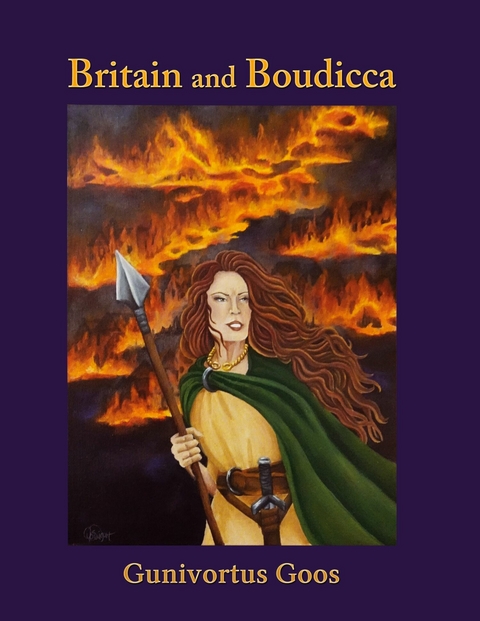
Britain and Boudicca (eBook)
292 Seiten
Books on Demand (Verlag)
978-3-8192-8591-2 (ISBN)
Gunivortus Goos, affectionately known as Guus by family and friends, has authored several books and articles, some of which were published under his long-abandoned pseudonym GardenStone. Originally from the Dutch city of Groningen, this Dutch writer left his home country several decades ago and relocated to Germany. After a few stops along the way, he now resides in a charming town nestled in the beautiful Taunus Hills of Hesse. A computer enthusiast and a lover of fantasy literature, he enjoys a diverse range of music, from classical to folk metal, blues, country, and oldies, often while savoring a good beer or a glass of dry wine. However, his true passion lies in delving into historical topics that resonate with his personal interests, always striving to dig as deep as possible into the subjects he explores.
Part 2: The Time
Before Boudicca
When the UK left the European Union in 2016 following a referendum, it was a move that was approved by the British electorate by a narrow majority. But that was Brexit 2.0, because there was already a Brexit 1.0 a very long time ago.
Thousands of years in the past, Britain was geologically connected to mainland Europe, it was not an island.
There are several theories that explain why it separated from the mainland and became an island.
This Part is, among other things, about that, about the island, or archipelago, that we know as Britain, it is about its origins and about its early population.
How Britain Became an Island
Yes, there was a time when Britain was not an island, but connected by land to mainland Europe.
When that fixed link still existed, there is thought to have been migration of early populations in both directions between Brittany and Cornwall, during an ice age3.
A catastrophic flood separated Britain from France hundreds of thousands of years ago and changed the course of British history. Shortly before that happened, roughly 450,000 years ago, large parts of northern Europe, including what is now the North Sea, were covered in ice.
Sea levels were so low at the time that you wouldn't have needed to take a ferry or a train through the Channel Tunnel to get from France to the UK. Instead, the English Channel, which separates England today from mainland Europe, was as good as dry land—or, more accurately, a Siberia-like frozen tundra with a few small rivers running through it.
Water from rivers was prevented from flowing into the Atlantic Ocean by the ice masses and it built up into a large lake just before them. When the ice melted and retreated, there were only rocks left to hold back the water. It is assumed that this rock wall broke when a small earthquake occurred. This allowed the water masses of the lake, which were several dozen meters high, to flow away. The waterfalls they then formed were estimated to be 100 meters (ca. 328 ft.) high, as the land bridge was known to stand high above the surrounding landscape. It cut through the landscape with brute force.
However, this did not yet give rise to today's English Channel, as a much narrower waterway than the one we see today was formed.
A second outflow from other, smaller lakes in the ice sheets of the North Sea could have caused a second flood, which further eroded the resulting river, but it was still a small water.
The “Doggerland” is also mentioned in this context. Until around 6000 BCE, up to 45,000 square kilometers of dry land connected the British Isles up to Scotland with the region where Denmark, Germany and the Netherlands are located today. This gigantic land bridge was formed at the end of the Weichselian Ice Age.
In the northern hemisphere, huge masses of water were trapped in the ice, so that the sea level was around 120 meters (ca. 394 ft.) below today’s level. At the same time, the ice retreated northwards before the land dried up a good 10,000 years ago.
Around 6000 BCE, an almost apocalyptic catastrophe occurred. Part of what is now called 'Norway’, the so-called Storegga, collapsed, causing one of the largest tsunamis in human history and triggering the “Storegga landslide.” Across a width of 800 kilometers (ca. 497 miles), earth masses of about the size of Iceland collapsed into the sea and created a tidal wave that washed ten to twenty meters (ca. 66 ft.) high over the coasts of Europe. What remained of Doggerland disappeared into the sea. Only the red rocks of the German North Sea island “Helgoland” stood out above the water and still do today.
The North Sea took, roughly, its original shape and Britain lost its physical connection to the mainland. Without these dramatic breaks, Britain would still be part of mainland Europe.
That was Brexit 1.0; the Brexit no one voted for.
All that remains of Doggerland is Dogger Bank, a large, elongated sandbank in the North Sea that in some places is only 13 meters (42.7 ft.) below sea level.
The Oldest Inhabitants of Britain
Before the arrival of the Celts, humanity in Britain had evolved greatly in two periods: the Stone Age and the Bronze Age.
The British Stone Age dates back some 950,000 to 700,000 years, as evidenced by the tools found at Pakefield in Suffolk and Happisburgh in Norfolk (South and East Britain respectively).
These inhabitants differed from modern humans, as the footprints found by scientists suggest that they may have been Homo antecessor (Latin Homo: man; antecessor = predecessor, a form of human over 780,000 years old), a type of human that has been found in Spain in particular.
Reconstruction of a Homo heidelbergensis head
Apart from this species, another human species, estimated to be 500,000 years old, lived in the British Isles area during this period. Homo heidelbergensis, a large and imposing early human species, is the first for which we have found fossil evidence in Britain: a leg bone and two teeth found at Boxgrove in West Sussex.
These people lived there for over 100,000 years and they skillfully butchered large animals, leaving behind numerous horse, deer and rhinoceros bones. This indicates that they were able to plan and cooperate and hunt as a group.
This species of humans exhibited considerable strength and muscularity, characterized by prominent forehead ridges and comparatively large cranial capacities. They demonstrated a high level of skill in tool-making, crafting their implements with remarkable precision. Their hand axes and various stone tools attributed to them have been discovered at multiple archaeological sites across Britain.
Fossils of very early Neanderthals, dated to around 400,000 years ago, have been found at Swanscombe in Kent, and of classic Neanderthals, around 225,000 years old, at Pontnewydd in Wales. Between 180,000 and 60,000 years ago, when the Neanderthals returned, Britain was uninhabited by humans. It is estimated that by 40,000 years ago—there are several millennia of leeway here—ancient human forms had died out there and modern humans had reached Britain. However, Neanderthals and Homo sapiens are thought to have coexisted and interbred for a short time. This assumption is based on DNA traces of Neanderthals in modern humans in Western Europe.
Our own species is a relative newcomer to Britain. The earliest direct evidence is a jaw fragment found in Kent’s Cavern, Devon. Scientific analysis has shown that it is approximately 40,000 years old.
For thousands of years, the presence of Homo sapiens in Britain was brief and sporadic. It has only been continuous for around 12,000 years.
The modern humans who appeared in Britain were highly adaptable hunter-gatherers. Their ability to innovate differed from that of all previous species. They lived in larger groups, had wider social networks and moved over greater distances. This extended interaction led to the sharing of stories and information, including the spread of new ideas and knowledge.
The first colonization of Britain by Homo sapiens was short-lived, as the climate fluctuated between low temperatures and a tundra habitat and severe ice ages that made Britain uninhabitable for long periods.
Megalithic Monuments
One of the most famous relics from the Stone Age is Stonehenge. This is a megalithic structure from the last phase of the Stone Age. It is located near the River Avon near Amesbury, southern England. It was built from at least 3000 BCE in several successive versions. The site was used at least until the Bronze Age and then abandoned. What remains is a badly damaged monument.
There are various, sometimes complementary, sometimes contradictory hypotheses about the reason and ultimate purpose of this very elaborate monument. They range from the assumption that it was a site for burials and other religious cults to that of an astronomical observatory with calendar functions (e.g. for sowing times).
All hypotheses, even the purely speculative ones, agree on one point: The horseshoes and the stones placed vertically in front of their openings are precisely aligned with the sunrise on the day of the summer solstice at that time.
But apart from Stonehenge, there are many more amazing human-made Stone Age monuments in England, such as
- The Avebury Stone Circle, near the village of Avebury in Wiltshire county
- The Mên-an-Tol, between Madron and Morvah, Cornwall
- The Boswens Menhir, northeast of St Just in Penwith, Cornwall
- and the impressive Castlerigg Stone Circle in Allendale, Cumbria.
Castlerigg stone circle, dated to the
transition period Stone Age – Bronze Age
Many such monuments are listed on a well-known website about Megalithic monuments4, usually with links to other relevant websites.
With the “Anglian Glaciation” (p. 7), Britain was depopulated, as the cold of the glacial period made it impossible for people to survive there.
After the last glaciation, which ended about 10,000 years ago (this date is sometimes given as about 12,000 years), Britain has been continuously inhabited ever since.
Bell Beaker Culture
Beall Beaker ceramic
In the penultimate millennium BCE, Britain was inhabited by people who belonged to the Bell Beaker culture. This was a Copper Age culture...
| Erscheint lt. Verlag | 6.5.2025 |
|---|---|
| Sprache | englisch |
| Themenwelt | Literatur ► Biografien / Erfahrungsberichte |
| ISBN-10 | 3-8192-8591-1 / 3819285911 |
| ISBN-13 | 978-3-8192-8591-2 / 9783819285912 |
| Informationen gemäß Produktsicherheitsverordnung (GPSR) | |
| Haben Sie eine Frage zum Produkt? |
 EPUB (Wasserzeichen)
Größe: 74,3 MB
DRM: Digitales Wasserzeichen
Dieses eBook enthält ein digitales Wasserzeichen und ist damit für Sie personalisiert. Bei einer missbräuchlichen Weitergabe des eBooks an Dritte ist eine Rückverfolgung an die Quelle möglich.
Dateiformat: EPUB (Electronic Publication)
EPUB ist ein offener Standard für eBooks und eignet sich besonders zur Darstellung von Belletristik und Sachbüchern. Der Fließtext wird dynamisch an die Display- und Schriftgröße angepasst. Auch für mobile Lesegeräte ist EPUB daher gut geeignet.
Systemvoraussetzungen:
PC/Mac: Mit einem PC oder Mac können Sie dieses eBook lesen. Sie benötigen dafür die kostenlose Software Adobe Digital Editions.
eReader: Dieses eBook kann mit (fast) allen eBook-Readern gelesen werden. Mit dem amazon-Kindle ist es aber nicht kompatibel.
Smartphone/Tablet: Egal ob Apple oder Android, dieses eBook können Sie lesen. Sie benötigen dafür eine kostenlose App.
Geräteliste und zusätzliche Hinweise
Buying eBooks from abroad
For tax law reasons we can sell eBooks just within Germany and Switzerland. Regrettably we cannot fulfill eBook-orders from other countries.
aus dem Bereich


