


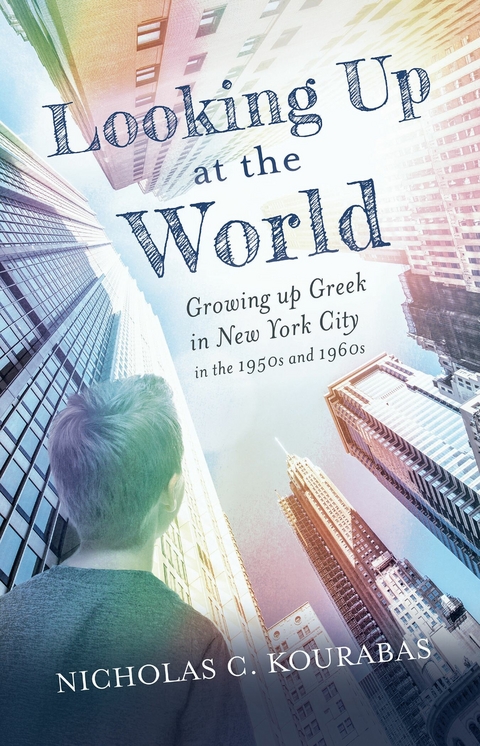
Looking Up at the World (eBook)
248 Seiten
Bookbaby (Verlag)
979-8-3178-0300-1 (ISBN)
Nick Kourabas is a retired high school English teacher and school counselor, whose career in education spanned over four decades. A storyteller for anyone who will listen, Nick believes that every person on the planet has a story to tell and 'Looking Up at the World' is his second book dealing with that story. His first memoir, 'A Teaching Life', published in 2022, told of his professional career. 'Looking Up...' concerns itself with Nick's early life, growing up in New York City. Nick and his wife, Deborah, live in Scituate Massachusetts, in order to be closer to their children, granddaughter and granddogs. Nick is a pretty good bowler, a terrible golfer and loves the seaside living that Scituate has to offer.
A memoir about Nick Kourabas', aka "e;Nicky"e;, first 18 years of life. We follow young Nicky as he ventures from the comfort of his loving family and home into encounters with the larger, sometimes scary, funny and confounding world. Follow him through Greek School, the Greek Orthodox church, playing New York City street games, working in his dad's business, dealing with a sudden hospitalization at almost 10-years-old, and many other events both large and small. Watch as Nick finds his stride as he enters late adolescence. Nick tells of his journey through his sexual awakening and overhearing his uncle talk about who he might become and how to make the most of those experiences. These stories unfold against the backdrop of some major historical events, such as the assassination of JFK and the arrival of The Beatles. Nick battles his own thoughts and prejudices as we watch him learn about the large world before him and eventually reach "e;eye level"e; with it.
Last
The first time I saw a urinal I was five and a half years old. I really don’t know if this is unusual, if it may represent an average age at which a little boy sees his first urinal, or if this is some sign of significant cultural deprivation. I do know this: as a boy, I never went anywhere. My family never went anywhere. Let me say this again, for emphasis. We did not go to any places other than our home. And school or work, if those applied to you and the homes of a few relatives.
We never went out to eat. We didn’t go to the movies. We did not go on vacations. Actually, my mom, dad and I did go to Indianapolis, Indiana, when I was eleven years old. An aberration, believe me. (Anyway, can we call a trip to Indianapolis a vacation in any sense of the word?) We did not go on picnics. Or on walks in the park. Or to the theater, visits to downtown New York City or any other places you can think of. So, I never was in a place, until I was five and a half, where there was a public bathroom and a urinal.
In my apartment, in the Inwood section of Manhattan, we had two bathrooms. They both had regular toilets. Our relatives, Aunt Mandy, Aunt Millie, “Theia” Stavroula, all had regular apartment type bathrooms. (Theia is the Greek name for aunt, by the way.) So did the apartments of all of my friends. Skippy, Buzzy, Buster (1950s nicknames were really interesting), had bathrooms like mine. Since these were the only places that I ever ventured to, with or without my family, I had never been faced with an alternative to the toilet.
I am the youngest of four children. My dad, Chris Kourabas, was born in Kalamata, Greece, and immigrated to the US when he was about twenty years old. He loved telling the story about being in New York for only a matter of days and being assigned to a pushcart to sell snow cones. He was given this task by the network of Greek friends and relatives that preceded him to New York. As he told it, he was given his cart and pretty much turned loose on the mean streets of the Big City. Seeking a clientele, he decided to look for a building which displayed the American flag. He reasoned that such a place would either be a school or a government building and would contain hungry children or adults, seeking the satisfying sweetness of a paper cone filled with shaved ice and topped off by a syrupy sweet concentrate. He was right. He found a school. It was his first taste of survival in the harsh world of New York City.
In fact, he would more than survive. By any measure, my father thrived in his new homeland. He would own businesses, buy real estate and move his family into a beautiful, spacious apartment in Upper Manhattan with views of the Hudson River. I can’t imagine that as a young, poor boy in a small town in Greece, my father would have had the audacity to dream that he would be living such an affluent life in the United States, in its nominal capital city, victorious over whatever forces of economics, prejudice, politics and lack of privilege may have been arrayed against him. No other accomplishment by any other human being has been a greater factor in my life than what my father accomplished in this country, with his life.
My mom’s story was different. She was a first generation Greek-American, born Mary Scholomiti in Butte, Montana. This is not a misprint. Butte. Montana. My mother told stories of how her father would chase away the “Indians” that would camp out in the backyard of their house. Ironic, now that I think of it, that Native Americans were shooed away by a Greek immigrant. Here was this Greek family building a life in this frontier land of promise, while chasing away the people who inhabited that land for many generations. One person’s fortune can be another’s pain and tragedy.
Mom was the eldest of four children. She was followed by a sister (Aunt Mandy) and two brothers. I always thought it was pretty neat, from whenever I was old enough to think about it, that my mother had her children in the same birth order, by gender, as her mother did. Two girls followed by two boys.
Why Butte, you might ask. Nobody really knows for sure, but the running joke in my family was that my grandfather and his brothers were certain that they did not have a diner there yet, so it was fertile economic ground. Lots of workers in the copper mines in and around Butte … they would all need to eat! My grandfather was an angry individual, by many accounts, who was very harsh towards my mother (he once sat on a porcelain doll of my mom’s and crushed it, to punish her for some reason) and eventually left my grandmother flat with their children. In an effort to find stability and support, they moved to New York, to Greece and back to New York. It was not an easy existence, for sure.
As for my parents, you could say that their marriage was arranged. My mother was into the second half of her twenties and still single. My father had graduated from snow cones to the restaurant business and was looking to settle down, I’m sure. My mother’s uncle, Uncle Tom as we all knew him until his death at nearly a hundred years old, fixed up my mom and dad. This was not the first, nor would it be the last time that Uncle Tom brokered a marriage. I don’t know if “family patriarch” was a title he was actively seeking or one that he simply fell into, but it suited him. He took care of his nieces in this way, gave one of his nephews a lifetime job at his flower shop and kept track of his growing family from his perch on Willis Avenue, in the Bronx. He never married. Never fathered any children. A single man who owned a flower shop. I know what you’re thinking. You’re wrong, I think … but who really knows?
Back to my dad. He had even tried a stint in silent films. To this day, one of my sisters has his publicity photo framed in her house. Pretty dashing looking guy. He always lamented, “The talkies killed me,” because the death of silent films exposed my dad’s fairly thick Greek accent. Bad timing. It would probably be an asset today.
How, incidentally, after residing in the US for a scant five years or so, my dad worked his way into acting and filmmaking is an utterly unimaginable achievement. How could he have done this? During this time, he dated a show girl! Her name was Bubbles. Are you kidding me? Who really was this man who was my father? The other interesting note about this episode in my dad’s life was that my mom, so many years later, would tell the story about how Dad dated Bubbles when he was making movies. And she told it with some glee. I guess she was able to separate the fact about my dad having a girlfriend before he met Mom, from the joy she got from telling the story.
The Banana King. This was the one film that my dad appeared in, to the best of our knowledge. I have scoured the internet in the hopes of finding a copy or a clip, but nothing exists. I have gone back and forth, imagining the setting of the film to be concerned with some Caribbean or Central American country or to have been early cinematic pornography. Sadly, no clue.
In any case, Mom and Dad got together, were intimate four times, (no, five … there was a miscarriage), and there was our family that stayed home all the time. Helen, Electra, John and me, in that order. Four years separated Helen from Electra and there were four more between Electra and John. I came six years after John. My mother was forty three years old when I was born. My siblings kindly referred to me as “the mistake.” My parents never disabused me of this notion.
It would be logical, perhaps, to think that a fourth child, born to a couple in what at that time was clearly middle age, would be neglected, forgotten, treated as a nuisance. Well, I did not get tons of attention from my dad. He had entered the bowling business by the time I came along and this was a line of work which ate up his days like a jungle animal that had not eaten a meal in weeks. He was never home. My mother likely lost much of her passion for raising children and although I clearly felt loved, I don’t think that she threw herself into the daily rigors of raising a little boy with quite the necessary verve and energy. In some ways, she tolerated the task.
Nonetheless, every child on the face of the Earth should have had my childhood. My mother, for a number of reasons, turned over much of the daily supervision of me to my two older sisters, Helen and Electra. This was especially true when I was very little and my sisters would come home from school.
My sisters embraced this task with, if not unbridled enthusiasm, enough energy and love to make me feel as special and unique as any child can possibly feel. This was, however, a two-way street. While Helen and Electra were certainly performing a wonderfully altruistic task, I served an important purpose for them. If they needed to get out of the house, avoid other chores or plan furtive rendezvous, I was a convenient excuse.
“Mom, I’m taking Nicky for a walk outside!”
“This is the third time today, Electra!”
“Fresh air is good for him!”
When I was a bit older, around five or six, Helen would take me to Orchard Beach on Saturdays. Orchard Beach is in the Bronx and in those days was notorious for its polluted water. You had to be crazy … or me … to swim in that water. What else was I going to do at the beach? I hated the sand. I still do today. It gets in everything, for crying out loud. I would get...
| Erscheint lt. Verlag | 2.5.2025 |
|---|---|
| Sprache | englisch |
| Themenwelt | Literatur ► Biografien / Erfahrungsberichte |
| ISBN-13 | 979-8-3178-0300-1 / 9798317803001 |
| Informationen gemäß Produktsicherheitsverordnung (GPSR) | |
| Haben Sie eine Frage zum Produkt? |
 EPUB (Ohne DRM)
Größe: 4,7 MB
Digital Rights Management: ohne DRM
Dieses eBook enthält kein DRM oder Kopierschutz. Eine Weitergabe an Dritte ist jedoch rechtlich nicht zulässig, weil Sie beim Kauf nur die Rechte an der persönlichen Nutzung erwerben.
Dateiformat: EPUB (Electronic Publication)
EPUB ist ein offener Standard für eBooks und eignet sich besonders zur Darstellung von Belletristik und Sachbüchern. Der Fließtext wird dynamisch an die Display- und Schriftgröße angepasst. Auch für mobile Lesegeräte ist EPUB daher gut geeignet.
Systemvoraussetzungen:
PC/Mac: Mit einem PC oder Mac können Sie dieses eBook lesen. Sie benötigen dafür die kostenlose Software Adobe Digital Editions.
eReader: Dieses eBook kann mit (fast) allen eBook-Readern gelesen werden. Mit dem amazon-Kindle ist es aber nicht kompatibel.
Smartphone/Tablet: Egal ob Apple oder Android, dieses eBook können Sie lesen. Sie benötigen dafür eine kostenlose App.
Geräteliste und zusätzliche Hinweise
Buying eBooks from abroad
For tax law reasons we can sell eBooks just within Germany and Switzerland. Regrettably we cannot fulfill eBook-orders from other countries.
aus dem Bereich


