


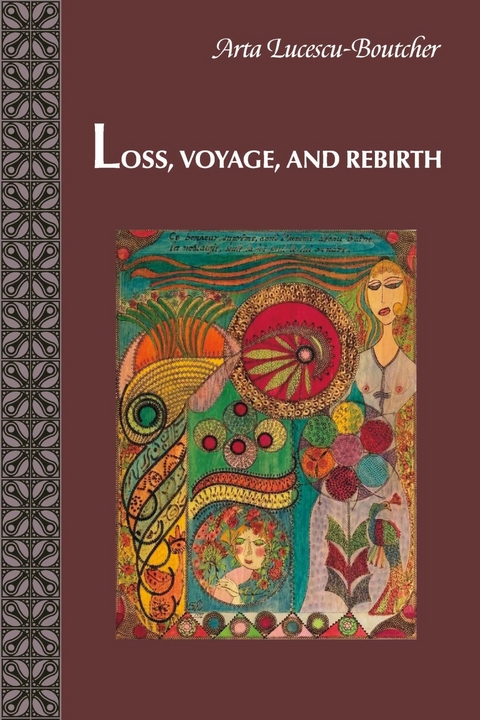
Loss, Voyage, and Rebirth (eBook)
232 Seiten
Bookbaby (Verlag)
979-8-3509-9421-6 (ISBN)
Arta Lucescu-Boutcher is a Romanian born painter and writer who has been living in the United States since 1971. Her book, 'Rediscovering Benjamin Fondane,' has been published by Peter Lang and is available on Amazon. She received her doctoral degree in 20th century French literature from the Graduate School of the City University of New York and her Master's degree in Spanish literature from Middlebury College and is now a retired professor of French. Many of her paintings have been on exhibit in galleries located in New York and New Jersey. She continues to write and paint while enjoying her time with her daughter, Emmadora, in Vermont and her husband, Jerry, a retired German and English teacher.
This memoir presents the author's life from her beginnings in Romania during the Ceausescu regime where she grew up and lived until the age of 14. She lost contact with her family and friends when she emigrated to Paris, France, together with her mother, Sofia, in 1970. After her stay in Paris where she learned French and became fond of French culture, Arta and her mother continued their voyage to New York where they reunited with her mother's sister and her family. Loss of identity and culture shock were to follow as they adapted little by little to life in the United States. Her mother remarried and Oliver, her brother, was born in 1971. School was an important anchor for Arta who obtained her Bachelor degree from Stony Brook University, a Master's degrees from Montclair State University and a doctorate from the Graduate School of the City University of New York. The rebirth she paints in her book happens in her professional life and her personal life when she marries and has one child, Emmadora. All along the many challenges of her life, Arta emphasizes the very special bond she had with her mother who guided her and supported her along the many transitions and transformations. They bonded spiritually and intellectually in many ways both engaged in producing unique art such as this books illustrates. And all was possible because of the financial support of Michael Ionita, Sofia's husband, and adoptive father, and Arta's husband, Jerry.
Chapter I:
In Romania
Part I : The Early years in Romania
I don’t know when I first became aware of her name. To me she was just Mamica at all times. Dark, with olive skin, a sign of her Greek origin although we were all born in Romania, she had beautiful brown eyes that looked deep into yours searching for the real you. I learned to trust those eyes no matter what, and I could never lie to them. Voice, strong and melodious with a laughter that could shake all the sadness out of you. Smile, real and wide that came from the depths of her being.
My earliest memories place me in the park in Oradea, in 1961, when I was just five years old. Oradea is a city in northwestern Romania not far from the Hungarian border. My mother had been hired there to work as an actress in the local theater. On sunny days, we went to the park which was right across the apartment building where we lived. We sat on a bench watching birds chirp all around us and we fed them bread crumbs so that they would come closer to us.
“I want to hold one in my hand!” I told my mother as I slipped off the bench and ran after the little sparrows.
“They need freedom in order to fly,” my mother replied. It wasn’t until much later in life that I understood the meaning and need for freedom.
At home I danced for my mother the minute she played a record with classical music. I loved ballet and dreamt of becoming a ballerina but most of all, I loved the applause I received at the end; after all, I had watched my mother play “Puck” in Shakespeare’s Midsummer Night’s Dream where she danced a lot and received much applause. During those wonderful days, Mamica applauded after my dancing and then picked me up joyfully in her arms whispering in my ear:
“I am your life, and you are my life!” I repeated after her:
“I am your life, and you are my life…”
When Mamica remarried, life became a little more complicated. My stepfather, Victor Cupsa, thought that I was too spoiled, especially when I wanted to sleep next to Mamica every night. Also he thought that I was old enough to run errands.
“She can go to the corner tobacco store and buy a pack of cigarettes,” Victor told my mother.
“Artuta mea? My little Arta? But she is only five years old! I guess she can do it, but only after we teach her the way,” replied my mother. Then they both walked to the corner store with me for cigarettes. The next day I was ready to do the errand on my own; the hard part was that I had to cross the street, something that I feared greatly. I looked intensely at the light and made sure that it was green ; I crossed the street along with some nice lady so that I could step aside an adult. The rest was easy.
“May I have a pack of cigarettes?” I asked the salesperson, while handing her the money.
“What kind?” she asked, showing me the different packets with the various pictures on them.
“That one!” I said, pointing to the packet of Snagov which I recognized because it had mountains as the background. Those were the days when all I wanted was to please my mother and my new father.
“Mom, how come I can have two fathers?” I asked my mother one day.
“No, your real father will always be Mircea, but you now have a second father because I am married a second time to Victor,” explained my mother. It was all too confusing for me, but I trusted that Mamica knew what she was doing. Victor was thin with a dark complexion and piercing dark eyes; I enjoyed talking to him because he always made me think a little deeper.
“Why can’t Mamica read me stories tonight?” I asked Victor one evening at bedtime.
“Maybe your mother is just too tired tonight after the rehearsals she attended all day,” said Victor as he tucking me into bed. I had never thought about my mother having limited energy; she was all powerful like a Goddess in my eyes.
Most of all, I loved watching Victor paint in our living room, where he had installed his studio. And I watched him for hours because the colors were so enchanting that I could not take my eyes off of his canvases. With delicate brush strokes, magic was happening right before my eyes. I set my doll aside, gave her a kiss, and then sat cross legged on the floor behind Victor watching and asking questions.
“What are you going to paint now?” I inquired.
“Now I am going to paint the background but I really don’t like to be interrupted while I paint. You can watch but please don’t talk!” That was very hard to do because I had a million questions I wanted to ask him. How could he mix two colors and create such mesmerizing blues or yellows? Why did he place the sun to the right rather than the left of the painting? Who was the lady in the painting?
One day, Victor decided that I could be his model and asked me if I would sit for him on a chair holding a red balloon. I agreed to it but I soon realized that this was not as much fun as watching him paint. For one thing, I could not see anything from where I was modeling and I could not do anything but wait, wait for what seemed like an eternity. In the end it was all worth it because there I was holding my red balloon on this freshly new painting with his magic colors. The little girl looked just like me although I thought that her face was too serious. The painting was exhibited and I was glad to see it hanging together with all his other worthwhile works of art. Finally someone bought it and I never saw it again.
From time to time, I got to visit with Mircea, my biological father who lived in Bucharest. I loved my dad: he was so handsome that even a little five-year-old girl like me could recognize that there stood Zeus, and not some ordinary human being with amazing green eyes. I loved placing my hand through his thick black hair while giving him a kiss on the cheek because he smelled so good. The scent lingered even in the bathroom and I sat there a little longer than necessary to breathe in the perfumed air.
“Let’s read Pif,” he said when we were getting ready for bed. He read me stories from this French magazine for children and although the language was foreign to me, I could understand almost everything due to the cartoons. Pif was a sweet little dog looking like a beagle and he had a son named Pifou. There were numerous adventures we followed, page by page, every time I visited with my dad. Once in a while, he stopped and laughed a quiet laugh enchanted also by the drawings.
My dad was a symphony conductor who then worked for the Operetta in Bucharest. There I listened to many of his concerts, sitting in the front row, and imitating him with an imaginary baton during the performance. People sitting next to me guessed that I was his daughter and then asked me questions I was happy to answer. I told them that, one day, I too would become a symphony conductor.
Soon after Mamica divorced my father due to his infidelities, something she explained to me much later in life, we moved to Oradea. She worked late nights as an actress and was overwhelmed by her many responsibilities as a single mother. That is why she decided to place me in a sleepover nursery school. I would come home on weekends but, during the week, I would live together with other children in a beautiful environment, outside of the city of Oradea where fresh air was guaranteed. And there was a nice playground with swings, my favorite entertainment. So when we arrived, she took me to the swings explaining how wonderful this place would be for me. I didn’t understand anything, most of all I didn’t comprehend why I had to part with her even if she was going to fetch me on weekends. So I grabbed my mom by the hand and I did not let go.
“Mamico, I don’t want to stay here, please take me home…” I sobbed. Suddenly, nothing interested me, not even the swings.
“It will be all right,” she explained while she kissed and embraced me. And then she left. I couldn’t believe it. It felt like she was gone forever. I had no interest in meeting other kids or going inside the building with the caregiver who was holding my hand. That night I cried myself to sleep in my bed, next to two other little beds with children who knew better than to cry for their mothers. The next morning, it wasn’t any better. I did not want to play or talk to anyone. I just wanted my mother. So days went by, one by one, while my despair grew deeper and darker. I just wanted to go home and nothing amused me, not even the trip to the local orchard where fall was in its glory with trees more beautiful than I had ever seen before. I carried a large dose of sadness that would not go away, no matter what anybody said or did for me.
One morning, a month later, when we were having our breakfast, we were warned not to touch the cereal that was left behind by one of the boys because he was sick. A group of children were invited to visit with him in the infirmary and I went along with them.
“What happened to you?” I asked little Andrei, who was lying still in his hospital bed. He slowly raised his head, smiled at us, and in a feeble voice answered:
“I’m sick but I’m not sorry because I’m going home and my mom is going to pick me up any minute now…”
“Oh, lucky you,” I said, suddenly filled with envy. I finally saw a way out of my misery: I too wanted to go home, so the next morning, I ate the rest of the cereal leftovers from Andrei, who had sat next to me in the cafeteria, while waiting for his parents to...
| Erscheint lt. Verlag | 30.4.2025 |
|---|---|
| Sprache | englisch |
| Themenwelt | Literatur ► Biografien / Erfahrungsberichte |
| ISBN-13 | 979-8-3509-9421-6 / 9798350994216 |
| Informationen gemäß Produktsicherheitsverordnung (GPSR) | |
| Haben Sie eine Frage zum Produkt? |
 EPUB (Ohne DRM)
Größe: 9,7 MB
Digital Rights Management: ohne DRM
Dieses eBook enthält kein DRM oder Kopierschutz. Eine Weitergabe an Dritte ist jedoch rechtlich nicht zulässig, weil Sie beim Kauf nur die Rechte an der persönlichen Nutzung erwerben.
Dateiformat: EPUB (Electronic Publication)
EPUB ist ein offener Standard für eBooks und eignet sich besonders zur Darstellung von Belletristik und Sachbüchern. Der Fließtext wird dynamisch an die Display- und Schriftgröße angepasst. Auch für mobile Lesegeräte ist EPUB daher gut geeignet.
Systemvoraussetzungen:
PC/Mac: Mit einem PC oder Mac können Sie dieses eBook lesen. Sie benötigen dafür die kostenlose Software Adobe Digital Editions.
eReader: Dieses eBook kann mit (fast) allen eBook-Readern gelesen werden. Mit dem amazon-Kindle ist es aber nicht kompatibel.
Smartphone/Tablet: Egal ob Apple oder Android, dieses eBook können Sie lesen. Sie benötigen dafür eine kostenlose App.
Geräteliste und zusätzliche Hinweise
Buying eBooks from abroad
For tax law reasons we can sell eBooks just within Germany and Switzerland. Regrettably we cannot fulfill eBook-orders from other countries.
aus dem Bereich


