


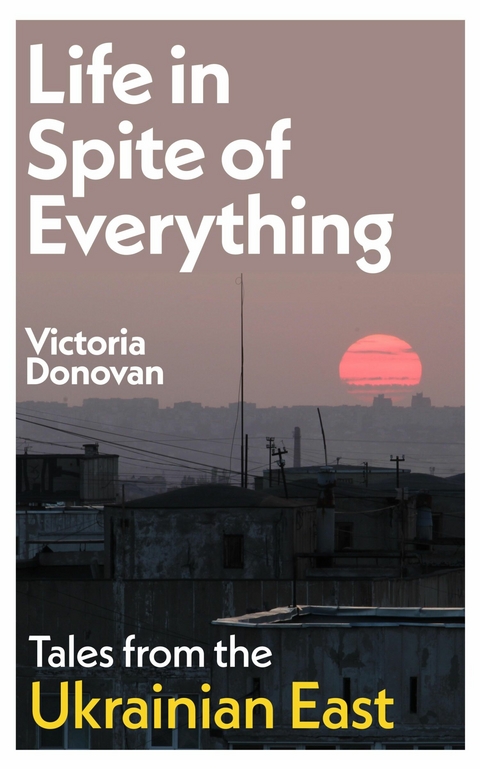
Life In Spite of Everything (eBook)
308 Seiten
Daunt Books (Verlag)
978-1-917092-15-9 (ISBN)
Victoria Donovan is Professor of Ukrainian and East European Studies and Director of the Centre for Global Postsocialisms, Southeast, Central and East European Studies at the University of St Andrews.
A cultural portrait of the Ukrainian east, and an urgent, essential read. Since the start of Russia's war against Ukraine in 2014, its eastern region Donbas has been synonymous with conflict. With the escalation of that war in 2022, its cities such as Bakhmut and Lysychansk have become familiar to us through the images and reports of brutal devastation. Victoria Donovan excavates a rich, multicultural history of this area, and paints a radically different picture. Travelling from the dramatic, jagged peaks of Bilokuzmynivka to the marshland of Mariupol, from a warehouse rave to an abandoned gypsum mine, the physical world and its importance to this region's identity is brought to vivid life. But above all else, by speaking to those whose lives are embedded there now curators, artists, railway workers, young people who have grown up amidst instability and destruction Donovan amplifies local voices and reveals the intensely personal lived reality of Putin's war. Revelatory, evocative and deeply humane, Life In Spite of Everything is a celebration of a country's past and present, and its people's tenacity, creativity and independence.
I first visited the Ukrainian east, often referred to as Donbas, in the summer of 2019. I was travelling to the chemical-making city of Sievierodonetsk for a summer school that I’d helped to organise, and was taking the overnight train from Kyiv to the nearest railway station in the east in Lysychansk. On boarding the train, I found that I was sharing a cabin with two women from what was already terrorist-occupied Luhansk. The women insisted that I have a glass of the brandy they’d brought along for the journey. They’d had a couple of drinks already and talked loudly over each other for my benefit about how good life was in the occupied zone. ‘There are traffic jams everywhere,’ one told me, painting the city as a populated and thriving urban metropolis, ‘the cinemas are full every night.’ I excused myself after a while and went down the train in search of my friend Dima, whose family had been displaced from Luhansk five years earlier, when Russian military and fighting groups had invaded the region. Dima listened to my anecdote about the tipsy women in silence. Then he told me that he sometimes dreamed of his family home in the occupied city, and of the now surely overgrown basketball hoop in his backyard, where he had played as a child.
When I woke the next morning, the skyline, visible through the crack in the blind, was distinctively flat. I went out into the corridor, where Dima and a couple of others in our party were already up, to get a better view of the steppe landscape. The region’s iconic coal slag heaps, known as terykony in Ukrainian, from the French terricones, whizzed regularly past the window. I asked Dima if he’d ever climbed any of these industrial pyramids. ‘Of course,’ he answered, ‘everybody who grew up here has. We can climb one together if you like.’ I would climb my first terykon in Myrnohrad two years later in July 2021. On the outskirts of this coal-mining ‘monotown’ (a single-industry settlement of around 50,000 people), I scrambled up the side of a slag heap behind Dima, gripping branches of trees as the shale slipped underfoot. At the top a picturesque view greeted us: a low slice of ebbing sunlight at the horizon, punctuated by more terykony and warm yellow streetlamps. At that same moment, Russia was massing thousands of troops and military equipment on the border with Ukraine. Six months later, they would invade and the region would be engulfed by the devastating war that remains ongoing at the time of writing.
People have written about how war erases not only buildings and infrastructures, but a sense of self and professional identity as well.1 As a researcher who writes about Ukraine but has no family in the country, I am undoubtedly at the outer limit of this war’s emotional orbit, yet nonetheless also experienced a sense of erasure. When Russia invaded, I was in the middle of writing a very different book to this one, about the region known as Donbas, a heavily industrialised and, since 2014, war-impacted part of the Ukrainian east. The book was a more conventional history, written in a detached academic voice, which I’d tried to keep untainted by my feelings of anger and injustice about the structural violences that had caused so much human and environmental suffering to this place and other resource-rich regions like it. The book lingers unfinished in a folder on my desktop. Since Russia launched its full-scale war, I haven’t been able to access that detached academic voice to finish it off. Instead, the anger and sadness has poured over onto the pages of my writing. This angry, sad history of Donbas is what you hold in your hands now. It is, it seems, the only story that I am able to write.
My research on Donbas began in my hometown of Cardiff back in 2015. I had been pondering for some time the strange parallels between Wales and Ukraine – the regionalised industrialisation, language politics, and culturally dominant eastern neighbour – and had been lightly googling this topic when I came upon the Hughesovka Research Archive, housed within the city’s Glamorgan Archives. This collection documents a chapter in Wales’s history about which I then had no idea. It records the migration in the late nineteenth century of hundreds of Welsh miners, engineers, and chemists to a newly founded settlement in what is now Donbas called Hughesovka (named after John Hughes, an industrial entrepreneur from Merthyr Tydfil), then part of the Russian Empire. The Welsh labour migrants stayed in Hughesovka until 1917, when, following the Bolshevik Revolution, the mines they owned and managed were nationalised and they were thrown out of the communist state. Hughesovka became Stalino, named in honour of the dictatorial architect of Soviet industrialisation, before in 1961 being rebranded as Donetsk. Today Donetsk is the capital of the unrecognised ‘People’s Republic of Donetsk’, an illegal, Russian-manufactured territorial entity responsible for many atrocities in Ukraine since the outbreak of war in 2014.
Through the story of John Hughes and the Welsh migrants to Donetsk, I began to dig deeper into the history of Donbas. I discovered the pre-industrial life of the region through the writings of Soviet palaeobotanists, studying their pencil sketches of gigantic tropical plants and swamps to glimpse long-gone vegetal environments that formed the perfect stew to produce coal millions of years later. I studied the maps of industrial geologists, following their delicate swathes of pastel pinks and yellows to learn where the seams of Cretaceous-era limestone, Permian-era gypsum, and (the most sought-after mineral of all) Carboniferous coal shale were distributed across the territory. From the ideologically inflected corpus of Soviet-era industrial historiography, I gleaned insights into the cults of industry that emerged in different parts of this region. I learned about the ‘Stakhanovites’ who had broken records with their labour, overfulfilling their quotas for mining coal, casting iron, or pouring steel. Drawing on these sources, I constructed a mental map of the region, populated with all the places that I wanted to see and visit: the salt flats of Sloviansk, the coal seams of Lysychansk, the sprawling steelworks of coastal Mariupol.
From 2019, I began to visit the Ukrainian east at least once or twice a year. Led by local historians, geologists, and cave explorers, I discovered the region’s overground and subterranean realities, learning first-hand about the places that until then I had only read about in books. In Ivanhrad, I walked the labyrinthine tunnels of the Donetsk region’s abandoned gypsum mines. A hundred and eighty metres below the ground in Soledar, I encountered a chilled and sparkling world of hollowed-out salt deposits. The resourceful miners leading our excursion there had developed tourist offerings when the market for salt crashed after 2014. On the front line of the fighting in Toretsk, I joined a tour of Donbas’s oldest working coal mine. At the top of the decrepit headframe (the encased triangular metal structure that sits above a mine), where huge winches had pulled the half-dressed miners from the depths below, the director warned us not to go outside, since Russian-backed fighting groups still fired across the border. All these places, so rich in history and heritage, now trapped under Russian occupation, their residents displaced, their industries destroyed.
‘What exactly is Donbas?’ This is a question that gets posed again and again in the Soviet-era history textbooks that I’ve been using for my research. These works, being Soviet teaching resources, are mostly written in the colonial Russian. In Russian the question looks like this: Что такое Донбасс? And sounds like this: Chto takoe Donbass? If I had to convey the intonation of this phrase it would be: What exactly is Donbas? In that ‘is’ there is the suggestion of doubt, of something that needs to be cleared up. I’ve been thinking a lot about this ‘What exactly is’ question, about when and in what contexts it gets asked. You’d never find it asked about the West Highlands, for example, or Bavaria; everyone, it’s assumed, knows exactly what those places are. Why, then, have historians and writers been so preoccupied with the existential meaning of this place? Why were they so keen to answer this question? Why is this question still being asked so insistently today?
The short answer is colonialism. Donbas, a region that has historically been located at the intersection of different empires, has been the focus of multiple colonisation campaigns and with them, many efforts to re-categorise and rebrand. Donbas, before it was known as Donbas, was assigned many other politically instrumentalising names. From the sixteenth century it was known as part of the ‘Wild Field’, a name that, like the ‘Wild West’, suggested a place waiting to be ‘civilised’ through colonisation; for a short time in the eighteenth century the Russian Empire rebranded it as...
| Erscheint lt. Verlag | 24.4.2025 |
|---|---|
| Verlagsort | London |
| Sprache | englisch |
| Themenwelt | Literatur ► Biografien / Erfahrungsberichte |
| Literatur ► Essays / Feuilleton | |
| Schlagworte | black-and-white integrated images • Black Earth City • Charlotte Hobson • Conflict in Ukraine • engaging writing • Hardback • In Black Earth • Jess Mühling • nuanced • sense of place • Sophy Roberts • The Lost Pianos of Siberia |
| ISBN-10 | 1-917092-15-6 / 1917092156 |
| ISBN-13 | 978-1-917092-15-9 / 9781917092159 |
| Informationen gemäß Produktsicherheitsverordnung (GPSR) | |
| Haben Sie eine Frage zum Produkt? |
 EPUB (Adobe DRM)
Kopierschutz: Adobe-DRM
Adobe-DRM ist ein Kopierschutz, der das eBook vor Mißbrauch schützen soll. Dabei wird das eBook bereits beim Download auf Ihre persönliche Adobe-ID autorisiert. Lesen können Sie das eBook dann nur auf den Geräten, welche ebenfalls auf Ihre Adobe-ID registriert sind.
Details zum Adobe-DRM
Dateiformat: EPUB (Electronic Publication)
EPUB ist ein offener Standard für eBooks und eignet sich besonders zur Darstellung von Belletristik und Sachbüchern. Der Fließtext wird dynamisch an die Display- und Schriftgröße angepasst. Auch für mobile Lesegeräte ist EPUB daher gut geeignet.
Systemvoraussetzungen:
PC/Mac: Mit einem PC oder Mac können Sie dieses eBook lesen. Sie benötigen eine
eReader: Dieses eBook kann mit (fast) allen eBook-Readern gelesen werden. Mit dem amazon-Kindle ist es aber nicht kompatibel.
Smartphone/Tablet: Egal ob Apple oder Android, dieses eBook können Sie lesen. Sie benötigen eine
Geräteliste und zusätzliche Hinweise
Buying eBooks from abroad
For tax law reasons we can sell eBooks just within Germany and Switzerland. Regrettably we cannot fulfill eBook-orders from other countries.
aus dem Bereich


