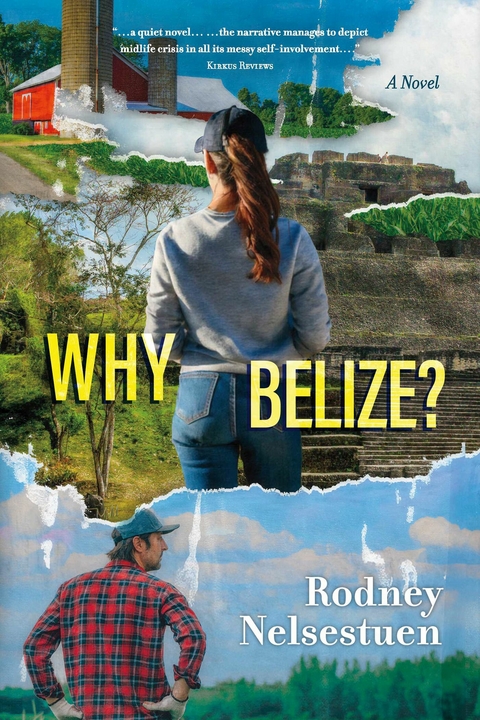
Why Belize? (eBook)
216 Seiten
Bookbaby (Verlag)
979-8-3509-9480-3 (ISBN)
Rodney Nelsestuen is a Minneapolis-based author who has published more than a dozen works of both fiction and nonfiction across a variety of literary journals. Nelsestuen has served as a judge in several writing contests including the Minnesota Book Awards, the Pacific Northwest Writers' Association, and the national Eric Hoffer Award. In addition, his writing has won or been honored in a number of literary contests. Nelsestuen has published four novels, the latest of which 'Why Belize?' has been recognized by Kirkus Reviews as a 'thoughtful, quiet meditation on aging.'
Elieen Sologoski is overwhelmed by life's disappointments: a distant husband, a tyrannical father-in-law, and life on a bleak rural homestead. Seeking escape and a reset, she flees to Belize, leaving behind everything-her job, her husband, two children, and even her name. When her in-laws arrive unexpectedly in Belize City on a cruise ship, the newly christened Lennie is forced to confront the choices she has made, and the things she has left behind; as well as what it would take for her to return home. Meanwhile, her ex-husband James has determined to free himself from his domineering father and set course toward a destiny all his own. With his resolution comes a measure of hope both for him and maybe even Eileen. "e;Why Belize?"e; considers the human condition in how we assess the lives we live, the disappointments we suffer, and asks what else there may be. What possibilities are there for a new beginning, and when is the time to seize it?
Life at its Edges
The evening sun hung low against the western sky as Lennie wove through the streets from the docks back to the bungalow. Here and there snatches of light flashed in her face between the flat-angled roofs of the houses she passed. The light felt good until she remembered how her tan, something she’d once sought to deepen, had grown leathery and added years to her face. The dark glasses hung from the string around her neck and bounced against her chest as she slowly made her way. Tonight she was unusually tired and couldn’t muster her normal gait even though walking slowly put her in the type of contemplative mood that could dredge up the past.
As an independent guide, Lennie found herself working the edges of the economy, the tour guide equivalent of a street vendor. Most of the independent taxi drivers knew her and would often team up on spur-of-the-moment tours since Lennie held the familiarity of the American middle class while they were unknown, untrusted on their own.
Most days she had no tours at all, with two a week being a good run. She’d made contacts through Tog at the Princess Hotel that resulted in periodic work. The afternoon group of four had been on her schedule for nearly a month. Then, yesterday she’d been asked by the Belizean Travel Agency to help Felicia with a morning busload of tourists. The agency likely started down its list of guides before Felicia asked for Lennie. But it was the peak of tourist season and extra guides with both knowledge of Mayan history and the capacity for compelling narrative were scarce. Lennie had just enough of the former and had developed an uncanny skill at the latter. The tour guides most in demand were at least part Mayan. Mestizos could pass and even Garifuna, the dark-skinned cross between Indians and the descendents of African slaves, were preferred over whites. But Lennie only assisted Felicia and the tour group itself was American.
“Awright,” Herrmann DeLangen had said, “you’re exotic enough for this busload of Kansans, Lennie.” He grinned that patronizing grin and patted her on the lower back like he always did, dangerously close to her buttocks.
She didn’t like Herrmann. He dripped his own form of lechery whenever he found himself around a woman he thought attractive. Still, she tried to make joyful greeting every time he hailed her since she knew his power. Besides owning one of the most popular pubs in the city, Herrmann’s ex-wife was the sister of Belize’s head of Tourism. Even after she caught him with another woman, his brother-in-law kept Herrmann on the payroll since the money assured his sister’s alimony.
Eduardo had said that the day Herrmann decided he didn’t like her she’d be through leading tours. Other libras, as guides like Lennie were known, had met this fate at Herrmann’s hands. “They were swept from the very earth, Lennie,” Eduardo had said. So she’d cultivated unspoken boundaries with Herrmann and had drawn the line at his giant, fat hands, gold and diamond rings on almost every finger, patting the top of her tailbone. Sometimes he’d bend close to her face and flash gray, ill cared-for teeth well within the limits of her personal space. She’d find herself gritting a breathless grin against the smell of damp cigar until gaining a foot’s distance. Kita once told her to slap him.
Herrmann had been in Belize for fifteen years after leaving Australia. It was rumored he boarded a boat the day he left prison. He opened a bar and restaurant named The Oyster Woman, a favorite of tour groups because of its walk-in humidor more than its food. The humidor was as big as Eduardo’s entire house and boasted, on a hand-written sign at the door: More than ten thousand Cuban cigars.
Herrmann had made a fortune – albeit merely a Belizean fortune – but had been careful to diversify his interests, certain the U.S. would some day lift its embargo on Cuba and destroy the cigar business.
That his background was of some question wasn’t unusual. Many of European descent were people with some mystery or myth surrounding them. Lennie would weave a bit of intrigue into her narrative about Belize, giving color to an otherwise quiet, unassuming place that history and the world had largely forgotten. It wasn’t as if there was no intrigue at all, though. Belize was in constant dispute with Guatemala over its independence. With the rest of the western world supporting that independence, there was no real threat beyond political rhetoric.
Belize was a haven for Guatemalan squatters. Lennie often saw them trying to make their way, half hidden by the weeds along the roadsides where the vacant eyes of near destitute children followed each passing car with suspicion and hope mixed in the same stare. They were often driven back by La Guardia, the nation’s combined army and police force
The country had also become a thoroughfare for the South American drug trade, especially cocaine. This happened in part because it had less of an international light on it since it ceased being British Honduras in the early nineteen eighties. Independence had also taken away the international presence that at one time had policed what came and went from the tiny nation.
Lennie had even led a few questionable characters on tours. She usually chatted up the tourists but made it a point not to seek out those she expected of other business. Most of the time their kind liked to blend in with the cruise ship tours to avoid drawing attention. At least twice she’d led small but suspicious groups that Herrmann himself had brought her. One was an obvious ruse of a family. She’d worried about the children who traveled with the patriarch, slick and nervous at the same time, and his “wife,” too young and terse to be the mother of what appeared to be twelve year old boys. Eduardo had told her to report them as being suspicious. But when she saw how quickly his face paled when she asked him to go with her, she declined. It still bothered her although, with no money left, she had to take on all paying customers, not to mention keeping Herrmann’s good will.
During her divorce proceedings, she learned that she and her husband owned nothing. Edgar Sologoski and his wife, Wilma, owned the farm, the cattle, the machinery, the entire Michigan operation while their son – her husband James – was little more than a hired man. They’d talked for nearly twenty years of how James was “building equity” as the farm’s eventual owner. But nothing was ever committed in writing and when it came to the divorce settlement, James’ sole possession was a six year old pickup truck. Her lawyer told her it was an all-too familiar situation in the Thumb, that no ownership plan really existed except in the minds of the heirs. She had hoped the judge would find a verbal contract existed. But he didn’t.
Neither she nor James would likely have discovered this if she hadn’t filed for divorce. Once she had the list of marital assets, though, it struck her how naïve they both were, thinking that Edgar would follow through on his word without some sort of paper trail, a contract, something to document what they’d been working for. Here they were, she in her forties and James nearly fifty and neither of them really understood the rudiments of business. Of course they knew about contracts. She had one as a teacher. They had bought things for the house on contract. But when it came to the farm, their future largest asset, she and James were nothing more than blank sheets of paper. And fools.
It went beyond the last straw. The last straw, she had once thought, came after many years of slowly letting it sink in that Edgar wasn’t just a hard businessman. He was cruel. Lennie tried to get James to take a month off in the summers. She had the time and the boys, who had just finished high school, were old enough to be left on their own, especially with their grand parents around to dote on them. In nearly twenty years they’d never taken more than a long weekend away from the farm. Lennie wanted to take a driving tour. She’d mapped out the whole route – southwest on I-69, straight into Indiana, Illinois, on to St. Louis and then west to the Grand Canyon, north to Wyoming, Utah and Montana and back east toward Michigan. She’d found no less than twelve national parks and monuments they could visit.
But it wasn’t just a vacation. It was meant to get the two of them back in touch, to feel that deep-to-the-core connection they once had. In the early years she felt linked with James at the very center of their being, the rope that bound them thickening in the hours of endless quiet evenings together. By the time she left him she chided herself for having thought he was the strong, silent type when all she’d ever witnessed was the silent part.
She began thinking about the longer trip after they got back from an anniversary weekend in Toronto. During those three days she stood back from the rush of daily life and came to see they had little in common any more. The only topics they could muster were the about boys and farm work. Once the boys were grown she and James would be lost together – or worse, lost separately. In Canada she’d tried to tell him about the need to feel his heart inside of hers again. But she couldn’t say exactly that because he couldn’t think in...
| Erscheint lt. Verlag | 10.6.2025 |
|---|---|
| Sprache | englisch |
| Themenwelt | Literatur ► Romane / Erzählungen |
| ISBN-13 | 979-8-3509-9480-3 / 9798350994803 |
| Informationen gemäß Produktsicherheitsverordnung (GPSR) | |
| Haben Sie eine Frage zum Produkt? |
 EPUB (Ohne DRM)
Größe: 7,9 MB
Digital Rights Management: ohne DRM
Dieses eBook enthält kein DRM oder Kopierschutz. Eine Weitergabe an Dritte ist jedoch rechtlich nicht zulässig, weil Sie beim Kauf nur die Rechte an der persönlichen Nutzung erwerben.
Dateiformat: EPUB (Electronic Publication)
EPUB ist ein offener Standard für eBooks und eignet sich besonders zur Darstellung von Belletristik und Sachbüchern. Der Fließtext wird dynamisch an die Display- und Schriftgröße angepasst. Auch für mobile Lesegeräte ist EPUB daher gut geeignet.
Systemvoraussetzungen:
PC/Mac: Mit einem PC oder Mac können Sie dieses eBook lesen. Sie benötigen dafür die kostenlose Software Adobe Digital Editions.
eReader: Dieses eBook kann mit (fast) allen eBook-Readern gelesen werden. Mit dem amazon-Kindle ist es aber nicht kompatibel.
Smartphone/Tablet: Egal ob Apple oder Android, dieses eBook können Sie lesen. Sie benötigen dafür eine kostenlose App.
Geräteliste und zusätzliche Hinweise
Buying eBooks from abroad
For tax law reasons we can sell eBooks just within Germany and Switzerland. Regrettably we cannot fulfill eBook-orders from other countries.
aus dem Bereich