


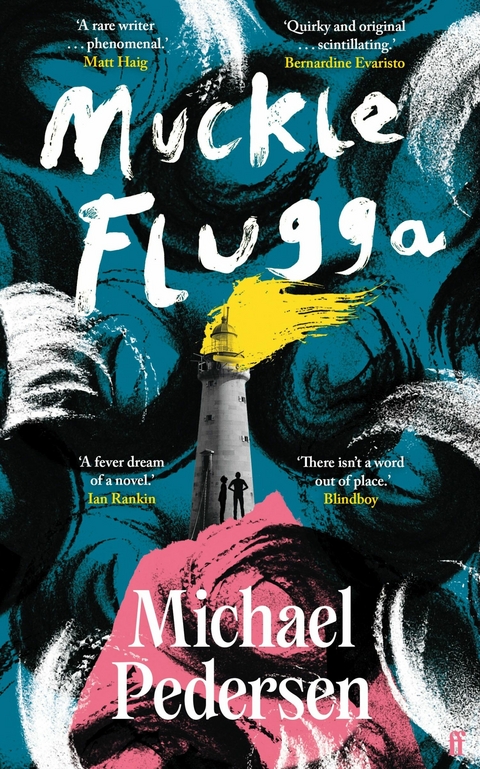
Muckle Flugga (eBook)
256 Seiten
Faber & Faber (Verlag)
978-0-571-38776-2 (ISBN)
Michael Pedersen is a prize-winning poet and author of Boy Friends, which was a Sunday Times Critics Choice and shortlisted for the Saltire Scottish National Book Awards. He was awarded a Robert Louis Stevenson Fellowship and is the current Writer in Residence at the University of Edinburgh, and Edinburgh's Makar (Poet Laureate).
AN OBSERVER BOOK OF THE YEARSHORTLISTED FOR THE SALTIRES FICTION BOOK OF THE YEAR'A kaleidoscopic and linguistically daring work . . . Scintillating.' OCEAN VUONG'A quirky and original debut that sizzles with scintillating prose.' BERNARDINE EVARISTO'Michael Pedersen is a rare writer of real passion and power and this debut is phenomenal.' MATT HAIGLife on a remote island is turned upside down by a stranger's arrival, testing bonds of family and tradition and leaving a young dreamer's future hanging in the balance. It's no ordinary existence on the rugged isle of Muckle Flugga. The elements run riot and the very rocks that shape the place begin to shift under their influence. The only human inhabitants are the lighthouse keeper, known as The Father, and his otherworldly son, Ouse. Them, and the occasional lodger to keep the wolf from the door. When one of those lodgers - Firth, a chaotic writer - arrives from Edinburgh, the limits of the world the keeper and his son cling to begin to crumble. A tug of war ensues between Firth and the lighthouse keeper for Ouse's affections - and his future. As old and new ways collide, and life-changing decisions loom, what will the tides leave standing in their wake?
He won’t miss being alive, Firth concedes. It would be an audacity to mourn something he never made the most of. Particularly as he’s thrashing out these thoughts hanging off the side of a metal monster – Fort Eidyn Rail Bridge. Having trudged along the tracks, full of gin, wet with woe, he barely even notices the tears now, streaming though they are.
He’s never doubted his conviction to jump: to keep something as unrelenting at bay as the will to die is a conquest beyond his resolve. That clawing, grating part of him too stubborn to give up its grip would eventually relent.
It’s not not terrifying. It’s everything he knew it would be, everything it was before, the last time he tried: foul winds, snarling ocean, massive boats tossed around like toys beneath him. The drop is bone-chilling, the sea petrifying, the tiny North Star Light Tower below offers little reassurance of safety. He takes solace in knowing that, for a second, its fickle beam will light his weightless body in a moment of unstoppable descent.
The lights of Edinburgh tremble pitifully in the distance. The entire city of Auld Reekie is clinging on for dear life, hanging off hills, cliffs and old volcanoes; even the bravest are buckling. Everything starts at the top and slopes downwards. It’s no wonder so many of its denizens end up mulching in the gutters: the city was designed this way.
Being born beneath a fish-wives’ gutting table on Leith Docks had two strident effects on Firth: he’ll always be as terrified of water as he is enthralled by it and he’ll never shake the reek of fish guts (in truth, he never wanted to). Though he left Leith while still a laddie and has since beguiled many of the New Town glitterati into thinking he could afford his seat at their table, the sham had always rested on a shoogly peg. What else could he do – dream wee, drink drams and stay low? Naw. Absolutely not, there is nothing worse than settling for a meagre lot. That was his dad’s mentality, not his, and look where it got the old man, poor wretch. Then again, look where this hullabaloo has got him.
For the briefest of moments, life had been as spectacular as blue sunsets over Mars. Now, on a good day, it resembles cheap hotel art, hung squint, above the bacon tray of the breakfast buffet. His was a life spent waiting for the next thing, plundering from the present any chance of happiness. He was not a real writer, not mordant, not cryptic, not even clever, not really – all bile and blather; damn emotion thief, cheating the reader: reader-cheater-cheap-trickster-fool. Faking the unfakeable, that’s all he’d worked out how to do: fudge it, smoke and mirror it; flog the old horse far as it would go then sell it for meat. Damn dilettante – didn’t even know what that meant until he was called it; took it as flattery at first.
It’s clear now, the future is a vision of a pussing wound. What a waste of a brain. Drugs: too many. Booze: too much. Compassion: not nearly enough. His best had been a leaky tap that eventually filled the glass whilst nobody was looking, so he offered it up to the thirsty like the gift of first water. Better fish feed, better compost, better make room for more worms. Good, gorgeous, wiggly worms whose value to this planet is ten times his own.
Who’s going to miss him, really? After the obligatory platitudes, who wouldn’t be better off for his absence? It’s his mediocre achievements that make him tolerable, and those are hyper-inflated or outright frauds. Besides, there might be something more, something numinous, a kingdom in the clouds. Unlikely, very fucking unlikely they’d let this uncommitted atheist sidle in, but not impossible, someone might forget to shut the door. Story of his life, sneaking in late and then pretending he was first to arrive.
Firth spits viciously off the bridge, globular and dense, following the fall with his eyes – a bit of him once warm inside is now faraway drowning. It’s not the actual dying Firth wills in – not pain, penance or comeuppance, not the process of extinguishing life, certainly not the damage it’ll cause those caught in the crossfire. It’s the stopping, everything stopping, and the silence that follows. No battles to fight, anxieties to ebb, or pretences to maintain: it all just stops.
And it’s not that he doesn’t believe in wonder, champion kindness, or give, receive and foment love. He does, he wants that more than anything. He just makes such a mess of chasing it – every success is embellished, every good thing cheapened, each moment hijacked by the auspices of something bigger, gaudier. A few times now, he’s worked hard enough to make his lies become reality. Become the bullshit: what a macabre and twisted mantra. What a sad, sad, sad man, Firth calls himself, adding repetitions until the words feel like home. He hates being so obliteratingly jealous of the version of himself he thinks he should be.
If only he could pause time just before the hubris kicks in, before the self-sabotage; where life is rejoiced for what it is, not bemoaned for what it’s missing. Because he has to admit, the last few years have not been without their boons and beacons. Even this moment of despair, gripping on to the cold shoulder of a giant that will see him to his end, is not without its inconvenience of beauty. Yes, the damn stars, still irritatingly lovely, flaring up in all their gloriosity. So clichéd to be rethinking life’s dominion at the mantle of their silly astral light – one more hexed hellboy smitten by the celestial.
He knew the risk of attempting to make his death dream a reality: he’d bungled this flimsy ceremony before. Firth recalls another crapulous crusade he made onto a bridge, when the rain was apocalyptic and the soaking went so deep that his brain clamped with cold and the notion of ever drying out seemed farcical. He had hoped his body would begin to let the water in and wash the muck out of him – a colonic irrigation of the soul. There’s a certain amount of booze addling that keeps his mind convicted; it’s an exact discipline to ensure pain and shame remain at the reins – in clever cahoots, protecting each other from any intruding hopefulness. There’s nothing more lethal than hope to someone lost and losing – damn Christmas carol of the subconscious, damn do-gooder stowed away in the synapses.
Firth feels himself failing, softening to the idea of living a little longer, searching for any teeny cosmic spark of significance to sanction his refusal to fly from this bridge. And it comes – the distant cry of the big old lie.
It’s not a shooting star, a good Samaritan or a sexual uprising that calls out to him, but a gobshite of a gannet. A blasted seabird, in full flight, cruising past, all chutzpah and vibrato, as if it was their big finish and not his. A presence so close Firth hears a swoosh in the air. So close he could have touched its svelte feathered carriage.
The trouble is, to Firth, the gannet is not just a creature that’s appeared from nowhere, but a winged sigil. It couldn’t be more sickeningly redolent of the best bits of his boyhood; its yellows turned ultraviolet having once filled him with the grit of life. Even in the stubborn dark, the gannet glows. This googly-eyed lantern of the sky is the only creature capable of revivifying a forgotten promise he’s held in storage all these hard, long years. From deep within, a promise made before his decency curdled comes back to haunt him.
In his youth, Firth had been enthralled by his grandfather’s tales of life in the navy – a world of open waters, camaraderie and sleeping under starlight. He especially revelled in his grandfather’s vivid descriptions of all the fantastical beasts he encountered – those that lurked below or soared above the high seas; some without names, without body or form. Yet beyond any doubt, the old man’s favourite of all these wild and motley creatures was the yellow-capped, brown-booted brute: the northern gannet. The very same bird that had just dived past Firth, inches from his perch, shrieking and shocking him out of his latest attempt at a premature ending. Back then, with brass and conviction, he had vowed to seek out his grandfather’s favourite bird and paint it. The best place to find them, so the old man waxed on about, was Muckle Flugga and Out Stack – those magical islands. And thus it became a quest Firth vowed to fulfil one day on both their behalves. A quest that his own selfish ambitions had sidelined until it fell entirely from his memory – that is, until this raucous reminder.
Such a common bird may be direful inspiration to some, but for this particular aching heart, it’s just the tonic. A treaty between a grandfather and grandson to paint some daft-looking bird has come forth to save his life.
Firth is no artist, not since his teenage years, and his grandfather is long dead, but he has money enough to buy a decent case of paints and time enough to travel north to Shetland to settle something once made with purpose – something honest, imbued with purity. After steadying himself, he barks it out: Muckle Flugga. It falls off his lips predictably flat, so he tries again, this time with gusto: Muckle...
| Erscheint lt. Verlag | 20.5.2025 |
|---|---|
| Sprache | englisch |
| Themenwelt | Literatur ► Historische Romane |
| Literatur ► Romane / Erzählungen | |
| ISBN-10 | 0-571-38776-4 / 0571387764 |
| ISBN-13 | 978-0-571-38776-2 / 9780571387762 |
| Informationen gemäß Produktsicherheitsverordnung (GPSR) | |
| Haben Sie eine Frage zum Produkt? |
 EPUB (Adobe DRM)
Kopierschutz: Adobe-DRM
Adobe-DRM ist ein Kopierschutz, der das eBook vor Mißbrauch schützen soll. Dabei wird das eBook bereits beim Download auf Ihre persönliche Adobe-ID autorisiert. Lesen können Sie das eBook dann nur auf den Geräten, welche ebenfalls auf Ihre Adobe-ID registriert sind.
Details zum Adobe-DRM
Dateiformat: EPUB (Electronic Publication)
EPUB ist ein offener Standard für eBooks und eignet sich besonders zur Darstellung von Belletristik und Sachbüchern. Der Fließtext wird dynamisch an die Display- und Schriftgröße angepasst. Auch für mobile Lesegeräte ist EPUB daher gut geeignet.
Systemvoraussetzungen:
PC/Mac: Mit einem PC oder Mac können Sie dieses eBook lesen. Sie benötigen eine
eReader: Dieses eBook kann mit (fast) allen eBook-Readern gelesen werden. Mit dem amazon-Kindle ist es aber nicht kompatibel.
Smartphone/Tablet: Egal ob Apple oder Android, dieses eBook können Sie lesen. Sie benötigen eine
Geräteliste und zusätzliche Hinweise
Buying eBooks from abroad
For tax law reasons we can sell eBooks just within Germany and Switzerland. Regrettably we cannot fulfill eBook-orders from other countries.
aus dem Bereich


