


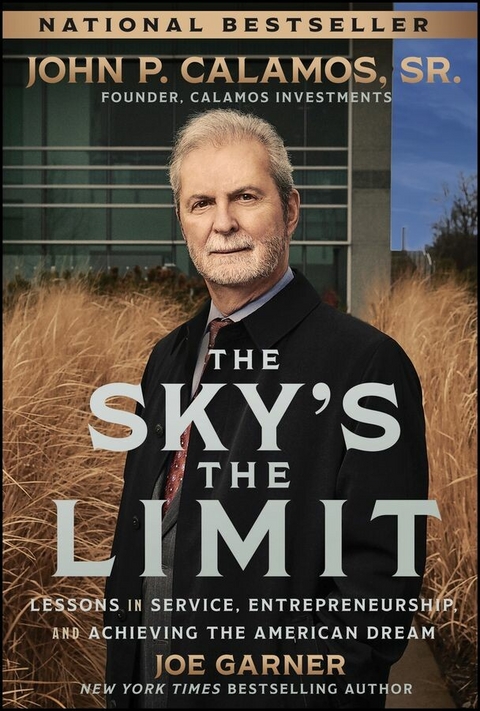
The Sky's the Limit (eBook)
221 Seiten
Wiley (Verlag)
978-1-394-30403-5 (ISBN)
Stories and lessons from John P. Calamos Sr., a rags-to-riches self-made American billionaire
Sky's the Limit: Lessons in service, Entrepreneurship and Achieving the American Dream tells the inspirational tale of John P. Calamos Sr., an American trailblazer, self-made success story, and living legend in the world of investing. Each chapter contains stories and business lessons he learned along the way. From a stock boy in his parents' grocery store in Chicago's west side, to 400+ combat missions in Vietnam, to launching his own firm which now has upwards of $35 billion in assets, John's career and the extreme success he's enjoyed through that career have been built on taking risks and being resilient. Some of the events detailed in this book include:
- Teenage John's discovery of stock certificates in his family's basement ignites a passion for investing
- Major Calamos' time in the Air Force, including five years of active duty flying B-52 bombers and twelve years in the Reserves flying A-37 jet fighters
- Pioneering initiatives to launch one of the first convertible funds in 1985 and one of the first liquid alternative funds in 1990
Sky's the Limit: Lessons in Service, Entrepreneurship and Achieving the American Dream earns a well-deserved spot on the bookshelves of all individuals seeking to mirror the success of a man who is a living embodiment of the quintessential rags-to-riches American dream.
JOHN P. CALAMOS, SR. is Founder, Chairman, and Global Chief Investment Officer of Calamos Investments. He is a pioneer in the fields of convertible securities and liquid alternative investments, as well as a Vietnam veteran who has flown over 400 missions as a combat pilot and a recipient of the Distinguished Flying Cross.
JOE GARNER, deemed the 'Ken Burns of the written and recorded word' by talk show legend Larry King, is a six-time New York Times bestselling author renowned for his innovative storytelling and multimedia approach. His groundbreaking New York Times bestselling debut, We Interrupt This Broadcast, pairs pivotal historical moments with authentic news broadcasts and features forewords by Walter Cronkite and Brian Williams. Garner has collaborated with celebrated figures across industries, including Academy Award winner Dustin Hoffman, sports broadcast icon Bob Costas, comedy greats Carl Reiner and Rob Reiner, and NASCAR Hall of Famer Jeff Gordon. With a unique ability to bring history, culture, and personal legacies to life, Garner remains a leader in the world of nonfiction.
Chapter 1
The American Dream: A Journey Begins
“You don't know where you're going unless you know where you came from.”
—John P. Calamos, Sr.
At the heart of America lies a fundamental truth: its population is made up of individuals from diverse corners of the globe. From the earliest settlers, including the nomads who crossed the Bering land bridge to become the first Native Americans, to those seeking refuge from persecution and countless others pursuing the promise of a brighter future, the American narrative is one of migration and hope. The journey of the Calamos family embodies this quintessential American tale.
In the early 1900s, as Europe stood on the brink of World War I, Greece faced the aftermath of the Balkan Wars amid a fragile geopolitical landscape. Internal divisions between monarchy and republicanism left the country's primarily agrarian economy offering little opportunity for its youth.
America was seen as a land of boundless opportunity, often referred to as the golden land. Stories of success and the chance to earn a living far beyond what was possible in Greece fueled dreams of a better life.
With America's industrial economy booming and a high demand for labor, immigrants found prospects for work and the ability to earn and save money—something nearly impossible in the struggling Greek economy.
The tale of the Calamos (Kalamoutsos) family finds its origin in the tranquil village of Vourvoura, nestled near the historic city of Tripoli on the Peloponnese peninsula in southern Greece.
Amid the timeless olive groves and vineyards unfolds the saga of a family whose journey would epitomize the essence of the American Dream.
In 1908, Evangelos Calamos, the patriarch of the family, answered America's call for promise. He was among nearly 40,000 Greek laborers recruited to work on railroads, mines, and mills across the country. Making multiple trips back and forth, he shared stories of America that ignited the ambitions of his son, Peter.
By 1914, young Peter Calamos, barely 17 years old, decided to follow in his father's footsteps and journey to America with a few friends from the village.
Beyond the economic challenges of their home country, the rising tumult that would soon lead to World War I made the challenges of immigration seem a worthy gamble.
With his parents' encouragement and support, Peter embarked on his journey, his dreams and apprehensions packed tightly alongside his sparse belongings. The ship sailed out into the vast Atlantic, but because his voyage coincided with the start of World War I, the ship had to cautiously hug the coastline to evade German U‐boats until they were well out at sea.
It's easy to imagine that the nearly month‐long voyage wasn't just about crossing from one continent to another. As the days passed, there would have been ample time for reflection, turning it into a journey of personal growth.
Finally catching sight of Lady Liberty must have been exhilarating, yet Ellis Island, still a mere mile off the US coastline, loomed as the last barrier before reaching America. Surrounded by the island's imposing structures and a constant stream of newcomers from every imaginable background, the scene was overwhelming.
Amid this mosaic of humanity, a cacophony of voices—young and old, speaking myriad languages—echoed throughout the large receiving hall, each voice carrying the weight of varied emotions: hope, fear, excitement, and apprehension.
Processing at Ellis Island was undoubtedly daunting, especially for someone as young as Peter. The entry conditions were strict, aimed at admitting only those who could contribute to the growing society of their new homeland. Dreams were scrutinized, and futures were decided in the course of just a few interviews.
On arrival, immigrants underwent a series of medical and legal inspections to ensure they did not pose a public health risk or become a burden on American society. The medical examination was the first critical hurdle, with doctors checking for diseases or disabilities that could prevent an individual from working.
This was followed by legal interviews, where officials verified documents and questioned immigrants about their backgrounds, financial status, and reasons for coming to America.
Immigrants had to prove they had a place to stay, some money, and that they would not likely become a public charge.
Once cleared, the weight of the new arrivals' journey gave way to exhilaration as they took their first steps on American soil—the land of boundless opportunity. With little more than the clothes on their backs, Peter and his friends from the village would have felt a rush of adventure as they set off for Ohio and the promise of manufacturing work the Midwest held.
The transition from the rustic, serene beauty of Greece to the industrial heartland of America was striking. Ohio's landscape, marked by its growing factories and the promise of employment, was a stark contrast to the life they had known.
They found work in one of these cathedrals of American industry, where the dreams of many immigrants were forged—and sometimes broken. However, the physical demands of their new roles were nothing compared to the social challenges they faced.
Greeks, Italians, Irish, and other immigrants were often met with suspicion and hostility, seen as outsiders in a nation grappling with its own identity. Slurs and prejudices were commonplace, serving as daily reminders that their acceptance was conditional, and their presence merely tolerated rather than embraced.
The factory became a crucible, testing the young men's resilience and shaping their understanding of the American work ethic.
It was amid the soot and clamor of production that tragedy struck—one of Peter's companions suffered a fatal accident. This pivotal moment in Peter's early life sparked a profound change, driving him to seek a new direction.
Leaving Ohio behind, Peter set his sights on Chicago. In this bustling metropolis, rich with a vibrant Greek community, he would plant the seeds of a legacy that would intertwine with the very fabric of America itself.
During this era, Chicago's population swelled, fueled by a steady influx of immigrants from Europe, including Greeks, Italians, and Eastern Europeans, along with a significant migration of African Americans from the South, part of the Great Migration.
These newcomers sought employment in the city's thriving factories, stockyards, and railroads, contributing to a vibrant yet sometimes strained cultural mix.
Economically, Chicago flourished as a center of manufacturing and meatpacking, with the Union Stockyards standing as a symbol of the city's industrial power. However, this prosperity came with its own set of challenges.
Socially and culturally, Chicago was lively, yet deeply divided by racial and ethnic lines.
Neighborhoods formed cultural enclaves where communities established networks of churches, schools, and social clubs.
Although segregation is often associated with racial divides, the ethnic distinctions in Chicago during that era were equally rigid. Peter quickly learned to navigate the boundaries separating Greek, Polish, and Italian neighborhoods.
Politically, this era was characterized by corruption and the growing influence of organized crime, which would come to the forefront during Prohibition in the 1920s. Notorious figures like Al Capone began their rise to power during this time, foreshadowing the city's ongoing struggle with the corruption, intimidation, and violence of organized crime in the decade ahead.
Chicago stood at a crossroads, embodying both the promise and contradictions of the American experience. Within this vibrant landscape, Peter found a sense of belonging in the city's expansive Greek community, which became a vital anchor for him. It offered not only a connection to his heritage but also essential support as he navigated his new life.
As Greek‐owned businesses, cafés, and restaurants began to flourish, Greektown emerged as a lively hub. These establishments served as informal meeting places where community members could gather and share news from back home.
The melodic cadence of the Greek language mingled with the savory aromas of traditional cuisine—garlic, oregano, roasted lamb, and calamari—creating an atmosphere of comfort and evoking a profound sense of belonging.
Instead of seeking jobs in factories or stockyards, Peter chose the entrepreneurial path. His time in Ohio's factories had left a bad taste in his mouth, driving him toward self‐employment. This decision would shape his family for generations, influencing the choices of his son, John.
Initially, he made a living by peddling produce, a practice that foreshadowed his eventual career in the grocery trade. Every morning, he would take a pushcart to the Fulton‐Randolph District wholesale food market, buy fruits and vegetables, and then walk down the alley selling them to his neighbors.
Encouraged by the success of his fruit and vegetable cart, Peter saw an opportunity to better serve the needs of the growing community. He reached out to a few friends, and together they pooled their resources and expertise to start a small grocery store.
For Peter and his partners, this venture was more than just a business; it was a chance to build something meaningful that would set them firmly on...
| Erscheint lt. Verlag | 17.4.2025 |
|---|---|
| Sprache | englisch |
| Themenwelt | Literatur ► Biografien / Erfahrungsberichte |
| Wirtschaft ► Betriebswirtschaft / Management | |
| Schlagworte | air force memoir • Business Advice • business inspiration • business lessons • calamos investing • Character development • investment advice • investment firm • investment guide • investment memoir • stock portfolio • veteran success story |
| ISBN-10 | 1-394-30403-X / 139430403X |
| ISBN-13 | 978-1-394-30403-5 / 9781394304035 |
| Informationen gemäß Produktsicherheitsverordnung (GPSR) | |
| Haben Sie eine Frage zum Produkt? |
 EPUB (Adobe DRM)
Kopierschutz: Adobe-DRM
Adobe-DRM ist ein Kopierschutz, der das eBook vor Mißbrauch schützen soll. Dabei wird das eBook bereits beim Download auf Ihre persönliche Adobe-ID autorisiert. Lesen können Sie das eBook dann nur auf den Geräten, welche ebenfalls auf Ihre Adobe-ID registriert sind.
Details zum Adobe-DRM
Dateiformat: EPUB (Electronic Publication)
EPUB ist ein offener Standard für eBooks und eignet sich besonders zur Darstellung von Belletristik und Sachbüchern. Der Fließtext wird dynamisch an die Display- und Schriftgröße angepasst. Auch für mobile Lesegeräte ist EPUB daher gut geeignet.
Systemvoraussetzungen:
PC/Mac: Mit einem PC oder Mac können Sie dieses eBook lesen. Sie benötigen eine
eReader: Dieses eBook kann mit (fast) allen eBook-Readern gelesen werden. Mit dem amazon-Kindle ist es aber nicht kompatibel.
Smartphone/Tablet: Egal ob Apple oder Android, dieses eBook können Sie lesen. Sie benötigen eine
Geräteliste und zusätzliche Hinweise
Buying eBooks from abroad
For tax law reasons we can sell eBooks just within Germany and Switzerland. Regrettably we cannot fulfill eBook-orders from other countries.
aus dem Bereich


