


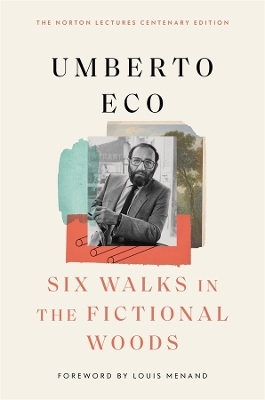
Six Walks in the Fictional Woods
Seiten
2025
Harvard University Press (Verlag)
978-0-674-30246-4 (ISBN)
Harvard University Press (Verlag)
978-0-674-30246-4 (ISBN)
In six lectures covering everything from James Bond to antisemitic conspiracy theories, Umberto Eco offers a master class in the philosophy of fiction. Dissecting the rhythms and ambiguities of narrative, Eco illuminates fiction’s intrusions into life, highlighting the ways that literary works conscript readers’ experiences and expectations.
“Erudite, wide-ranging, and slyly humorous.”
—The Atlantic
One of the great novelists and public intellectuals of our time gives a master class on the philosophy of fiction.
Umberto Eco was fond of pointing out that all writing is narrative. He published his famed debut novel The Name of the Rose when he was forty-eight years old, yet he believed that everything he had written to that point—from treatises on semiotics to essays on mass culture—took the form of a story. To Eco, scholarship, much like fiction, was shaped by narrative. It was the stuff of life itself.
Six Walks in the Fictional Woods, a collection of essays based on Eco’s 1992–1993 Norton Lectures at Harvard, illuminates fiction’s porous boundaries—in particular, the myriad ways that literary works conscript readers’ experiences and expectations. Fiction, says Eco, can offer metaphysical comfort by appealing to our desire for a smaller, more legible world, one that gives a definitive answer to the question of “whodunnit?” But it also makes demands of us, presupposing a model reader who possesses the cultural knowledge necessary to interpret the text, as well as a willingness to follow the never-quite-specified rules of the literary game.
Whether he is dissecting grammatical ambiguities in Gérard de Nerval’s nineteenth-century romantic masterpiece Sylvie, studying the rhythms of Ian Fleming’s James Bond novels, or tracing the web of fraud and misattribution that produced the antisemitic conspiracy theory of The Protocols of the Elders of Zion, this is Eco at his very best: intellectually omnivorous, endlessly fascinated by hoaxes, and always an adept navigator of the narrative forests that surround us.
“Erudite, wide-ranging, and slyly humorous.”
—The Atlantic
One of the great novelists and public intellectuals of our time gives a master class on the philosophy of fiction.
Umberto Eco was fond of pointing out that all writing is narrative. He published his famed debut novel The Name of the Rose when he was forty-eight years old, yet he believed that everything he had written to that point—from treatises on semiotics to essays on mass culture—took the form of a story. To Eco, scholarship, much like fiction, was shaped by narrative. It was the stuff of life itself.
Six Walks in the Fictional Woods, a collection of essays based on Eco’s 1992–1993 Norton Lectures at Harvard, illuminates fiction’s porous boundaries—in particular, the myriad ways that literary works conscript readers’ experiences and expectations. Fiction, says Eco, can offer metaphysical comfort by appealing to our desire for a smaller, more legible world, one that gives a definitive answer to the question of “whodunnit?” But it also makes demands of us, presupposing a model reader who possesses the cultural knowledge necessary to interpret the text, as well as a willingness to follow the never-quite-specified rules of the literary game.
Whether he is dissecting grammatical ambiguities in Gérard de Nerval’s nineteenth-century romantic masterpiece Sylvie, studying the rhythms of Ian Fleming’s James Bond novels, or tracing the web of fraud and misattribution that produced the antisemitic conspiracy theory of The Protocols of the Elders of Zion, this is Eco at his very best: intellectually omnivorous, endlessly fascinated by hoaxes, and always an adept navigator of the narrative forests that surround us.
Umberto Eco (1932–2016) was an acclaimed writer, philosopher, medievalist, and semiotician. In addition to dozens of nonfiction books, he authored seven novels, including The Name of the Rose, which has been translated into more than forty languages and has sold more than fifty million copies worldwide. Louis Menand is a historian, essayist, and the author of several books, including The Metaphysical Club, which was awarded the Pulitzer Prize for history, and The Free World, which was named one of the best books of 2021 by the New York Times. A staff writer at the New Yorker, he is Lee Simpkins Family Professor of Arts and Sciences and Anne T. and Robert M. Bass Professor of English at Harvard University.
| Erscheinungsdatum | 05.09.2025 |
|---|---|
| Reihe/Serie | The Charles Eliot Norton Lectures |
| Vorwort | Louis Menand |
| Zusatzinfo | 11 illus., 1 photo |
| Verlagsort | Cambridge, Mass |
| Sprache | englisch |
| Maße | 140 x 210 mm |
| Gewicht | 358 g |
| Themenwelt | Literatur ► Essays / Feuilleton |
| Geisteswissenschaften ► Philosophie ► Sprachphilosophie | |
| Geisteswissenschaften ► Sprach- / Literaturwissenschaft ► Anglistik / Amerikanistik | |
| Geisteswissenschaften ► Sprach- / Literaturwissenschaft ► Literaturwissenschaft | |
| ISBN-10 | 0-674-30246-X / 067430246X |
| ISBN-13 | 978-0-674-30246-4 / 9780674302464 |
| Zustand | Neuware |
| Informationen gemäß Produktsicherheitsverordnung (GPSR) | |
| Haben Sie eine Frage zum Produkt? |
Mehr entdecken
aus dem Bereich


aus dem Bereich
Unser schöner neuer Sprachgebrauch
Buch | Hardcover (2025)
zu Klampen Verlag
CHF 27,90
Eine Geschichte über Verlust und Erneuerung
Buch | Hardcover (2025)
Rowohlt Taschenbuch (Verlag)
CHF 29,90


