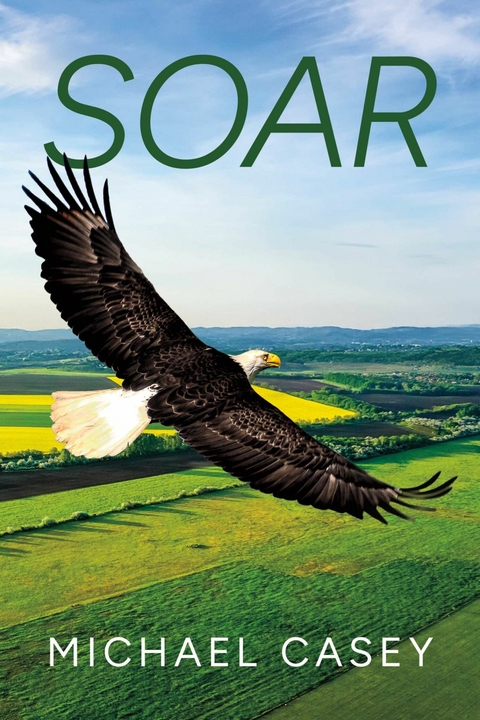
Soar (eBook)
232 Seiten
Bookbaby (Verlag)
979-8-3509-8688-4 (ISBN)
Michael Casey, an attorney licensed in the States of Illinois and Wisconsin, has written three novels. His first, Passage, was written under the pen name of Vince Hurley, and takes place on the East Side of Milwaukee in the early 1970's. His second, In Nominee Patris, takes place in Chicago and the Driftless of Wisconsin in the mid-1980's. Soar takes place on the East Side and Wisconsin generally sometime in the aughts. All three novels share connections, characters, places, and themes, but each also stands on its own. Mr. Casey recommends In Nomine Patris, Soar, and Passage, in that order, even if not chronological. He currently resides with his wife near the great Lake Michigan on their beloved East Side of Milwaukee.
Bonnie Gold, twenty-eight, Native American, Jewish, Irish, recent Phd in hand, has fallen through the cracks, adrift, and lost without direction or purpose, until she's drawn into her mother's uphill battle for governor of the State of Wisconsin. Bonnie's life improbably begins to come together as her parents' relationship comes apart under the stress of the all consuming political campaign fraught with dirty tricks and dark money. Shattered windows, shots in the night, and violence endemic to our troubled political times result in pain and loss that Bonnie must overcome as she is forced to take a leading role in her mother's campaign in the run up to the election. With her father's guidance she grapples to find meaning in the madness of a world spinning out of control and strength to rise up and lead a new generation of hope and promise.
Chapter One
(PROLOGUE)
Ben Gold survived two novels. One just barely, a scar he will carry until the day he dies, which might explain his reticence, his calm, his still shadow behind the scenes. Deliberate, analytical, without haste, on the plus side, but an unfortunate lack of ambition and what might appear to others as apathy on the other. A psychologist saw the scar as a fear of death, his father, an Ashkenazi, having died when Ben was young enough to remember. But that was dead wrong. Ben Gold did not fear anything. He died once before. So his life was a mulligan, and he lived every day, or tried to anyway, in awe and wonder, a poem, all too short to ruin wasting time with self-inflicted fear.
After his father died he was raised on the Menominee Tribal Reservation in North Central Wisconsin by his mother, a Menominee, and her extended family, members of the Eagle Clan. Tall, lean, with the bronze look of a bird of prey, he wore his straight black hair in a ponytail down his back, over white shirts and blue jeans. Went to college, did well, fell in love, ran into trouble, paid his dues, married Colleen Ryan, went to law school, moved to a farmhouse, had two kids, spent time farming, doing good deeds, and several years after Colleen completed her residency he and his family moved to what was for him an embarrassingly large house on the East Side of Milwaukee just two blocks from where native peoples used to scratch out a living among tall bluffs and deep ravines at the edge of the great Lake Michigan.
His mother passed years before, but he kept her alive by retelling her stories, her spirits, the mysteries of her people. Proust would appreciate the memory: to bed in a small shack among tall pines in the North Woods, his mother wrapped in blankets rocking in a chair, her face aglow in the light of a candle, her soft voice whispering tales of tears and joy, great adventures and small kindnesses, passed down from mother to mother to mother over thousands of years. But of all the stories his mother told and he, in turn, told his children, there was one of which he, his mother, and his children were particularly fond. And it went something like this:
Long, long ago, and even longer before that, there were no people on this land—just woods and rivers and mountains and lakes and beasts, large and small. Then one day, far away on the other side of the ocean, a small tribe chased by a band of warriors escaped across a forbidden bridge that led into a new world. They vowed they would not stop until they found a land where good spirits dwelled. So they asked the gods to help them find their way. And the gods sent from the heavens a large bird who told the people she would lead them to such a land but only if they came in peace and would do no harm. Convinced of their goodness, the great bird agreed to lead them to the good land, so she set off swooping and circling across the sky, and the people followed her over rivers and mountains and many years. And over time those who first crossed the forbidden bridge passed on, their legacy taken up by children and grandchildren and great-grandchildren, generation after generation, and the great bird was joined by other great birds along the way, a multitude of great birds and women, men, and children flowing in processions like giant rivers across the land and sky searching for the good land across a wide continent.
At long last, after crossing plains and prairies, on a midsummer day hemmed in by cloud, the clan of eagles stepped out from deep woods into a broad oak savannah that opened onto a bluff overlooking a great lake they could not see around or across. It was there, at the edge of the bluff, that the flock of great birds circled in formation several times and swooped down whispering songs of deliverance and farewell over the heads of the people. The clouds opened. The sun shone brightly upon the people standing at the edge of the blue lake. The great birds circled one last time before they wheeled off into the heavens, and the people rejoiced, because at last their adventure and that of their ancestors had come to an end, for here indeed the land was good.
The land stretched atop a tall bluff along the edge of a wide bay formed by three rivers that came together and spilled into the great lake. In most places the bluff was sheer, sixty feet high, but broken, torn, by deep harsh ravines that cut and slashed and twirled and funneled spring freshets down into the great lake. There were seven ravines in all: from north to south, the first, ragged and deep with a hard right into the rocky beach; the second, longer, inland, forming slowly curve after curve, in no hurry, parallel to the rocks below; the third, twisting, turning, and draining into the fourth, a straight slash into a copse of cedar and pine at the edge of the water; the fifth, a waterfall; the sixth and seventh, carving a promontory, a wide spit of land where the clan built its lodgings, spent its warmest and best days, and returned in the spring, year after year, to the savannah above the great lake, where the infinite horizon spread its wide arms far out and high above the bluff along the shore, where over generations they lived among oak and maple, bluestem and ox-eye, working the three rivers that flowed into the wide bay.
But over time, others arrived upon the land, keeping their distance, customs, gods, and language. Some came in peace; others not. Some worshiped the sun; others the moon. Some sought union with the earth; others to exploit it. In some men dominated; in others women. In some they were equals. In some the best got the most; in others all was shared. There were no lines on maps, but each knew of the other and where each called home. Some respected the others’ land; others not. Some traded with the others; others stole. Some welcomed strangers; others killed them. Some sought friendship; others, conflict.
But above all, what they all shared, between the differences, was constant change. From generation to generation, nothing remained the same. Personalities changed, talents changed, the sky and earth changed, game was plenty, then game was scarce. Too much rain, not enough, heat, cold, wind, wisdom, courage, fear—everything swirling together and apart from one another in a million little eddies in a much larger river flowing thousands of miles over thousands of years and from the smallest drop to the most powerful current—never the same. From year to year, the peaceful became warlike; the wise, dull; the powerful, weak; and one could never be entirely certain, so inevitably, for good reason, fear lurked at the edge of the far reaches of what each called home.
True to their word, Eagle Clan members came in peace and did their best to maintain it. It was not always easy. From time to time they had to protect their land, their people, the mounds where their parents were buried, their fields of beans and squash. But always defensive, when necessary, not for advantage, in part because they did not need advantage. They had what they wanted. There was nothing else to gain; only to lose.
For as long as anyone could remember, clan leaders were chosen by a council of women who chose three leaders, usually but not always men, each of whom could be removed by the same council. Leaders had no possessions, and whatever they received they gave away. Often, but not always, a leader would train a son or daughter to succeed him or her, and in such cases the leader’s decision would usually be respected. Would-be successors were trained in the art of persuasion, in language, song, and ritual, and foremost in humility and selflessness. For persuasion, logic, and reason, with the goal of protecting the whole, prevailed over force, personality, and ego. Leaders resolved disputes, decided when to leave for winter hunting grounds, where to make camp, when to return, and how to deal with neighbors. They had no power to force anyone to do anything; clan members need not do what they were told, but mostly they did, because it was best for everyone if they did so. Those who acted for the benefit of all were held in high esteem; those who did not led lonely, unhappy lives.
Around two thousand years ago, one of the clan’s leaders, Pole Star, highly respected for his wisdom and kindness, who had served the clan for more than forty years, began to feel his age. He had thought of his successor for some time, and it weighed on him greatly. Of all his children, his oldest son, Bold Wind, was the likely choice. He was taller than most, more handsome, smarter, stronger, a better warrior and hunter, one of a kind. When time came for the clan to go to or from winter hunting grounds, Bold Wind and his closest warriors led the way. The people admired, respected, trusted him, and profited from his success. He was born a leader, especially for the young men of the clan.
His prowess in hunting, his strength, intelligence, and cunning had begun to reap advantages. His lodgings had grown to accommodate those he had captured from raiding parties he had repelled, including several wives. He and his growing family took the best of the game he killed and the largest trout he caught and the finest hides from the animals he hunted. He, his wives and his children were adorned in the finest shells from the great lake and the largest feathers from the great birds. And no one begrudged him any of it, for he deserved it: he had earned it, and as everyone knew, from all the great deeds he accomplished the clan benefitted as well. What was good for him was good for them.
Bold Wind was the obvious choice to become Pole Star’s successor, as everyone knew and expected. And yet, Pole Star had his doubts. He loved and was very...
| Erscheint lt. Verlag | 10.4.2025 |
|---|---|
| Sprache | englisch |
| Themenwelt | Literatur ► Krimi / Thriller / Horror |
| ISBN-13 | 979-8-3509-8688-4 / 9798350986884 |
| Informationen gemäß Produktsicherheitsverordnung (GPSR) | |
| Haben Sie eine Frage zum Produkt? |
 EPUB (Ohne DRM)
Größe: 665 KB
Digital Rights Management: ohne DRM
Dieses eBook enthält kein DRM oder Kopierschutz. Eine Weitergabe an Dritte ist jedoch rechtlich nicht zulässig, weil Sie beim Kauf nur die Rechte an der persönlichen Nutzung erwerben.
Dateiformat: EPUB (Electronic Publication)
EPUB ist ein offener Standard für eBooks und eignet sich besonders zur Darstellung von Belletristik und Sachbüchern. Der Fließtext wird dynamisch an die Display- und Schriftgröße angepasst. Auch für mobile Lesegeräte ist EPUB daher gut geeignet.
Systemvoraussetzungen:
PC/Mac: Mit einem PC oder Mac können Sie dieses eBook lesen. Sie benötigen dafür die kostenlose Software Adobe Digital Editions.
eReader: Dieses eBook kann mit (fast) allen eBook-Readern gelesen werden. Mit dem amazon-Kindle ist es aber nicht kompatibel.
Smartphone/Tablet: Egal ob Apple oder Android, dieses eBook können Sie lesen. Sie benötigen dafür eine kostenlose App.
Geräteliste und zusätzliche Hinweise
Buying eBooks from abroad
For tax law reasons we can sell eBooks just within Germany and Switzerland. Regrettably we cannot fulfill eBook-orders from other countries.
aus dem Bereich