


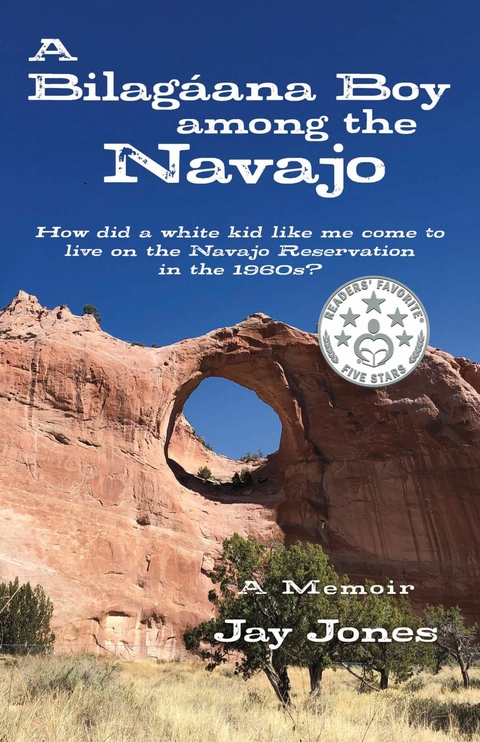
Bilagaana Boy among the Navajo (eBook)
224 Seiten
Bookbaby (Verlag)
979-8-3509-9219-9 (ISBN)
Jay Jones is the new author of the book, 'A Bilagáana Boy among the Navajo.' In this true story, he chronicles his four years living as a white kid on the Navajo Indian Reservation in Window Rock, Arizona. As the son of two Air Force veterans, he was born in Tachikawa, Japan and lived across the United States. After a turbulent childhood, Jay grew up quickly and joined the Marine Corps at 17 and served in Bermuda before receiving an honorable discharge. He has worked as a pizza and short order cook, professional photographer, security guard, fire alarm salesman, employment counselor, drugstore manager trainee, hotel front desk clerk, bar manager, restaurant manager, disk jockey, beauty pageant MC, financial advisor, investment wholesaler, volunteer, and more. While working, Jay obtained his degree in Business Management and retired after 33 years as a Chartered Financial Consultant sales executive. He lives at Dove Mountain near Tucson, and his happy place is reading by the pool with his wife Liz in the Southern Arizona heat. Jay may also be golfing, traveling, or mixing mean cocktails while cooking.
How did a white kid like me come to live on the Navajo Reservation in the 1960s?In 1965, six-year-old Jay is witness to his mother's affair and mental breakdown after his father's lengthy military deployment. After his parents' divorce, Jay must unwillingly live with his mother and new stepfather, a Bureau of Indian Affairs employee, on the Navajo Nation Reservation in Arizona. From 1967 to 1971, Jay is a "e;bilagaana,"e; the Navajo term for white boy, to his new friends and bullies alike on the reservation. While trying to avoid his stepfather's abuse and pending adoption he dreams of moving back to live with his father, he escapes to the hills around Window Rock and joins the Boy Scouts and a Navajo Little League baseball team. His neighbors, the Begay's, welcome and immerse him in Navajo culture and visits to their elders at their remote Hogan, while the Jackson family teaches Jay to become a real cowboy on a Navajo ranch. As he searches for a purpose and attempts to find a path back to his father, Jay knows that he will have to grow up fast on the reservation. This memoir follows Jay's misadventures as he navigates being a privileged outsider in a group of both Navajo and white kids who are struggling to understand their place in a world shaped by racism, poverty, and 100 years of federal Indian policy. Decades later, he has come to grips with how those four years there transformed his life.
Chapter 2
1967 Arrival in Window Rock, Arizona
My mother opened the passenger side door, and as I stepped out, she wrapped me in her arms. “You’re home!” she exclaimed, even though this house and Window Rock had never been my home. She looked pretty much the same as she had before, with her short, dark hair and glasses. There was a new ring on her finger that I had never seen before. She and Will had only been married for six months when I arrived.
I hugged her as I warily eyed Will standing beside her. This was the first time I had seen him with clothes on. He was tall and imposing, and with his balding, salt-and-pepper hair, he clearly looked the eleven years older than my mother that he was.
“Hiya, Buddy,” he said to me as I shook his hand. I was annoyed that he was acting like we were best buds already when we didn’t even know each other. “I’ll get your suitcases,” he said. My father opened up the trunk for him, and he took them inside while my parents awkwardly stood there.
Finally, my dad said, “Well, I should get a move-on. It’s getting late and it’s a long drive to see Don in Coolidge.” My eyes started filling with tears at the realization that this was really it; he was truly leaving me here. I had no idea when I would see him again. I looked around at this barren place, feeling abandoned already.
“Don’t go, Dad,” I pleaded with him as he hugged me goodbye. “Take me with you,” I begged.
“You know I can’t do that,” he said, wiping tears of mine away. “You’re going to be fine. You’ll love it here, I’m sure. You’re back in the West now!” He gave me one last hug and pat on the shoulder, and then got back into his Rambler.
As he backed it down the driveway, I walked after the car and then ran after him down Circle Hill Drive. “Dad!” I yelled. When I saw him turn the corner, I knew he was really gone. I stood there for a while, not wanting to walk back up to whatever was waiting for me.
By the time I walked back up the hill, my mother was sitting on the front stoop smoking a cigarette. Her eyes looked like she had been crying from witnessing the affection I had for my dad. Maybe she was second-guessing if she’d made the right decision separating us. She opened her arms again and hugged me. “I’m so happy you’re here,” she said. “I know it will take some time to get adjusted. You’re going to love it here.”
“Do you love it here?” I asked her. She didn’t answer but just stood up and opened the door.
“Let me show you around,” she said as we walked inside. The house was an adobe style with viga architecture constructed of large cut solid sandstones mortared and stacked like huge bricks. The inside walls had a little over an inch of uneven plaster pasted over the stones. It had a grassy sideyard with a long double line clothesline and board fence painted white. The home was likely built sometime in the ‘30s or ‘40s when the BIA brought in white employees to staff many of its offices on the Navajo Reservation. Large viga logs went through the ceiling about three feet apart and protruded outside the house. Right away, I noticed that it was cooler inside the house. But there was no air conditioning, even though it was becoming more and more common throughout Arizona.
Mom took me into the kitchen and pointed out where the glasses and plates were so I could help myself later. It had those 1960s harvest gold appliances and Formica countertops with little boomerangs on them. To complement the gold kitchen was a matching gold rotary dial telephone hanging on the wall with an extra-long telephone cord so one could move around while talking. She handed me a chocolate chip cookie that she had baked earlier that day in anticipation of my arrival. They tasted the same to me as the ones she made in Phoenix.
After she showed me the large pantry and laundry room, we walked through the dining room, and she pointed out the hi-fi cabinet and record radio player combo with speakers on each side that I remembered well. It was a sofa-sized behemoth piece of furniture and the same one she and Dad brought back from Japan. Mom had a pretty large assortment of 33 LP record albums of crooner singers she liked listening to.
I saw that the living and dining rooms were open to each other, and the furniture was the same set my parents had before their divorce with the addition of a black leather recliner. The living room had a fireplace that I didn’t realize yet we’d be using for heating every day in the winter. There was no carpet anywhere. Instead, all the floors throughout were nice hardwood pine.
She led me through a short hallway to a small room. “Your very own bedroom. Same bed,” she said, pointing. It was the same bunk bed that Don and I used in Phoenix, but now it had its legs cut down to where the bottom bed slid underneath the top bed that I slept on. The same upright dresser was there too.
I never had my own bedroom before. I walked over to the window by the bed and looked out, leaning on the radiator below it. I saw that I had a good view looking west for ten or so miles. The land was relatively flat, then gradually sloped up to juniper and cedar tree-lined hills in the distance. About twenty-five yards away from my window was an old pinon tree. “Isn’t that a lovely view?” she asked me, putting her hand on my shoulder.
“I guess,” I said. I didn’t want to admit to her that it was a pretty nice view.
My suitcases were waiting for me by the bed, and together, Mom and I began to unpack and put my clothes and other things away. She remarked on the new clothes I had that she hadn’t seen yet. I wondered where Will was, but I was glad he was making himself scarce right now.
“Let’s see the rest of the house and outside,” Mom said. She showed me the one bathroom and pointed to their bedroom, where Will was taking a nap. That was it for the house, all 1200 square feet of it. She took me out to the front, and we walked next to the gravel driveway where their two cars were parked. In front of the cars was a large white shed where garden tools were stored. Mom showed me the lawnmower, which I would use on the yard as one of my chores. I’d also be stacking the woodpile that had just arrived for when it got cold later. Another one of my chores would be to bring the wood inside every day in the fall and winter, she explained. Great, I thought. This is why they wanted me here: free labor. “And this is where we burn the trash,” she said, pointing to two rusting barrels at the edge of the driveway. “That will be your job,” she said.
“Really?” I asked. Up until that point, I had not been allowed to do anything with fire. We burned the trash at my grandparents’ home in Pennsylvania, but the fact that I would get to burn the trash without supervision appealed to me, like it would to any 8-year-old boy. At least I’d have one chore I might enjoy.
Will came outside to join us. “Your mother told you that you’d be burning the trash?” he asked. I nodded. Then he gave me some basic instructions and said I shouldn’t play with the fire once it got going inside the trash barrels. I already knew the horrible effects of fire, and most of what he told me wasn’t new. A year earlier, I’d seen a two-story apartment almost burn down a half block from our apartment in Alexandria and walked through the ruins the following day. I never forgot it. He said, “Also don’t put your mother’s empty hair spray or our Lysol aerosol cans in the fire because they will explode.”
That sounds pretty cool! I’ll have to see what that’s like sometime, I thought to myself. I nodded to him and promised, “I will always be careful.”
Will was about to show me the lawnmower when Mom changed the subject. “You can play out here all you want,” she said pointing to the yard and beyond, which was wide open everywhere. “I have looked out here every day since we got here, thinking about what fun it would be for you to climb those rocks and play in the hills.”
She wasn’t wrong. There were huge sandstone formations all around our place. I was itching to go explore out there.
“Can I go look around?” I asked her. Even though it was warm, I didn’t want to go back inside yet.
Will started to say no, but Mom cut him off. “Of course,” she said. “Don’t be gone for long. We’re eating dinner soon.” I ran across the hillside towards the rocks, scratching my legs on the thorny bushes. When I got to them, I scanned them over, looking for the easiest way to climb up. I found a foothold and got up on the first sandstone formation. I kept climbing higher, hoping to get to the top to see the view. I stumbled and almost fell several times but caught hold of the rough sandstone with my feet and hands. Soon I was filthy, tired, and very thirsty. I finally got to the top and sat down to look over the buildings below and Window Rock itself, a better view than from our house. I knew I wanted to climb up on it soon.
I didn’t know what time it was because I didn’t have a watch yet. Maybe I should have headed back then, but I wanted to keep going. I went down the rocks on the other side, sliding down on my butt at some very steep points, to where the ground flattened out. I saw more rocks further east, which I knew from the map my dad had in the car was probably over the New Mexico border. I wanted to explore those too, but it would have to be another time.
I made it back to the house as it was getting dark. “Where have you...
| Erscheint lt. Verlag | 7.4.2025 |
|---|---|
| Sprache | englisch |
| Themenwelt | Literatur ► Biografien / Erfahrungsberichte |
| ISBN-13 | 979-8-3509-9219-9 / 9798350992199 |
| Informationen gemäß Produktsicherheitsverordnung (GPSR) | |
| Haben Sie eine Frage zum Produkt? |
 EPUB (Ohne DRM)
Größe: 3,2 MB
Digital Rights Management: ohne DRM
Dieses eBook enthält kein DRM oder Kopierschutz. Eine Weitergabe an Dritte ist jedoch rechtlich nicht zulässig, weil Sie beim Kauf nur die Rechte an der persönlichen Nutzung erwerben.
Dateiformat: EPUB (Electronic Publication)
EPUB ist ein offener Standard für eBooks und eignet sich besonders zur Darstellung von Belletristik und Sachbüchern. Der Fließtext wird dynamisch an die Display- und Schriftgröße angepasst. Auch für mobile Lesegeräte ist EPUB daher gut geeignet.
Systemvoraussetzungen:
PC/Mac: Mit einem PC oder Mac können Sie dieses eBook lesen. Sie benötigen dafür die kostenlose Software Adobe Digital Editions.
eReader: Dieses eBook kann mit (fast) allen eBook-Readern gelesen werden. Mit dem amazon-Kindle ist es aber nicht kompatibel.
Smartphone/Tablet: Egal ob Apple oder Android, dieses eBook können Sie lesen. Sie benötigen dafür eine kostenlose App.
Geräteliste und zusätzliche Hinweise
Buying eBooks from abroad
For tax law reasons we can sell eBooks just within Germany and Switzerland. Regrettably we cannot fulfill eBook-orders from other countries.
aus dem Bereich


