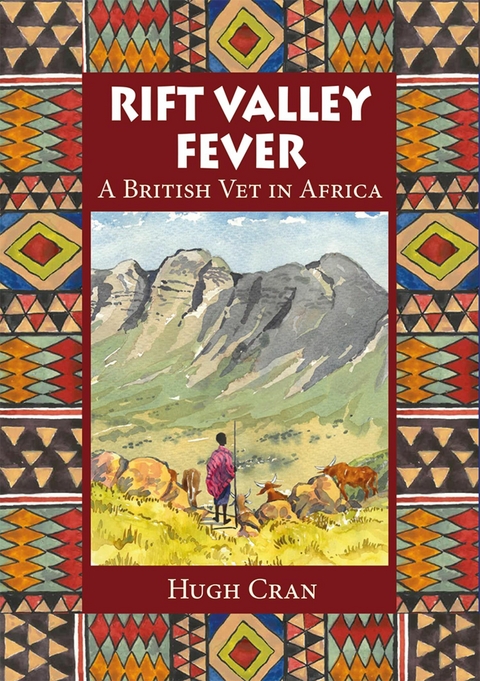
Rift Valley Fever (eBook)
352 Seiten
Merlin Unwin Books (Verlag)
978-1-913159-87-0 (ISBN)
Hugh Cran qualified as a veterinary surgeon in Edinburgh in the early 1960s. In search of adventure and more sunshine than Aberdeen could offer, he answered a small ad. in 1966 to work in a rural practice in Kenya. As well as working as a general vet in Nakuru, he kept diaries, and explored the wild mountains of Kenya. After a colourful and exhausting 50-year career in Africa he has just returned to the UK and now lives in Castle Carey, Somerset with his wife Berna.
Hugh Cran qualified as a veterinary surgeon in Edinburgh in the early 1960s. In search of adventure and more sunshine than Aberdeen could offer, he answered a small ad. in 1966 to work in a rural practice in Kenya. As well as working as a general vet in Nakuru, he kept diaries, and explored the wild mountains of Kenya. After a colourful and exhausting 50-year career in Africa he has just returned to the UK and now lives in Castle Cary, Somerset with his wife Berna.
The weeks following the accident were not restful.
For much of this time I was without the services of my Man Friday, assistant Moses, who had suffered bruised ribs and whiplash injury to his neck. If the lorry driver had not swerved at the last moment, thereby hitting the rear side of the car, instead of the front, Moses would almost certainly have been killed, or at the very least, seriously injured. When he did eventually reappear, he was unable to do much more than creep around like a geriatric tortoise, neck encased in an orthopaedic support.
I felt sorry for him. I would have felt rather more sorry if he had shown any inkling of remorse or regret for what had happened. But he never, ever, expressed any concern for the loss of my vehicle, nor for the major resulting inconvenience. It all smacked of suppressed feelings of guilt.
Meanwhile the work of the practice had to continue, come what may.
Things could not be held up by a mere traffic accident. Nor that shortly before that accident we had sold our gas-guzzling, three gear, Toyota Land Cruiser and were now down to one vehicle, whereas previously we had three – one practice Peugeot 504, another 504 for Berna, and the Toyota for safaris and emergencies. No indeed.
Three vehicles sounds extravagant, but with both parents working, with no available safe public transport, living miles from the nearest town and having to ferry children 40 miles to school, possessing more than one car was less of an extravagance than a necessity. Rona, our first born, was aged seven, and a weekly boarder at St. Mungo’s Preparatory School, an hour and a half drive away on the bracing heights of the Rift Valley, near Molo.
St. Mungo’s was the polar opposite to Dotheboys Hall. It was a caring, ecclesiastical sort of place, and many of the teachers were of a missionary bent. The head was no Wackford Squeers. He was a quiet-spoken chap, who never raised his voice and who preached in chapel on Sundays. This was all well and good, but it allowed strong personalities and natural gang leaders, like Rona, free rein. More than one young, idealistic teacher was brought to the edge of a nervous breakdown by Rona and her team, whose cunning, low key tactics were so subtle that their luckless victims were only dimly aware that they were being targeted by a junior Moriarty.
Sophie, our number two, when she duly arrived at the school, adopted the role of the mild innocent, assuming a butter-wouldn’t-melt-in-her-mouth attitude which left teachers baffled and confused.
Kim, the youngest, who seemed to know the answers to most questions before they were even asked, regarded many of her teachers with barely concealed scorn. Those who failed to meet her own exemplary standards were given the cool, blue-eyed, withering, drop-dead look, a look which left many apprehensive and on edge. One head went so far as to say that he had nightmares about coming back to the school as a junior teacher and finding to his dismay and horror that Kim was in charge as the new head.
But all three did well, amassing prizes and emerging with the wherewithal to move on to further spheres of higher education.
All this lay in the future. In the meantime I grappled with the aftermath of the accident.
While Berna ran her own small private school for infants, including Sophie and Kim, I was run off my feet dealing with a multitude of problems, not all animal related. As Honorary Correspondent for the British High Commission in Nairobi, an unpaid sinecure, I was expected to deal with any difficulties involving British Citizens in my area – an area extending from Mau Narok, 30 miles to the south, to the Ethiopian border, several hundred miles to the north.
And the problems were not slow in coming. An Ancient Briton, called Herbert Allen, took up a great deal of my time. Destitute, bed ridden, with heart problems, he seemed to appear out of nowhere. He told me that he had worked for many years in Uganda, had fallen on hard times, his heart began to give up the struggle, here he was and could I help him? I did, exceeding both his and my wildest expectations, and more importantly from her point of view, those of his African lady companion. By dint of making innumerable phone calls, and writing countless letters, I obtained for him not only a monthly stipend and rent payments from the British Legion and the East African Women’s League, but also a British old age pension, despite the fact, that as far as I could ascertain, he had made zero contributions. Herbert’s co-hab was over the moon with avaricious joy. She made a point of coming to the surgery on an almost daily basis, usually when I was in the midst of a particularly tricky diagnostic challenge, seeking, and demanding, information on the next financial instalment.
Eventually, with Mr Allen’s ticker beginning its terminal countdown, I arranged for him to be moved to the Cottage Hospital at Nanyuki, hard by the Mt. Kenya Safari Club. Here he lived out his last few months in more comfort that he had known in years, before being called to the Final Reckoning. But not before he had made an Honest Woman of his dusky companion, who, as the sorrowing widow of a British Citizen, promptly applied for, and was granted, permission to settle in the Mother Country, to which favoured isle her extended family soon followed, there to batten on the largesse of a state, to which neither her death-bed husband, nor she, had contributed a penny.
Coincidence! Is there a rational explanation to the phenomenon, or was it a random throw of Fate’s dice that decreed that Felicity Drudge’s pet giant rat and the Stock Theft Unit’s prize colt should both suffer testicular trauma on the same day?
The Stock Theft Unit beat Mrs. Drudge to the phone.
‘Harro? Dr Cran? Inspector Kiptanui here.’ Ah, Inspector Kiptanui, former star of the show jumping arena, whose bright comet blazed briefly across the fickle world of dressage, cross-country and three day events. Then he was slim, naturally dark and very handsome. A veritable African centaur, his proud entry into the ring caused many a female heart to go pit-a-pat. Now, instead of the saddle, he spent most of his time in his padded swivel office chair and it showed. The buttons of his uniform strained to contain his swelling paunch, below his moon face his triple chins flowed over his collar and at the back of his head there was a crease like a tectonic continental crack.
‘Yes, inspector, what’s the problem?’ I inquired. ‘It’s Imotep.’ ‘Imotep?’ ‘Yes Imotep, our best young stallion. He tried to mount one of our mares and she kicked him and one of his testicles is damaged. Doesn’t look too good. Can you come?’
The Stock Theft Unit’s head quarters was at Gilgil, about 30 miles away. I jumped into the 504 and sped to the scene of the crime. As I swerved to avoid an aberrant donkey strolling across the highway I mused on the choice of name for the stallion. Obviously the powers that be at the Stock Theft Unit had been watching too many episodes of The Mummy. But some films have that effect on people. The Jensens at Kampi ya Moto, for example. Their children must have been born when Dr Zhivago was all the rage and names with a Russian whiff were vogue. Otherwise why would they have chosen to bestow the names Ivan and Tanya on their son and daughter?
I was now abreast of Lake Elementaita, its blue waters shimmering in the sun. Drifts of white pelicans were circling, spiralling upwards on the thermals rising from the shoreline flats. A rim of pink at the water’s edge showed where greater flamingos were feeding in the soupy, algae-rich water. On the other side of the lake strange volcanic cones peppered the plain, while in the background rose the dark outline of the Mau Escarpment, formerly thickly forested, now thickly sown with a multitude of corrugated iron shacks, the forest gone, along with the shy bushbuck, the sad faced colobus monkeys and the elusive Dorobo hunters.
The road swerved past the Kariandusi Prehistoric Site and the nearby diatomite factory, spewing out white smoke as it rendered down the remains of the hard-shelled microscopic algae to soft abrasive siliceous powder. Then it was down and across a small stream, past the rustic Church of Good Will on the left and up a small rocky escarpment. A troop of baboons sat on boulders beside the road, eyeing the passing traffic, waiting for some vehicular vandal to throw an empty milk tetrapak or crisp packet out of a window. The prize would be seized and borne away for close inspection and any remnants of contents consumed. The unlovely township of Gilgil lay on top of the escarpment. An army barracks, a bank or two, breeze block buildings, a neglected railway station, a row of dukas, a police station, and one thanked one’s lucky stars not to live there. The Stock Theft Unit lay a few miles outside Gilgil. The Unit comprised many horses and a few camels. These in the past had been used in the pursuit and apprehension of cattle rustlers. With the advent of mechanization this role became subservient to nominal appearances in agricultural shows and in crowd control at times of periodic unrest.
An...
| Erscheint lt. Verlag | 3.4.2025 |
|---|---|
| Verlagsort | London |
| Sprache | englisch |
| Themenwelt | Literatur ► Biografien / Erfahrungsberichte |
| Veterinärmedizin | |
| Schlagworte | african vet • cattle vet • Kenya • Maasai • Nairobi • scottish vet • VET |
| ISBN-10 | 1-913159-87-6 / 1913159876 |
| ISBN-13 | 978-1-913159-87-0 / 9781913159870 |
| Informationen gemäß Produktsicherheitsverordnung (GPSR) | |
| Haben Sie eine Frage zum Produkt? |
 EPUB (Wasserzeichen)
DRM: Digitales Wasserzeichen
Dieses eBook enthält ein digitales Wasserzeichen und ist damit für Sie personalisiert. Bei einer missbräuchlichen Weitergabe des eBooks an Dritte ist eine Rückverfolgung an die Quelle möglich.
Dateiformat: EPUB (Electronic Publication)
EPUB ist ein offener Standard für eBooks und eignet sich besonders zur Darstellung von Belletristik und Sachbüchern. Der Fließtext wird dynamisch an die Display- und Schriftgröße angepasst. Auch für mobile Lesegeräte ist EPUB daher gut geeignet.
Systemvoraussetzungen:
PC/Mac: Mit einem PC oder Mac können Sie dieses eBook lesen. Sie benötigen dafür die kostenlose Software Adobe Digital Editions.
eReader: Dieses eBook kann mit (fast) allen eBook-Readern gelesen werden. Mit dem amazon-Kindle ist es aber nicht kompatibel.
Smartphone/Tablet: Egal ob Apple oder Android, dieses eBook können Sie lesen. Sie benötigen dafür eine kostenlose App.
Geräteliste und zusätzliche Hinweise
Buying eBooks from abroad
For tax law reasons we can sell eBooks just within Germany and Switzerland. Regrettably we cannot fulfill eBook-orders from other countries.
aus dem Bereich