


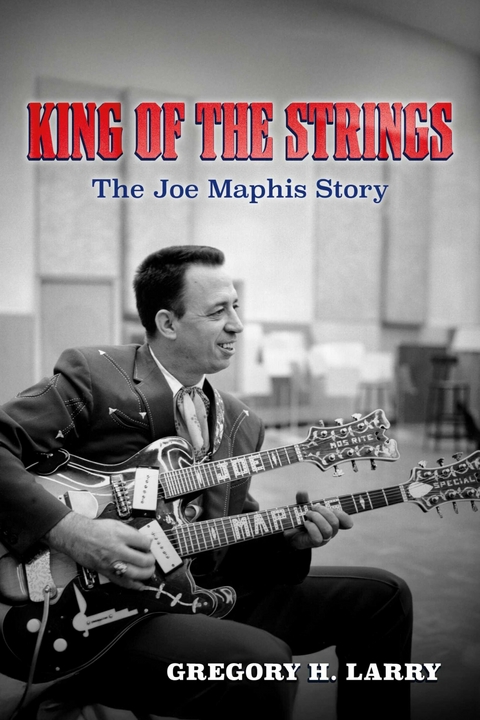
King of the Strings: The Joe Maphis Story (eBook)
292 Seiten
Bookbaby (Verlag)
979-8-3509-8891-8 (ISBN)
Gregory H. Larry has been a musician and writer since he was 16 years old. In addition to playing guitar, bass and writing songs, he became a professional journalist. Larry wrote for several newspapers including the the Cumberland Times-News in his hometown of Cumberland, Maryland where he worked for 12 years.
This book tells the story of an original pioneer of country music, the virtuoso guitarist Joe Maphis. Maphis is considered the first flashy lead guitarist of country who combined blazing quick picking with a relaxed, cool demeanor on stage. The book traces his life from his early days growing up in Cumberland, Maryland to performing live on WRVA Richmond, Virginia's "e;Old Dominion Barn Dance"e; as a musician, comedian and announcer during the golden age of radio. The book details Maphis' move to Los Angeles in 1951 where he appeared regularly on TV and became a studio musician playing on hundreds of records including TV and movie sound tracks. As band leader on the weekly "e;Town Hall Party"e; show in Los Angeles in the 1950s, Maphis, a multi-instrumentalist, became known as "e;The King of the Strings."e; "e;If an instrument had a string on it then Joe Maphis could play it,"e; Tex Ritter, the shows announcer, said. Joe's career benefited greatly from the support of his beautiful wife, singer Rose Lee Maphis. After marrying in 1952, Rose performed by Joe's side for the rest of his life. During their rise to fame in the 1950s, the couple would become known as "e;Mr. & Mrs. Country Music."e; The book offers an inside look at the development of country music through access to a collection of more than 300 letters and postcards shared between the Maphises and their friends and family from 1946 to Joe's death in 1986. Learn the story behind "e;Dim Lights, Thick Smoke (And Loud, Loud Music),"e; the country and bluegrass classic written by Joe and Rose. Read how Joe, in 1960, discovered an 11-year-old saxophonist and steel guitarist named Barbara Mandrell. Follow the Maphises remarkable journey performing with the likes of Johnny Cash, Patsy Cline, Sunshine Sue Workman, Chet Atkins, Mother Maybelle and the Carter Family, Buck Owens, Merle Travis, Ray Price, Waylon Jennings, Conway Twitty, Connie Smith, Dolly Parton, Ernest Tubb, Ricky Nelson and many more. The book features interviews and commentary from Barbara Mandrell, Tommy Emmanuel, Norm Hamlet, Marty Stuart, Deke Dickerson, John McFee of the Doobie Brothers, Brian Lonbeck, Jody Maphis, Zen Crook, Eddie Pennington and much more.
Preface
I don’t know how old I was when I first noticed the ghosts. When I was young and wild they hid from me easily. They were there, rest assured, as I ran blindly across the summer fields to feel the wind on my face. But as I grew older, and stopped running, I began to notice them. At first, it was a feeling I wasn’t alone. Then I began to see them. They would stand in the corners of the room as I was talking to someone. If I walked alone in the woods, or on a crowded street, the ghosts were there watching me. They seemed to want to be recognized, acknowledged. I sensed that they weren’t a threat, but I did not know them.
The ghosts didn’t arrive out of thin air. Others, particularly the elders of my family, had known them for years. They made their peace with these spirits and they had accepted them. My aunts, uncles and grandparents began telling me stories of those who came before us. They shared with me who they were and what they were about. They said our ancestors who lived long ago had not left us. They were still here. As I began to grasp what they were saying, the ghosts began to disappear. I would look around but they were gone. The ghosts of my ancestors past were part of me and I finally understood.
Welcome to “The King of the Strings: The Joe Maphis Story.” I’m Greg Larry, the author. I’d like to share with you how this book came about. My connection to country music star Joe Maphis (1921-1986) came through my family. My Grand Uncle Lou Kerns (1919-2017) told me about Maphis, the legendary guitarist who he had grown up with in our hometown of Cumberland, Maryland. Since I was a boy, Lou talked about Maphis’ skills as a musician, especially his talent for guitar, and I could tell he had great respect for Maphis. Uncle Lou, who was also a musician, told me about the people, places and songs that were part of his, and ultimately our family’s past. Each time we spoke I slowly began to realize he was teaching me about life. It would take me a while to appreciate what he was saying and the connection it had to me because I didn’t understand, at that time, how it fit into my world. I had questions that I didn’t have answers for.
Music was a part of my life as far back as I can remember. I was the youngest of three brothers. Randy was the oldest and David was in the middle. My mother, Mary Frances McCabe (1931-1996), following a divorce while we were young, was forced to raise three young boys on her own. I remember how mother would sing while she cooked or folded laundry. I enjoyed hearing her sing because to me it showed she was happy. It was the 1960s and the explosion of rock ‘n’ roll and the Beatles had arrived, but mom sang the songs popular in the 1930s and 1940s. Songs like, “Nothing could be finer than to be in Carolina in the morning,” the Kahn and Donaldson tune sung by Bing Crosby, or “Heaven, I’m in Heaven, and my heart beats so that I can hardly see …” from the Irving Berlin song “Cheek to Cheek,” sang by one of her favorites, Fred Astaire. I fondly remember her singing those songs around the house. My mother wasn’t a musician but she loved music.
But for me it was different. Born in 1960, I grew up in a time when music was changing rapidly, becoming the soundtrack to our lives. The baby boomers were coming of age and young people were everywhere. Social change had arrived and the music changed right along with it. The sound of electric guitars cut through the air and lyrics became far more adventurous to match the times. The relative innocence of the 1950s had given way to the rapid-fire change of the 1960s. I was captivated by the sounds I heard on the radio and saw performed on television, which consisted of four stations at the time. It was quite a change in comparison to the reserved times of my mother.
I grew up in a small house on Sedgwick Street on the West Side of Cumberland across the street from Allegany High School. As a pre-teen, I would sit on my front porch and hear the local bands playing at dances in the high school gym. I loved to hear songs like “Whiter Shade of Pale,” by Procol Harum; “Smoke on the Water,” by Deep Purple; “Day Tripper,” by The Beatles, and “Brown Eyed Girl,” sung by Van Morrison.
Myself and other kids on the block decided we would try to form a band. This was despite the fact that none of us played anything, let alone sing. We would gather in the basements of each other’s homes. Scott Shirey, who was one year older than me, had an acoustic guitar. He knew the beginning three bass notes of, “Joy to the World,” by Three Dog Night. Or course this immediately made him lead guitarist despite the fact that was about all he knew on the guitar. But to hear him play those notes, I was amazed. His brother Barry was the drummer. His drum set consisted of a row of cardboard boxes which he would bang upon. I’m not sure what I did. I think I pretended to sing and helped to write words for some of our “originals.” One of our dandies was titled, “Forgotten World,” with the rousing chorus lyrics: “We are living in a revolution, constitution, evolution. Independence is what we need, peace and love, plant a new seed. We got to get out of this forgotten world!” Thankfully, for the public’s sake, we never made it out of the basement. But, boy did we have fun.
When football season got into full swing at the high school in August, and the three-a-day practices got underway, I loved to hear what the kids older than me listened to. I was 11 or 12, and the high school guys, with their shoulder pads and helmets crashing together on the practice field, put me in awe of them. I loved the music they listened to get “psyched up” for a game, especially when they cranked up, “Taking Care of Business,” by Bachman Turner Overdrive. You could hear it bursting from the locker room windows or from their cars as they drove by. Those power chords on electric guitar in the song’s introduction got me on my feet every time.
The music of the late 1960s and 70s was in full swing and I loved it.
One of my first exposures to records was through my brother, David, who was three years older. He had begun collecting LPs exposing me to the music of Steely Dan, Alan Parsons Project, Neil Young and Crosby, Stills & Nash, I soon began purchasing albums of my own as my taste expanded to include popular groups of the day.
I was particularly fond of southern rock like Lynryd Skynyrd. I spent many hours listening to this new song with a great guitar jam at the end called, “Free Bird.” I would put on head phones and get lost in the barrage of whaling guitars. I also liked The Allman Brothers, Molly Hatchet and the Marshall Tucker Band. But I was also attracted to the wave of singer-songwriters of the era such as James Taylor, Paul Simon, Cat Stevens, Carole King and Lennon & McCartney of the Beatles.
But I took my love of music a step forward. In fact, many steps forward. I decided, at age 16, I wanted to learn to play guitar. However, it began with an ill-fated attempt to be a singer.
I had heard a local guitar player named Ross Firey was looking for a lead singer. I fancied myself at having a chance to get the gig. So I called Ross and he said he would come to my house to give me a listen. But when he and his friend Jimmy Allison, a keyboardist, showed up to give me an audition, they wanted me sing “My Love,” by Paul McCartney. I froze. That was way beyond me. I knew nothing more than I liked to sing along with my records. I had a lot to learn a vocal range. I quickly realized that I wasn’t going to be fronting a band as a singer anytime soon. Their verdict: thanks, but no thanks.
But what stuck with me about the experience was watching Ross Firey. He had brought his acoustic guitar and played a few songs including “Sister Golden Hair,” by America. It was my first time to watch someone play a guitar up close. I was captivated. The sound he got from the guitar was amazing. It burst from the sound hole and resonated off my living room walls producing wonderful tones. I could have listened to him all day. To me it was magical. I loved it. The experience launched my fascination with the guitar.
I began telling friends and family that I wanted to get a guitar and try my hand at it. A friend located a guitar for me. It was an old inexpensive Stella acoustic guitar with the strings horribly high off the frets, but to me it was fine. It was mine. I had a guitar. I spent hours plucking away until my fingers got so soar they would bleed. About a year later, when I had gotten decent at the basics, I ended up being selected by Firey to play rhythm guitar in a band that was forming called, “The Fatt Fritz Band.” The band was named after my overweight beagle, which was actually a female. We joked that she looked like a keg on tooth picks. And that was it, I was off and playing in a band, performing many of my southern rock favorites, including, “Free Bird.”
I would play in bands, and write songs, the rest of my life, staying active in the music scene from then on. But I often wondered why I became passionate about music, even learning to play an instrument and playing in bands. I would eventually learn the answer and that path of discovery would lead me to Joe Maphis.
As a young boy I discovered that my Uncle Lou Kerns was good on guitar and banjo. I also remember Uncle Lou’s mother Zowie, my great grandmother on my father’s side, who lived in her later years, in a house behind ours. She was also musically talented and I recall her playing the mouth harp one day. As a young boy I walked over to her house to visit and Lou was there. I recall he got out his guitar and...
| Erscheint lt. Verlag | 5.5.2025 |
|---|---|
| Sprache | englisch |
| Themenwelt | Literatur ► Biografien / Erfahrungsberichte |
| ISBN-13 | 979-8-3509-8891-8 / 9798350988918 |
| Informationen gemäß Produktsicherheitsverordnung (GPSR) | |
| Haben Sie eine Frage zum Produkt? |
 EPUB (Ohne DRM)
Größe: 3,7 MB
Digital Rights Management: ohne DRM
Dieses eBook enthält kein DRM oder Kopierschutz. Eine Weitergabe an Dritte ist jedoch rechtlich nicht zulässig, weil Sie beim Kauf nur die Rechte an der persönlichen Nutzung erwerben.
Dateiformat: EPUB (Electronic Publication)
EPUB ist ein offener Standard für eBooks und eignet sich besonders zur Darstellung von Belletristik und Sachbüchern. Der Fließtext wird dynamisch an die Display- und Schriftgröße angepasst. Auch für mobile Lesegeräte ist EPUB daher gut geeignet.
Systemvoraussetzungen:
PC/Mac: Mit einem PC oder Mac können Sie dieses eBook lesen. Sie benötigen dafür die kostenlose Software Adobe Digital Editions.
eReader: Dieses eBook kann mit (fast) allen eBook-Readern gelesen werden. Mit dem amazon-Kindle ist es aber nicht kompatibel.
Smartphone/Tablet: Egal ob Apple oder Android, dieses eBook können Sie lesen. Sie benötigen dafür eine kostenlose App.
Geräteliste und zusätzliche Hinweise
Buying eBooks from abroad
For tax law reasons we can sell eBooks just within Germany and Switzerland. Regrettably we cannot fulfill eBook-orders from other countries.
aus dem Bereich


