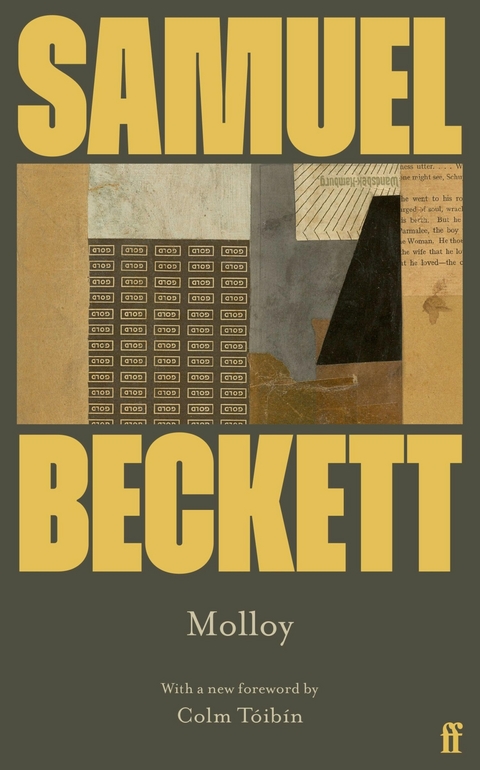
Molloy (eBook)
256 Seiten
Faber & Faber (Verlag)
978-0-571-39732-7 (ISBN)
Samuel Beckett was born in Dublin in 1906 and graduated from Trinity College. He settled in Paris in 1937, after travels in Germany and periods of residence in London and Dublin. He remained in France during the Second World War and was active in the French Resistance. From the spring of 1946 his plays, novels, short fiction, poetry and criticism were largely written in French. With the production of En attendant Godot in Paris in 1953, Beckett's work began to achieve widespread recognition. During his subsequent career as a playwright and novelist in both French and English he redefined the possibilities of prose fiction and writing for the theatre. Samuel Beckett won the Prix Formentor in 1961 and the Nobel Prize in Literature in 1969. He died in Paris in December 1989.
The first of the three greatest novels by the era-defining Nobel laureate, reissued for a new generation. I am still alive then. That may come in useful. Molloy, a sordid, bedridden vagrant, recalls a long bicycle ride in search of his mother. He describes sucking on stones, falling in love, getting arrested, killing a dog. Moran, a private detective, sets out to look for Molloy. But as Moran's physical and mental state deteriorate, his narrative starts to mirror Molloy's in mysterious ways. Molloy is the first of the three great novels Samuel Beckett produced during his 'frenzy of writing' in the late 1940s. The others are Malone Dies and The Unnamable.
I am in my mother’s room. It’s I who live there now. I don’t know how I got there. Perhaps in an ambulance, certainly a vehicle of some kind. I was helped. I’d never have got there alone. There’s this man who comes every week. Perhaps I got here thanks to him. He says not. He gives me money and takes away the pages. So many pages, so much money. Yes, I work now, a little like I used to, except that I don’t know how to work any more. That doesn’t matter apparently. What I’d like now is to speak of the things that are left, say my goodbyes, finish dying. They don’t want that. Yes, there is more than one, apparently. But it’s always the same one that comes. You’ll do that later, he says. Good. The truth is I haven’t much will left. When he comes for the fresh pages he brings back the previous week’s. They are marked with signs I don’t understand. Anyway I don’t read them. When I’ve done nothing he gives me nothing, he scolds me. Yet I don’t work for money. For what then? I don’t know. The truth is I don’t know much. For example my mother’s death. Was she already dead when I came? Or did she only die later? I mean enough to bury. I don’t know. Perhaps they haven’t buried her yet. In any case I have her room. I sleep in her bed. I piss and shit in her pot. I have taken her place. I must resemble her more and more. All I need now is a son. Perhaps I have one somewhere. But I think not. He would be old now, nearly as old as myself. It was a little chambermaid. It wasn’t true love. The true love was in another. We’ll come to that. Her name? I’ve forgotten it again. It seems to me sometimes that I even knew my son, that I helped him. Then I tell myself it’s impossible. It’s impossible I could ever have helped anyone. I’ve forgotten how to spell too, and half the words. That doesn’t matter apparently. Good. He’s a queer one the one who comes to see me. He comes every Sunday apparently. The other days he isn’t free. He’s always thirsty. It was he told me I’d begun all wrong, that I should have begun differently. He must be right. I began at the beginning, like an old ballocks, can you imagine that? Here’s my beginning. Because they’re keeping it apparently. I took a lot of trouble with it. Here it is. It gave me a lot of trouble. It was the beginning, do you understand? Whereas now it’s nearly the end. Is what I do now any better? I don’t know. That’s beside the point. Here’s my beginning. It must mean something, or they wouldn’t keep it. Here it is.
This time, then once more I think, then perhaps a last time, then I think it’ll be over, with that world too. Premonition of the last but one but one. All grows dim. A little more and you’ll go blind. It’s in the head. It doesn’t work any more, it says, I don’t work any more. You go dumb as well and sounds fade. The threshold scarcely crossed that’s how it is. It’s the head. It must have had enough. So that you say, I’ll manage this time, then perhaps once more, then perhaps a last time, then nothing more. You are hard set to formulate this thought, for it is one, in a sense. Then you try to pay attention, to consider with attention all those dim things, saying to yourself, laboriously, It’s my fault. Fault? That was the word. But what fault? It’s not goodbye, and what magic in those dim things to which it will be time enough, when next they pass, to say goodbye. For you must say goodbye, it would be madness not to say goodbye, when the time comes. If you think of the forms and light of other days it is without regret. But you seldom think of them, with what would you think of them? I don’t know. People pass too, hard to distinguish from yourself. That is discouraging. So I saw A and C going slowly towards each other, unconscious of what they were doing. It was on a road remarkably bare, I mean without hedges or ditches or any kind of edge, in the country, for cows were chewing in enormous fields, lying and standing, in the evening silence. Perhaps I’m inventing a little, perhaps embellishing, but on the whole that’s the way it was. They chew, swallow, then after a short pause effortlessly bring up the next mouthful. A neck muscle stirs and the jaws begin to grind again. But perhaps I’m remembering things. The road, hard and white, seared the tender pastures, rose and fell at the whim of hills and hollows. The town was not far. It was two men, unmistakably, one small and one tall. They had left the town, first one, then the other, and then the first, weary or remembering a duty, had retraced his steps. The air was sharp, for they wore greatcoats. They looked alike, but no more than others do. At first a wide space lay between them. They couldn’t have seen each other, even had they raised their heads and looked about, because of this wide space, and then because of the undulating land, which caused the road to be in waves, not high, but high enough, high enough. But the moment came when together they went down into the same trough and in this trough finally met. To say they knew each other, no, nothing warrants it. But perhaps at the sound of their steps, or warned by some obscure instinct, they raised their heads and observed each other, for a good fifteen paces, before they stopped, breast to breast. Yes, they did not pass each other by, but halted, face to face, as in the country, of an evening, on a deserted road, two wayfaring strangers will, without there being anything extraordinary about it. But they knew each other perhaps. Now in any case they do, now I think they will know each other, greet each other, even in the depths of the town. They turned towards the sea which, far in the east, beyond the fields, loomed high in the waning sky, and exchanged a few words. Then each went on his way. Each went on his way, A back towards the town, C on by ways he seemed hardly to know, or not at all, for he went with uncertain step and often stopped to look about him, like someone trying to fix landmarks in his mind, for one day perhaps he may have to retrace his steps, you never know. The treacherous hills where fearfully he ventured were no doubt only known to him from afar, seen perhaps from his bedroom window or from the summit of a monument which, one black day, having nothing in particular to do and turning to height for solace, he had paid his few coppers to climb, slower and slower, up the winding stones. From there he must have seen it all, the plain, the sea, and then these selfsame hills that some call mountains, indigo in places in the evening light, their serried ranges crowding to the skyline, cloven with hidden valleys that the eye divines from sudden shifts of colour and then from other signs for which there are no words, nor even thoughts. But all are not divined, even from that height, and often where only one escarpment is discerned, and one crest, in reality there are two, two escarpments, two crests, riven by a valley. But now he knows these hills, that is to say he knows them better, and if ever again he sees them from afar it will be I think with other eyes, and not only that but the within, all that inner space one never sees, the brain and heart and other caverns where thought and feeling dance their sabbath, all that too quite differently disposed. He looks old and it is a sorry sight to see him solitary after so many years, so many days and nights unthinkingly given to that rumour rising at birth and even earlier, What shall I do? What shall I do? now low, a murmur, now precise as the headwaiter’s And to follow? and often rising to a scream. And in the end, or almost, to be abroad alone, by unknown ways, in the gathering night, with a stick. It was a stout stick, he used it to thrust himself onward, or as a defence, when the time came, against dogs and marauders. Yes, night was gathering, but the man was innocent, greatly innocent, he had nothing to fear, though he went in fear, he had nothing to fear, there was nothing they could do to him, or very little. But he can’t have known it. I wouldn’t know it myself, if I thought about it. Yes, he saw himself threatened, his body threatened, his reason threatened, and perhaps he was, perhaps they were, in spite of his innocence. What business has innocence here? What relation to the innumerable spirits of darkness? It’s not clear. It seemed to me he wore a cocked hat. I remember being struck by it, as I wouldn’t have been for example by a cap or by a bowler. I watched him recede, overtaken (myself) by his anxiety, at least by an anxiety which was not necessarily his, but of which as it were he partook. Who knows if it wasn’t my own anxiety overtaking him. He hadn’t seen me. I was perched higher than the road’s highest point and flattened what is more against a rock the same colour as myself, that is grey. The rock he probably saw. He gazed around as if to engrave the landmarks on his memory and must have seen the rock in the shadow of which I crouched like Belacqua, or Sordello, I forget. But a man, a fortiori myself, isn’t exactly a landmark, because. I mean if by some strange chance he were to pass that way again, after a long lapse of time, vanquished, or to look for some lost thing, or to destroy something, his eyes would search out the rock, not the haphazard in its shadow of that unstable fugitive thing, still living flesh. No, he certainly didn’t see me, for the reasons I’ve given and then because he...
| Erscheint lt. Verlag | 11.3.2025 |
|---|---|
| Sprache | englisch |
| Themenwelt | Literatur ► Romane / Erzählungen |
| ISBN-10 | 0-571-39732-8 / 0571397328 |
| ISBN-13 | 978-0-571-39732-7 / 9780571397327 |
| Informationen gemäß Produktsicherheitsverordnung (GPSR) | |
| Haben Sie eine Frage zum Produkt? |
 EPUB (Adobe DRM)
Kopierschutz: Adobe-DRM
Adobe-DRM ist ein Kopierschutz, der das eBook vor Mißbrauch schützen soll. Dabei wird das eBook bereits beim Download auf Ihre persönliche Adobe-ID autorisiert. Lesen können Sie das eBook dann nur auf den Geräten, welche ebenfalls auf Ihre Adobe-ID registriert sind.
Details zum Adobe-DRM
Dateiformat: EPUB (Electronic Publication)
EPUB ist ein offener Standard für eBooks und eignet sich besonders zur Darstellung von Belletristik und Sachbüchern. Der Fließtext wird dynamisch an die Display- und Schriftgröße angepasst. Auch für mobile Lesegeräte ist EPUB daher gut geeignet.
Systemvoraussetzungen:
PC/Mac: Mit einem PC oder Mac können Sie dieses eBook lesen. Sie benötigen eine
eReader: Dieses eBook kann mit (fast) allen eBook-Readern gelesen werden. Mit dem amazon-Kindle ist es aber nicht kompatibel.
Smartphone/Tablet: Egal ob Apple oder Android, dieses eBook können Sie lesen. Sie benötigen eine
Geräteliste und zusätzliche Hinweise
Buying eBooks from abroad
For tax law reasons we can sell eBooks just within Germany and Switzerland. Regrettably we cannot fulfill eBook-orders from other countries.
aus dem Bereich