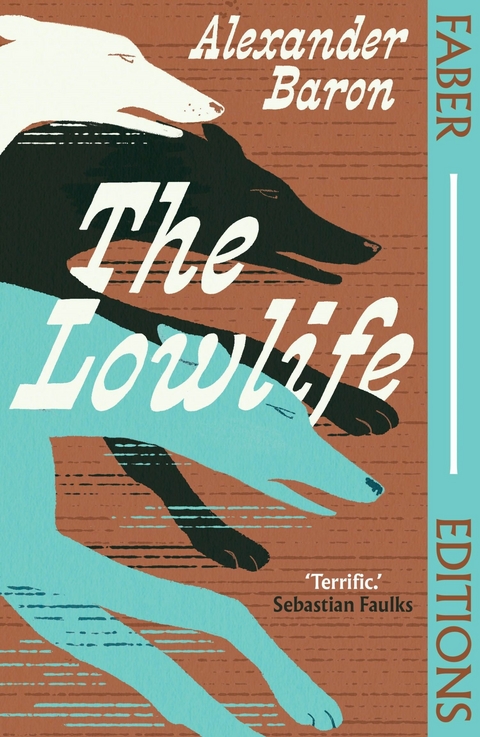
Lowlife (Faber Editions) (eBook)
252 Seiten
Faber & Faber (Verlag)
978-0-571-39348-0 (ISBN)
Alexander Baron (1917 - 1999) grew up in in Hackney, East London. The son of Jewish parents, he was drawn into the anti-fascist struggle, confronting Mosley's blackshirts on the streets of Whitechapel. He became assistant editor of Tribune before enlisting in the army in 1940 and fighting in Italy, Sicily and across France from the Normandy D-Day beaches. His experiences during the Second World War gave him the material for his first novel, From the City, From the Plough (1948), the first in his celebrated wartime trilogy. He wrote several novels set in London's East End as well as Hollywood screenplays and BBC adaptations of classic novels. Carl Foreman's great war film The Victors (1963) was adapted from Baron's The Human Kind (1953). He died in 1999.
One Londoner gambles on his own life in this lost classic by 'one of the great English Jewish novelists' (Times), introduced by Iain Sinclair. 'Terrific. Propulsive, funny and touching.' Sebastian Faulks'A fascinating snapshot of a lost London world, by a remarkable neglected writer.' Sarah WatersA wonderfully enduring novel . . . A great rediscovery.' William Boyd'Perfect . . . Captures London in all its grime and glory.' Benjamin MyersNever give up hope before the dogs have crossed the finishing-line. Harryboy Boas is a lowlife gambler. When he's not at the track, he lives in a Hackney boarding house, reading Zola, eating salt beef, pressing trousers and repressing wartime memories. But when a new family moves into the apartment downstairs, his life starts to unravel and Harryboy soon finds himself sinking into a murky East End underworld where violence, guilt and gangsters are the inevitable result for those who cannot pay their dues. A celebrated cult classic, The Lowlife brilliantly evokes post-war East London - dog tracks, sandwich shops, tenements, sex workers, newly arrived West Indians and Jews leaving for Finchley - all seen through the tragicomic eyes of Harryboy, our picaresque rogue hero suffering from 'existential burn-out in the shadow of the Holocaust' (Iain Sinclair) and driven to bet, brag and beg to survive. 'The greatest British novelist of the last war and among the finest, most underrated, of the postwar period.' Guardian
We live at a time when the pre-forgotten seek out the reforgotten, the old ones, hoping to verify a mythical past. Alexander Baron, when I visited him (with the film-maker Chris Petit) in the tranquillity of his Golders Green retirement, knew very well that the game had changed: he no longer had the publishers’ phone numbers, but he kept on writing. That’s what he did. What he had always done, since he returned from the war; a D-Day corporal, a former Communist. ‘A firebrand’, he called himself, ‘an extremist’. Why on earth would we want to talk to him? His books had drifted out of print. Even copies of his first big successes, From the City, From the Plough (1948), a novel which ran through countless editions, had to be searched out on market stalls or in Isle of Thanet charity pits.
In 1992, the journey to Baron’s Golders Green home was a disconcerting shift from the animation of Dalston Junction, competitive pavements and collisions, overspilling market with all the voices, to a tranquillised zone of watchful silence. It is only in 2024, in a political move that felt like a Transport for London tribute to Baron’s literary preoccupations, that a dedicated bus route, the 310, was launched. With no halts in potentially tricky territory along the way, passengers are freighted directly from Stamford Hill to Golders Green. This voyage, a classic centrifugal drift, makes manifest the spine of Baron’s fiction. And of his life. Fear of present acts of anti-Semitism provides the justification for a ‘safe’ route. Baron remembered Cable Street and Mosley’s mouthpieces in Ridley Road, but his own psychogeography was based in active community theatre, in communism, in direct confrontation with the spirit of place. He traced the trajectory of something much stronger than sentiment to the edge of the abyss, to Whitechapel.
We took the veteran author back to Cheshire Street, to Hare Marsh, the location for King Dido (1969), a fierce fable in which a working man rages against his inevitable fate, the taint in stone; the way that certain areas defy redemption. The elderly author, unpublished since 1979, when his Spanish novel, Franco Is Dying, met with the indifference that seems to be the lot of any awkward cuss who refuses to step aside when his number’s up, was bemused to find himself transported to an unconvincing but oddly familiar set. With his stocky build, silvered hair, fists bunched in the pockets of a white raincoat, he reminded Petit of the actor Lino Ventura in a underworld flick by Jean-Pierre Melville. Baron was physically strong but out of sync with present dereliction and neglect, the corrugated fence, the piles of smouldering rubbish, the feral dogs. To regress, to dredge up reminiscences of post-war Hackney, the family home, months of wandering the streets like a sleepwalker, was visibly stressful. He faced the cameras, square on, but his eyes moved away, tracking a palpable absence.
Something had gone badly wrong. The novels, when Baron discussed them with one of the new generation who found their way to his house—the novelist John Williams, or the researchers Jeb Loy Nichols and Lorraine Morley (Other Words, December 1988)—were written by a doppelganger, a cocky pretender who shared the old man’s name. ‘You’ve stirred up memories there,’ he would say. This was a mensch, modest, soft-spoken, generous with his time. A man who had outlived his expectations. There were no comebacks on the horizon, but Baron’s books, so the youthful pilgrims insisted, lived on in the perpetual present of achieved and transformed experience. Reservoirs of darkness can never be dispersed. The Hare Marsh pub, outside which Dido Peach fights, emerged with the passage of time as the Carpenter’s Arms, a command post for the Kray twins; the backwater from which they set out on the night that Jack ‘The Hat’ McVitie was killed. Violence feeds on acoustic echoes, fictional templates.
Baron was a true Londoner, which is to say a second-generation immigrant, a professional stranger; the confrontations of urban life were always a major part of his project. His novels are enactments of placed (rather than displaced) autobiography. Favoured geographical zones represent stages in the evolution of the author’s sensibility. King Dido is Whitechapel, the bloody theatre of survival; the microclimate from which the disenfranchised newcomer has to escape. Aspirant Hackney tolerates the well-crafted fiction of Baron’s maturity. Golders Green is the serene garden, the final reservation from which all the mistakes, loves and dramas can be recalled, re-imagined, appeased.
Hackney was where Baron returned when he was demobbed. To his mother’s house. A period of wandering the streets, meditative traverses, gave him the time to notice the minute particulars of a ravished landscape, the scams and hustles, the culture shifts. Years later, in 1963, sifting those post-war memories, he would craft The Lowlife, his delirious Hackney novel. ‘A writer’s job,’ Baron told Jeb Loy Nichols, ‘is to be the spectator who hopes he can see more of the game and try to make sense of it.’
The wonder of The Lowlife is that it does justice to a place of so many contradictions, disguises, deceptions, multiple identities. Hackney, I had thought, was defined by being indefinable. A fistful of mercury. Shape it and it spills. A logging of Kingsland Road, which I attempted in Lights Out for the Territory (a book of speculative London essays), was redundant before I reached Dalston Junction. Graffiti, as I copied them into a notebook, were overpainted; the heavy drench of jerk chicken giving way to the scented fug of Kurdish football clubs. Balkan refugees punting contraband cigarettes blocked my view of a voodoo boutique that was doomed before I could finish counting the shrunken skulls. An old-time manufacturer of bespoke dressing-gowns (think David Kossoff) lived on as a faded sign, partly obscured by a swivelling surveillance camera on a tall pole. Time is thinner (and faster) now. More text, less meaning. The Lowlife, with the lean and disciplined structure of old-time social realist television, captures the moment of transition. The known is still known—market gardens, brick works, oily-fingered industry—but the new life, brought by the West Indians, Bangladeshis, is recognised early, and celebrated.
Harryboy Boas, a gambler and sometime Hoffmann presser, lives in a boarding-house (timid/aggressive landlord skulking like a rat in the basement), on the hinge of Dalston and Stoke Newington; between the frenzy of Ridley Road Market and the hushed Hasidic enclave to the north. Harry has a privileged sense of history: as personal experience. He knows that Hackney isn’t, properly speaking, the East End. Nobody stays there. It’s a staging post on the journey to respectability (EastEnders, the TV soap, accurately replicates the physical outline of squares and pubs that can be found in the borough, but its fabulous demographics—mouthy geezers with a graveyard pallor, nightclub speculators, blacks and Asians as token frame-fillers—belong much further out. In Essex. Romford, Hornchurch, Upminster.)
Harry is detached, an observer. He’s damaged; compensating for events in his own past which have left him with a nagging sense of loss. He lives in an amnesiac daze, a willed forgetting: existential burn-out in the shadow of the Holocaust. Nothing to be done and he’s doing it on a daily basis. He has his analgesic rituals: the heavy lunch, long afternoons reading and dozing on the bed, the prostitute, the good cigar. Gambling is risk, inevitable loss. Necessary punishment. It is his only connection to the life of the city, the mob. The rigorous scholarship with which Harryboy chases his fancies, three-legged dogs and hobbled nags, is religious. He is a righteous man studying the Torah of the Tote. Temporary wealth, the wad that spoils the hang of a good suit, must be rapidly dispersed, recycled; converted into secondhand literature. Conspicuous charity, hits of sensual pleasure, return Harryboy to the Zen calm of having nothing, no possessions, no attachments, no unfulfilled ambitions.
The Lowlife moves at a pace. The mundane domesticity of Harryboy’s boarding-house totters on the brink of a Gothic abyss, the half-remembered horrors of Whitechapel and the river. If he should falter, lose faith, hit a bad run at the track, he could be sucked into the swamp, the Jack London nightmare. He would join the animals, fighting for a crust. In one vivid episode, Harry takes an excursion to the lower depths: he’s toying with respectability, an investment in a slum property. He wins a house, a terrace of houses, on a cut of the cards; then loses everything to an Indian in a Cable Street dive: ‘a smell in the café which was like asthma cigarettes’. Alexander Baron forsees Peter Rachman: the treaty of convenience between prostitution, dope, bricks and mortar. The Hackney gambler is advised by Marcia, a tart he sometimes...
| Erscheint lt. Verlag | 6.5.2025 |
|---|---|
| Einführung | Iain Sinclair |
| Sprache | englisch |
| Themenwelt | Literatur ► Krimi / Thriller / Horror |
| Literatur ► Romane / Erzählungen | |
| ISBN-10 | 0-571-39348-9 / 0571393489 |
| ISBN-13 | 978-0-571-39348-0 / 9780571393480 |
| Informationen gemäß Produktsicherheitsverordnung (GPSR) | |
| Haben Sie eine Frage zum Produkt? |
 EPUB (Adobe DRM)
Kopierschutz: Adobe-DRM
Adobe-DRM ist ein Kopierschutz, der das eBook vor Mißbrauch schützen soll. Dabei wird das eBook bereits beim Download auf Ihre persönliche Adobe-ID autorisiert. Lesen können Sie das eBook dann nur auf den Geräten, welche ebenfalls auf Ihre Adobe-ID registriert sind.
Details zum Adobe-DRM
Dateiformat: EPUB (Electronic Publication)
EPUB ist ein offener Standard für eBooks und eignet sich besonders zur Darstellung von Belletristik und Sachbüchern. Der Fließtext wird dynamisch an die Display- und Schriftgröße angepasst. Auch für mobile Lesegeräte ist EPUB daher gut geeignet.
Systemvoraussetzungen:
PC/Mac: Mit einem PC oder Mac können Sie dieses eBook lesen. Sie benötigen eine
eReader: Dieses eBook kann mit (fast) allen eBook-Readern gelesen werden. Mit dem amazon-Kindle ist es aber nicht kompatibel.
Smartphone/Tablet: Egal ob Apple oder Android, dieses eBook können Sie lesen. Sie benötigen eine
Geräteliste und zusätzliche Hinweise
Buying eBooks from abroad
For tax law reasons we can sell eBooks just within Germany and Switzerland. Regrettably we cannot fulfill eBook-orders from other countries.
aus dem Bereich