


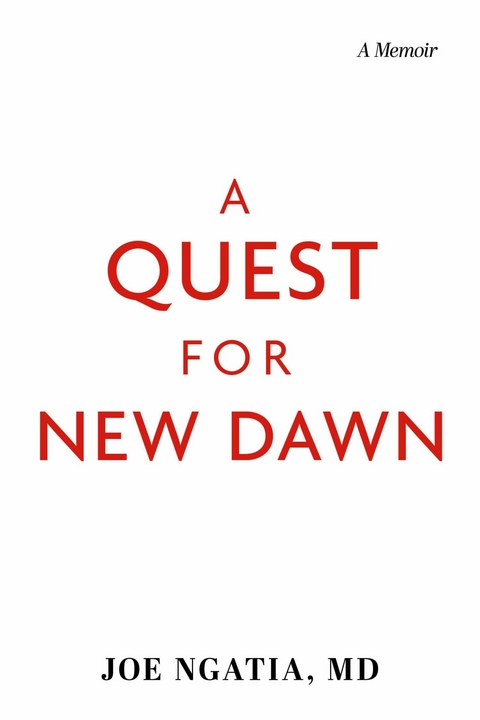
Quest for New Dawn (eBook)
488 Seiten
Bookbaby (Verlag)
979-8-3509-8844-4 (ISBN)
Dr. Joe Ngatia is an anesthesiologist who provides life-supporting care to patients undergoing minor and major surgeries. His breadth of clinical expertise ranges from newborn care to older patients undergoing complex surgeries. He was born and raised in a remote tribal village in the foothills of Mount Kenya. His extensive and unique life experiences include a childhood among the veterans of the Mau Mau uprising, a four-year stint in a tough all-boys boarding high school, and a two-year full-time service as a Mormon Missionary in East Africa. He received his associate's degree in pre-medicine from Ricks College in Idaho, a bachelor's degree in microbiology from Brigham Young University, and a medical doctorate from the University of Utah School of Medicine. He completed a surgical internship and anesthesiology residency at the University of Florida in Gainesville, Florida.
In A Quest for New Dawn, Joe Ngatia gives the reader an intimate glimpse of his epic life journey. Through a rich and vivid narrative, we are compelled to contemplate life's most timeless and universal questions. The story begins in a remote village on the foothills of Mount Kenya. Towering mountains and pristine valleys surround this enchanting natural paradise. But it is also a pitiless world, where, in the words of Goethe, "e;life and freedom must be conquered anew each day"e; by all its inhabitants. This region has a dark past as it was the epicenter of the Mau Mau uprising against British colonial rule. Long after the end of the war of liberation, the invisible specter of imperial terror still casts a shadow of dread in the hearts of those who survived it. It is on the laps of these veterans that the author finds his first perch in life. We encounter a restless society, as it turns away from an ancient rhythm to the chaos of modernity. Nowhere is this change more acutely felt than on the brutal campuses of the nation's boarding schools; here, ambitious teenagers are ushered onto the path of intellectual curiosity while confronting momentous privations and challenges. The most transformative event in the author's youth occurs at the age of seventeen when he meets Mormon missionaries. His conversion and devotion to this foreign and maligned religion set the stage for a moving psychological drama that takes centerstage during the next two decades. It is as a Mormon that he embarks on a grueling mission to convert "e;the gentiles"e; in his own country; he is inspired by its theology to seek an immigrant visa at the American Embassy in Nairobi where he is nearly annihilated by a terrorist's bomb in the process. He eventually moves to an alien landscape in the American West where his eyes are opened to the hidden history and unsavory secrets of his new faith. Accompanying this spiritual drama is an intense, and at times humorous, lived reality of a poor foreign student with an oversized ambition. His insatiable quest for meaning, more than his grit and wits, sees him through the long and fierce struggles that pave his path through college and medical training. After he is inducted into the specialty of anesthesiology, he discovers in its practices a power more potent than a magician's spell. In its craft, the curtain of consciousness is pulled back, exposing a magnificent hidden universe behind our eyeballs. Through the discerning gaze of his brilliant mind, we are exposed to the intricacies of the human condition in captivating and affecting details. In the end, we are at once awakened and liberated from a primal innocence. It is at this intersection of grace and terror that he finds a new dawn.
Chapter One
I came to life in a world carved out of bare earth. Our grass-thatched, dirt-floor, circular mud huts melded into the landscape like ant mounts on the savannah. Most pieces of furniture in the hut were barely a step removed from their natural state of existence. Timeless volcanic rocks, arranged in a triangle, formed the hearth, where the ambience of domesticated fire connected the living to their departed ancestors. Around this fiery altar, our forebears’ palpable presence felt like a mere stretch of hands across the flaming embers.
The fireplace was at the center of the hut. Above it was the itara, a loft where firewood was dried and stored. The interior décor in every hut included the ubiquitous traditional jungwa, three-legged stools carved from tree trunks. When metal nails found their way to our village, however, the jungwa gave way to comfort and convenience. A new type of chair with back-support appealed to the aging, even though misplaced nails occasionally launched old bones into anguished flight. Low, short benches were pieced together to seat several children, allowing parents of meager means the privilege of reproducing without the hassle of scavenging for additional seating.
Beds were equally simple. They were made of a wooden frame, with crisscrossed rubber bands forming the central support. Fortunately, the mud walls and thatched roofs were impenetrable to exterior weather; otherwise, our threadbare blankets and thin mattresses would have been woefully inadequate for warmth. They offered refuge to both humans and bedbugs. When an infestation grew unbearable, the beddings were hand washed and laid outside in the sun to dry, while tribesmen sprayed the bed frames with pesticides (usually Malathion) without the slightest awareness that vulnerable humans, too, could be harmed by these chemicals. For a few days afterwards, the garlic-like smell of this pesticide would follow us to our dreams.
Our cooking pots (nyungu) were molded from clay, although later we’d have “modern” aluminum cookware. We mostly ate with our bare hands from bowls made from calabash (kihuri), the gentle heat of the food warming the fingertips as they scooped up mashed potatoes, maize, and beans. But all around us, a glacial but sustained incursion was gradually altering the ancient balance of life. Like everywhere else on the planet, the march of technology subtly disrupted the intimate connection between man and nature. Eventually, the harshness of stainless steel would accompany each morsel to the tongue. Not everyone in the village was eager to embark on this expedition to modernity, but the radical hold-outs who insisted on clinging to the primal past risked falling into the disreputable company of night-runners and witches.
Still, the business of life carried on at an unhurried pace. During the wet season, the rains fell on our thatched roofs soundlessly, quenching the thirst of parched earth. As the inviting scent of rain perfused the air, we converged around the fire to listen to ageless tribal folklore.
“Once upon a time,” Grandma’s voice rose above the flames, “there was a terrible drought. All the animals were haunted by an endless famine. The hyena roamed everywhere searching for food, but the ravenous drought had even consumed the carcasses. He knew his days were numbered when his empty stomach begun to rub against his spine. Out of despair, he turned to Kirinyaga (Mount Kenya) and cried to Ngai (God) with a solemn supplication. Thaai thathaiya Ngai thaai! he pleaded. Suddenly, Ngai answered his prayers with a fat calf tied to a tree. Wait a minute, hyena said to himself, why was I wasting my time begging Ngai for food while all I had to do was open my eyes to the tethered calf right next to me? He turned his gaze to Kirinyaga and told Ngai he didn’t need his help after all. Who did that?”
“Who did what?” we, the children, inquired in a chorus of confusion, eager to resolve the problem and return to the storytelling.
“Someone farted…what stench! His anus must be rotten!” Grandma retorted with barbed harshness.
Grandma had a terrible temper, and when it erupted, searing lava spewed out of her mouth. Her anger was sheer madness. Like a fiery jolt of electricity, it charged and animated her wiry frame with diabolical vigor. While the inferno raged, I’d descend into the hidden crevasses of my inner landscape: the bitter taste on a tongue that seemed to swell, the cold chill of fear, the rise and fall of a chest full of baited breath….and then, at last, the warm rush of blood to the face when the storm broke.
“Where were we?” Grandma inquired when she reunited with sanity.
“The hyena found a fat calf,” I answered eagerly. Goddamn it, I would have added, if only I could.
“Yes, the calf tied to the tree…and he told Ngai that he had wasted his time praying since he had discovered this bounty all on his own,” Grandma continued. “Now, the hyena was desperately hungry and intended to savor every bite of this timely meal. He decided to start by eating the rope with which the calf was tethered before moving to the tender steak. As he ate the rope, he closed his eyes with pleasure. He had been so hungry, so close to dying! Salvation had arrived at the nick of time. But…just then the calf saw an opportunity to save her life. She jumped into the air and took off in great speed. The stiff rope jerked and plucked out all of the hyena’s teeth. Still starving, but now also wounded and toothless, the hyena’s fate was sealed!”
“What a foolish hyena!” Uncle Maina declared, opening the floor to commentary and opinions.
“I’d have eaten the calf first, and then finished with the rope if I was still hungry,” Aunt Njeri stated.
“Maybe the rope was sweet…perhaps it was made from sugarcane,” Uncle Kamanu, Grandma’s last-born son, chimed in.
“But aren’t you glad the calf escaped?” Joyce, my sister, said, forcing a shift in focus.
I routinely had little to add to Grandma’s evocative stories. This was partly because they turned on a powerful switch in my head. It was almost as if I was physically thrown into that realm where animals talked and schemed, fully possessed of human emotions. It always took some effort for me to extricate myself and return to the ordinary world.
***
As long as I can remember, my life was a winding maze. Even as a child, I knew that my place in society was tenuous, and nothing was guaranteed. I don’t know exactly when my sister and I ended up in our maternal grandparents’ custody. Our parents had mysteriously fallen off the face of the earth, although that fact, too, was lost to me. In my earliest memory, I am in my grandparents’ village, the only home I knew. The sun is hot, and I am coming home from Gititu Nursery School, indicating that I am four or five years old. My grandpa has finally come through with a promise. I can still see the brown calf with a white starry patch on her forehead. I don’t quite recall if the calf was a replacement or the first cow we had ever owned, but for obvious reason, we named her Njata (star).
My grandmother, Damaris Nyambura, was a fierce, indomitable woman who worked tirelessly from dawn to dusk to eke out a living for her large family. She kept a herd of goats and a single cow throughout my childhood. Whenever the cow gave birth, the calf was sold off as soon as it was weaned.
Grandma’s life revolved around the family’s hilly patch of land, which her husband had inherited from his clan. She was one of the countless rural African peasants who, in spite of endless toils, only managed to live from hand to mouth. She defied every stereotype of a grandmother. She was irritable and easily driven to verbal and physical violence. I called her Mami, which was our Kikuyu language transliteration of the English Mommy. Until much later, I assumed she was every bit my biological mother, as she was to my aunts and uncles. In fact, four of my mother’s younger siblings were just slightly older than my sister and me. Uncle Kamanu, Grandma’s youngest, was my classmate in fourth grade, but I later left him behind when he was held back because of academic challenges.
On the other hand, my grandfather was a mild-mannered, quiet man who preferred solitude over company. I called him Baba, Kikuyu for father, for the same reason that I called Grandma Mami. Grandpa hardly ever did any work. He spent most of his days resting on a torn sisal bag under the shade of a large tree near the homestead. He was a broken man who only remained among the living because death had not yet claimed him.
There was minimal interaction between Grandpa and Grandma. I do recall an occasion when Grandma directed her temper toward him. She had been annoyed by Grandpa, for reasons I wasn’t privy to, and had reacted in her usual style by hurling insults at him. He had threatened to put her in her place, which only stoked her rage. The verbal exchange was soon followed by a scuffle in the garden next to our homestead. Physical confrontation between the frail man and his more powerfully built bedfellow was a scene I had never witnessed. For not-so-mysterious reasons, the ruckus brought thrills and excitement to my youthful heart. I was rooting for Grandpa, hoping he’d beat the insolent cobra into total submission. Needless to say, the odds were not in his favor. To...
| Erscheint lt. Verlag | 14.2.2025 |
|---|---|
| Sprache | englisch |
| Themenwelt | Literatur ► Biografien / Erfahrungsberichte |
| ISBN-13 | 979-8-3509-8844-4 / 9798350988444 |
| Informationen gemäß Produktsicherheitsverordnung (GPSR) | |
| Haben Sie eine Frage zum Produkt? |
 EPUB (Ohne DRM)
Größe: 825 KB
Digital Rights Management: ohne DRM
Dieses eBook enthält kein DRM oder Kopierschutz. Eine Weitergabe an Dritte ist jedoch rechtlich nicht zulässig, weil Sie beim Kauf nur die Rechte an der persönlichen Nutzung erwerben.
Dateiformat: EPUB (Electronic Publication)
EPUB ist ein offener Standard für eBooks und eignet sich besonders zur Darstellung von Belletristik und Sachbüchern. Der Fließtext wird dynamisch an die Display- und Schriftgröße angepasst. Auch für mobile Lesegeräte ist EPUB daher gut geeignet.
Systemvoraussetzungen:
PC/Mac: Mit einem PC oder Mac können Sie dieses eBook lesen. Sie benötigen dafür die kostenlose Software Adobe Digital Editions.
eReader: Dieses eBook kann mit (fast) allen eBook-Readern gelesen werden. Mit dem amazon-Kindle ist es aber nicht kompatibel.
Smartphone/Tablet: Egal ob Apple oder Android, dieses eBook können Sie lesen. Sie benötigen dafür eine kostenlose App.
Geräteliste und zusätzliche Hinweise
Buying eBooks from abroad
For tax law reasons we can sell eBooks just within Germany and Switzerland. Regrettably we cannot fulfill eBook-orders from other countries.
aus dem Bereich


