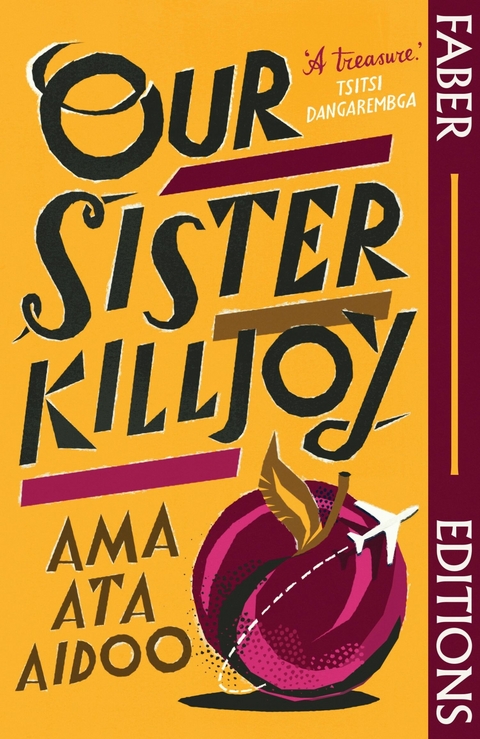
Our Sister Killjoy (Faber Editions) (eBook)
252 Seiten
Faber & Faber (Verlag)
978-0-571-38801-1 (ISBN)
Ama Ata Aidoo (1942- 2023) was a Ghanaian novelist, playwright, poet, politician, academic and activist: 'one of Africa's leading literary lights as well as its most influential feminists' (New York Times). Born in a Fante royal household, her grandfather had been murdered by British neocolonialists, and her father was a chief who built their village's first school. Aidoo attended Wesley Girls' High School and obtained a degree in English from the University of Ghana, Legon. She won her first story contest aged 19, and her breakthrough play, The Dilemma of a Ghost, made her the first published female African dramatist in 1965. Her debut novel, Our Sister Killjoy, or Reflections From a Black-Eyed Squint,was published in 1977, and Changes: A Love Story won the 1992 Commonwealth Writers' Prize. Aidoo rejected the 'Western perception that the African female is a downtrodden wretch' and chronicled the fight for equality as inextricable from colonial legacies. She taught at the University of Ghana for years, and served as a lecturer and professor in English at the University of Cape Coast. A Fulbright scholar, Aidoo spent many years as an expatriate academic and writer in residence. She also served as Minister of Education in Ghana in the early 1980s but resigned when she could not achieve her goal of making education free for all. After moving to Zimbabwe in 1983, she developed curriculums for the government, and later founded the Mbaasem Foundation in 2000 to support African women writers.
Join a young Ghanaian woman on her journey into Europe's heart of whiteness to meet the natives in this iconoclastic modern classic. 'A wondrous discovery.' Chimamanda Ngozi Adichie'A treasure: one of the works that inspired my own literary journey.' Tsitsi Dangarembga'Aidoo has reaffirmed my faith in the power of the written word.' Alice Walker'Modest, lyrical, reflective and intelligent .. Deserves as wide an audience as it can get.' Angela CarterFish and chips. They lied. They lied. They lied. Sissie is leaving Africa for the first time, arriving in Europe on a scholarship to experience the glories of a Western education. In Germany, as guest of honour over embassy cocktails, she cringes at her countrymen. In a Bavarian castle, she is seduced by a lonely local mother to Little Adolf. In freezing London, she witnesses 'been-tos' sharing myths of an overseas idyll. In between continents, she writes a letter on the plane to her exiled former lover. But it is not sent. She will tell these tales back at home. Ama Ata Aidoo's landmark debut Our Sister Killjoy exploded into the world in 1977. With its blistering feminist satire of the African diaspora, colonial legacies and toxic racism, expressed in a radical literary form - prose poetry, letter, manifesto - its provocative impact remains unmatched.
It is a long way from home to Europe. A cruel past, a funny present, a major desert or two, a sea, an ocean, several different languages apart, aeroplanes bridge the skies.
Her journey must have had something to do with a people’s efforts
‘to make good again;’
Because right from the beginning, the embassy had shown a lot of interest.
The minute her name had been submitted, they had come to the campus looking for her in a black Mercedes-Benz, its flag furled.
They had pulled strings for her to obtain her passport in a week instead of three months, and then advised her on the different inoculations to take.
Later, as time shrank for her to leave, the ambassador himself had invited her to his home. The first time to a cocktail party at which it was fairly clear that she was the only insignificant guest, and then to a small dinner in her own honour.
She was to remember that second evening for a long time. It had been full of many things that puzzled her.
The care they must have taken.
The effort they seemed to have made.
She tried very hard to understand why they wanted to go to such trouble.
Crisp table linen.
Glasses and cutlery that shone.
The food, which she instinctively knew was first class in spite of its foreigness, was served from steaming pots.
There was European wine. Her first encounter with that drink.
Who did they think she was?
There had been six of them.
There was the ambassador and his wife
There was another European man who might have been what she was to learn later was the First Secretary, and his wife.
Then there was this African, a single man, her fellow countryman.
She had no idea who he was and did not catch his proper name when they were introduced to each other.
Throughout the evening, they referred to him as Sammy, which was therefore, the only name she could ever associate with him in her mind.
Sammy laughed all the time: even when there was nothing to laugh at. Or when she thought there was nothing to laugh at.
And when he was not laughing loudly, he carried a somewhat permanent look of well-being on his face, supported by a fixed smile.
Sammy had obviously been to their country before and seemed to have stayed for a long time. He was very anxious to get her to realise one big fact. That she was unbelievably lucky to have been chosen for the trip. And that, somehow, going to Europe was altogether more like a dress rehearsal for a journey to paradise.
His voice, as he spoke of that far-off land, was wet with longing.
Perhaps he had been invited to the dinner just to sing of the wonders of Europe?
He spoke their language well and was familiar with them in a way that made her feel uneasy.
Our Sister shivered and fidgeted in her chair.
Saliva rose into her mouth every time her eyes fell on her countryman’s face.
More saliva rushed into her mouth every time he spoke.
She did not enjoy the food: and the strangeness of it was not the reason.
Time was to bring her many many Sammys. And they always affected her in the same way …
On the evening she was leaving, the ambassador and some members of his staff came to the airport to see her off.
Their press officer took pictures of her as she said her farewells.
About a week after she was gone and like a posthumous award, they published her picture in the local newspaper with some information on the trip.
Our Sister had made it.
At the time, many airlines were not allowed to stop at Accra because Johannesburg and other Afrikaaner cities formed a backbone to their African business.
One more Nkrumahn hallucination.
The man was great.
Therefore, Sissie took a plane from Accra to Lagos where she was to join another which would take her to Europe.
It had already arrived from the pit that is South Africa.
Some of us called that land Azania.
Ma-a-ma, ain’t no one can laugh at hisself like us.
Besides, when hope dies, what else lives?
As the announcement for departure came, Sissie went on board. She looked at her boarding pass and took the seat indicated on it. It was in the front section of the plane, and by two other seats already occupied by some two Europeans she later learnt were South Africans.
Immediately after they were airborne and instructions had come for them to loosen their belts and feel free to smoke, a neatly coiffured hostess of the airline walked to her. She said, ‘You want to join your two friends at the back, yes?’
‘My two friends?’ wondered Sissie.
She raised her eyes and, following the direction of the hostess’s finger, saw two faces. She was about to say she had not met them before …
Something told her to cool it.
She went to join them.
Of course, it was a beautiful coincidence that they were two extremely handsome Nigerian men who were going on the same programme she was on.
But to have refused to join them would have created an awkward situation, wouldn’t it? Considering too that apart from the air hostess’s obviously civilised upbringing, she had been trained to see to the comfort of all her passengers. Naturally, she was only giving Sissie a piece of disinterested advice to make her feel at ease enough to enjoy her flight
The hours of the flight had been organised in such a way that they passed over the bit of Africa left in their way in the dead hours of the night.
So that it was nearly dawn when they crossed the Mediterranean Sea. And as they left Africa, there was this other continent, lighted up with the first streaks of glorious summer sunshine.
Good night Africa. Good morning Europe.
Meanwhile, the moon had been travelling at eye level with them all night. Silent, deathly pale.
Some of us were to wonder at a future date whether the astronauts saw any madness-carrying bugs crawling in millions on rocks that they say have never known heat.
Maybe they didn’t notice anything like that.
Not part of operational specifics.
And why should it have been?
It definitely was not to pander to dark superstitious minds that fifty billions were spent!
But just where and when the sun came to chase the moon away, Our Sister thought she heard the music of the spheres.
The Alps at six o’clock in the morning. Grey rocks, more grey rocks. One huge grey rock … Is it really possible that any part of the earth can also reach so high in the sky?
Sissie was overwhelmed, a lowland born. Wondering if this was not the beginning of the world and amoeba yet to be.
She was to wonder the same, many years later in Kenya, as she stood somewhere in the Great Rift Valley, two miles deep in the bowels of the Earth.
Frankfurt. There was an official at the airport to meet them and see that all went smoothly.
From the airport, they took a taxi which drove them into the centre of the city.
The functionary guided them to an eating place where he ordered breakfast for four, including himself.
After they had eaten, they hired another taxi to a railway station. They were going to take a train from there to a small town where they would stay for two weeks and learn to get used to being in a very strange country.
At the station, they learnt that their train would not leave for another hour.
Therefore Sissie felt like strolling around instead of sitting on one spot.
The official was worried. However, Sissie assured him that she would not wander away. There was plenty in the neighbourhood to occupy her. For instance, there seemed to be more shops right inside the station than in the whole of her country. There was no need for her to go outside and get lost.
So she walked along in her gay, gold and leafy brown cloth, looking, feasting her village eyes.
Cloths. Perfume. Flowers. Fruits.
Then polished steel. Polished tin. Polished brass. Cut glass. Plastic.
As Sissie moved among what was around, saw their shine and their glitter, she told herself that this must be where those ‘Consumer Goods’ trickled from, to delight so much the hearts of the folks at home. Except that here, there were not only a million times more, but also a thousand times better.
Music. Sounds. Noises.
So many different noises mixed together.
Suddenly, she realised a woman was telling a young girl who must have been her daughter:
‘ja, das schwartze mädchen.’
From the little German that she had been advised to study for the trip, she knew that ‘das...
| Erscheint lt. Verlag | 11.2.2025 |
|---|---|
| Einführung | Ayesha Harruna Attah |
| Sprache | englisch |
| Themenwelt | Literatur ► Romane / Erzählungen |
| ISBN-10 | 0-571-38801-9 / 0571388019 |
| ISBN-13 | 978-0-571-38801-1 / 9780571388011 |
| Informationen gemäß Produktsicherheitsverordnung (GPSR) | |
| Haben Sie eine Frage zum Produkt? |
 EPUB (Adobe DRM)
Kopierschutz: Adobe-DRM
Adobe-DRM ist ein Kopierschutz, der das eBook vor Mißbrauch schützen soll. Dabei wird das eBook bereits beim Download auf Ihre persönliche Adobe-ID autorisiert. Lesen können Sie das eBook dann nur auf den Geräten, welche ebenfalls auf Ihre Adobe-ID registriert sind.
Details zum Adobe-DRM
Dateiformat: EPUB (Electronic Publication)
EPUB ist ein offener Standard für eBooks und eignet sich besonders zur Darstellung von Belletristik und Sachbüchern. Der Fließtext wird dynamisch an die Display- und Schriftgröße angepasst. Auch für mobile Lesegeräte ist EPUB daher gut geeignet.
Systemvoraussetzungen:
PC/Mac: Mit einem PC oder Mac können Sie dieses eBook lesen. Sie benötigen eine
eReader: Dieses eBook kann mit (fast) allen eBook-Readern gelesen werden. Mit dem amazon-Kindle ist es aber nicht kompatibel.
Smartphone/Tablet: Egal ob Apple oder Android, dieses eBook können Sie lesen. Sie benötigen eine
Geräteliste und zusätzliche Hinweise
Buying eBooks from abroad
For tax law reasons we can sell eBooks just within Germany and Switzerland. Regrettably we cannot fulfill eBook-orders from other countries.
aus dem Bereich