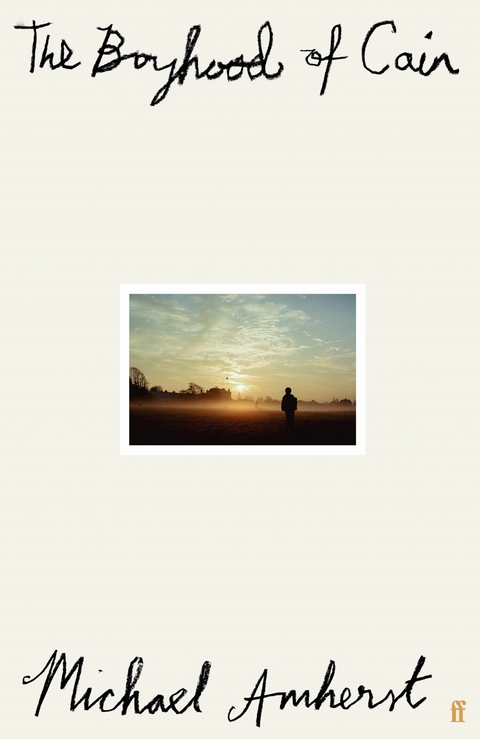
Boyhood of Cain (eBook)
256 Seiten
Faber & Faber (Verlag)
978-0-571-38762-5 (ISBN)
Michael Amherst has been published in the Guardian, New Statesman, the Spectator, The White Review and Contrappasso magazine. His book-length essay, Go the Way Your Blood Beats, won the 2019 Stonewall Nonfiction Prize. He is also the winner of the 2020 Hubert Butler Essay Prize and was shortlisted for the Observer/Anthony Burgess Prize for Arts. His short fiction has been longlisted for the BBC National Short Story Award and shortlisted for the Bridport Prize, and has featured at Stroud Short Stories, the inaugural London LitCrawl and the Accidental Festival at London's Roundhouse. The Boyhood of Cain is his first novel.
** An Irish Times and New Yorker Book of the Year **'Terrific.'Guardian'A powerful, searing tale.' Andre Aciman'I read this book with my heart in my mouth and could not put it down.' Mary Costello'Amherst has created a young protagonist of extraordinary depth and complexity.' Nathan Filer'A beautiful coming-of-age story.' Michael Magee'A stellar achievement.' The CriticA poignant debut novel about a boy on the precipice of adulthood, struggling to understand how he might give and deserve love. Danny's family live in a large house close to the school where his father is headmaster. At school, his father's importance gives Danny certain privileges, but it also sets him apart from his classmates. When a new boy Philip, for whom everything seems easy, arrives, he surprises Danny by wanting to be friends. So when he and Philip are invited to work after school with inspiring, artistic teacher Mr. Miller, Danny believes he has found somewhere he can shine. Until Danny's world tilts: his father loses his job, and their house. And then Danny finds himself shut out from Mr. Miller and Philip's world too. Desperate to make amends, he keeps trying to find a way back in, but will Danny's efforts send things spinning beyond everyone's control?Readers love The Boyhood of Cain?????'Beautifully written study of childhood innocence into adolescence. Short but perfectly formed.'?????'Emotional and very atmospheric.'?????'So evocative.'????'The book captures the delicate, almost ethereal atmosphere of English summers and schoolyard anxieties.'????'The insight into the mind of the boy is exceptional and the result is very moving.'
In class, the teacher, Mrs Walters, tells them animals can see only in black and white.
‘What about my cat?’ he asks.
‘All cats,’ she tells them.
‘So what about my uniform? Can they—’
‘It would all be black and white,’ she says. ‘Black, white and grey.’
Throughout the rest of the lesson, they are given three photographs, which they must copy onto pieces of paper. He has a picture of a family, one of a cat and dog, and finally an owl in a tree. They are told they must draw each of these out twice, and colour them in – once as they see it, and once as animals see it. The teacher shows them how deep reds and blues will become almost black, while the light tones of skin, pale pinks and yellows will appear grey or almost white.
Midway through he puts his hand up to ask a question.
‘Also, some people are colour-blind,’ he says.
‘Yes,’ responds the teacher.
‘And animals only see black and white.’
‘Yes.’
‘So how do we know what the real colour is?’
The teacher doesn’t understand the question.
‘Well, we might see the sky as blue and a cat might see it as grey, but really it might be green,’ he says.
‘I don’t think so,’ she responds, and she makes her way down the aisle of desks.
He puts his hand up again. But the teacher does not respond or pretends not to see. Eventually, desperate, he calls out: ‘But we don’t know. What if the animals are right? What if everything is only grey?’
The girl sat in front of him tells him to shut up, before covering her work with a hand. Maybe she thinks he is showing off.
‘I don’t believe, if everything were only grey, we would be able to see all the other colours,’ the teacher tells him, crossing her arms across her breast. ‘If we can see all the colours – all the extra colours – then they must be there. While the animals can only see two colours – black and white, and the two mixed together as shades of grey.’
The boy thinks again.
‘Maybe there are lots of other colours,’ he begins. ‘Other colours we can’t see. Maybe the grass is blue and the sky is green. What if—’
‘Look,’ the teacher finally says. ‘I don’t think any of this is very helpful. You’ve been given the exercise and you are to get on with it. Everyone else is getting on with it, why can’t you?’
‘But what if—’
‘I’ve told you what the colours are,’ she snaps. ‘You know what the task is. Everyone else is getting on quietly. Now I advise you to do the same.’
He becomes quiet. One boy turns and glowers at him. But he worries about his cat. He would like his cat to see in colour. He feels sorry for his cat if she cannot. At home, he lies on his front, across the carpet, and stares into her yellow eyes, hoping she might reveal the truth.
He hopes Mrs Walters is wrong. He hopes only some animals cannot see colours. But above all he wants to know what colour things truly are. He worries. He does not know what the teacher means by green; it may mean something different when he sees it to when his mother sees it. What if green for him is blue for his mother? What if no one sees the same thing? What then? And why does no one care?
*
He has had discussions like this with his mother. He will demand answers from her that she either does not know or refuses to give. Chief among them is the question of why he must go to school. He has never wanted to go to school. He knows that everyone must go, but this does not seem a sufficient reason. He does not know why he can’t do what he likes. There was a time when he stayed at home all day with his mother. He cannot see why this should have changed. He can’t understand what would force a child to leave his parents and their home. He recognises school as a first step, the first in a series of moves he does not wish to make.
His mother reprimands him. ‘Soon, Daniel, you will realise there are things you simply have to accept. You cannot just will things different because you don’t like them as they are. Some things you just have to get on with.’
If he were Jesus then he would never have to go to school. The subject of his being Jesus has come up before. When he was younger his mother would come and sit on the end of his bed and talk or sing to him while stroking the hair from his forehead. She would run a finger around his palm, before trailing it up to the crook of his elbow, and then back down again. She would wait until he fell asleep and then he would wake to find her gone, his arm cold above the duvet.
On one of these nights, as his mother sits and tries to brush the frown from his brow, he challenges her. ‘Why do I have to go to school?’
‘Because everyone goes to school,’ she replies.
‘But I don’t have to.’
‘Yes you do, everyone has to.’
‘Why?’
‘Because that’s the way it is.’
This does not satisfy him as an answer.
‘But why?’
‘Well, you need to go to school so you can learn things and get a job.’
‘But I don’t want a job.’
She laughs.
‘Most people don’t want a job,’ she tells him.
He finds this answer silly. If no one wants a job, then surely no one should have one. As far as he can see, the point of being an adult is that you no longer have to do things you don’t want to do. That is the only good thing about it.
Being grown up means an end to play and he wants to keep playing. Why do you have to become anything, instead of just playing at it? One day he’d like to be a teacher and the next day a train driver. As an adult this should be possible, but it would seem it is not.
‘Why do I have to have one? Why does anyone have one, if no one wants one?’
‘So you can earn money to buy food and to be able to look after yourself. And your family,’ she adds. She takes her hand away from his forehead and holds it in her lap.
‘But I don’t have a family.’
‘But you will one day.’
‘Why can’t I just stay here? Why can’t I just stay here with you? You can look after me. Then I won’t need a job.’
‘But we won’t be around forever.’
His mother has taken to saying this, it seems, whenever she does not know the answer to one of his questions. She summons up a time when he will be on his own. This upsets him, this far-off place that will take away his parents. But in that moment, he does not want to get distracted from the task in hand. He is ready to compromise.
‘Well, until then.’
‘Until then what?’
‘Until then I can stay with you and Daddy. Here. So I won’t need a job and I won’t need to go to school.’
She sighs.
‘You still need to go to school,’ she begins again.
‘But why?’
‘So you can meet people and have friends.’
‘But I don’t want friends.’
‘So you can meet someone and get married and have a family of your own.’
He looks at her. None of this seems very likely. Is that all that is to happen? Are people born, have jobs, have a family, then die? Is this it? He feels she must be holding something back.
‘If I were Jesus,’ he says, ‘I could make it so I didn’t have to go to school.’
‘If you were Jesus,’ his mother tells him, ‘you would know.’
‘Maybe I do know,’ he says cryptically. He knows enough to have asked, he reckons, to have had the thought. Jesus cannot have known he was the Son of God. If he did, he would have been an insufferable child, a difficult adolescent. To have told the other children you were the Son of God would demand a certain amount of bullying. He has learnt from school that boasting of his father’s status does not endear him to the other children. How much worse would it have been for the carpenter’s son. Jesus cannot have been told, his parents would have been too wise for that.
Jesus must have found the realisation of his special nature growing within him. Neither does he believe Mary would have randomly told him one day – how then would Jesus have believed it? What would have happened to his relationship with Joseph? So no, he reckons that, like himself, Jesus must have started simply by asking the question: am I the Son of God? And that, like him, his mother would have told him to stop being so silly, until eventually the inevitable overcame them both.
...| Erscheint lt. Verlag | 11.2.2025 |
|---|---|
| Sprache | englisch |
| Themenwelt | Literatur ► Romane / Erzählungen |
| ISBN-10 | 0-571-38762-4 / 0571387624 |
| ISBN-13 | 978-0-571-38762-5 / 9780571387625 |
| Informationen gemäß Produktsicherheitsverordnung (GPSR) | |
| Haben Sie eine Frage zum Produkt? |
 EPUB (Adobe DRM)
Kopierschutz: Adobe-DRM
Adobe-DRM ist ein Kopierschutz, der das eBook vor Mißbrauch schützen soll. Dabei wird das eBook bereits beim Download auf Ihre persönliche Adobe-ID autorisiert. Lesen können Sie das eBook dann nur auf den Geräten, welche ebenfalls auf Ihre Adobe-ID registriert sind.
Details zum Adobe-DRM
Dateiformat: EPUB (Electronic Publication)
EPUB ist ein offener Standard für eBooks und eignet sich besonders zur Darstellung von Belletristik und Sachbüchern. Der Fließtext wird dynamisch an die Display- und Schriftgröße angepasst. Auch für mobile Lesegeräte ist EPUB daher gut geeignet.
Systemvoraussetzungen:
PC/Mac: Mit einem PC oder Mac können Sie dieses eBook lesen. Sie benötigen eine
eReader: Dieses eBook kann mit (fast) allen eBook-Readern gelesen werden. Mit dem amazon-Kindle ist es aber nicht kompatibel.
Smartphone/Tablet: Egal ob Apple oder Android, dieses eBook können Sie lesen. Sie benötigen eine
Geräteliste und zusätzliche Hinweise
Buying eBooks from abroad
For tax law reasons we can sell eBooks just within Germany and Switzerland. Regrettably we cannot fulfill eBook-orders from other countries.
aus dem Bereich