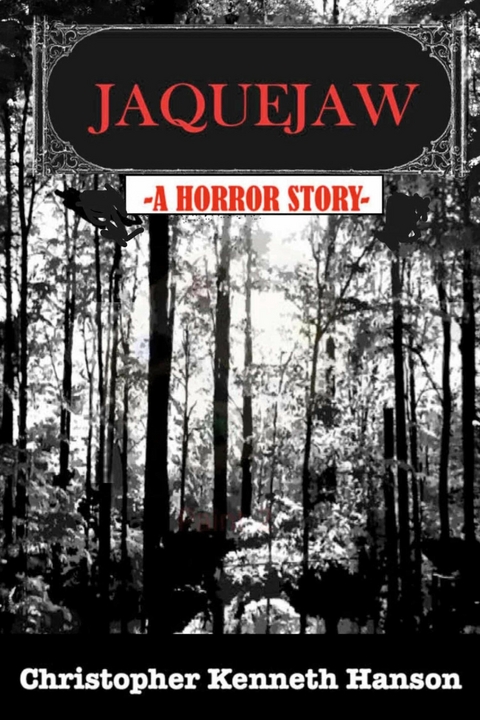
JaqueJaw (eBook)
144 Seiten
Bookbaby (Verlag)
979-8-218-57036-1 (ISBN)
Christopher Kenneth Hanson is a creative writer. He has written books of poetry, juvenile fiction and longer fiction/novels. Additionally, Christopher has created music and art under the name, ckhanson81.
"e;JaqueJaw"e; is a compelling story, set in the fictive town of Berryton, NJ. The story explores the ethics of scientific advancement, particularly through the character of David L. Bardd. Bardd's work represents the classic scientific ethical dilemma of "e;Just because we can, should we?"e; While Bardd has the technical ability to create hybrid creatures through genetic engineering, his complete disregard for the consequences shows the dangers of scientific advancement without moral constraints. The novel explores themes of scientific ethics, revenge against society, and the consequences of unchecked ambition, while functioning as a horror story about a man-made monster terrorizing a small community.
Chapter 1
Of Berryton
A hellish monstrosity once roamed deep in the woods of northern New Jersey. Locals still talk about a terrifying creature that hunted and haunted many hikers in the Berryton Woods. Thrill seekers hoping to get a glimpse of the beast swarmed the town in the summer. Still, many hikers remained surprisingly naive to ‘the Maniacal Monster of Berryton’ also known as the Jaquejaw. No one claiming to have battled the devious beast had ever succeeded in providing complete details. And if they had confronted the monster, they were more often than not driven insane or killed.
One horrifying account involves the Jaquejaw and an optimistic hiker by the name of Morton M. Anklemonn. Locals recount a variety of versions of Anklemonn hiking through the woods and being killed by the beast.
The devastating tale became part of a collection of legends kept alive by a handful of irate drunks, so termed by the self-proclaimed rational folk.
In various tales, one individual appeared to be more linked to the Jaquejaw than others. He was a geneticist by profession, and a crafty individual by nature, David L. Bardd.
Bardd had a rough childhood and adolescence. He grew up with a mentally unstable sister, and an abusive father. His sister, Darla, saw him having one of his dream visions:
Bardd would be outside sitting by one of the trees, and he’d been talking to something or someone when no one was there. He’d hop up and down trying to grasp for something in the air. And his mind would wander. After his mother died, Bardd was reminded of her through Darla. Both women were in need of help. They were both sick in a variety of ways. His mother was consumed by her drinking and drugging, which Darla would copy later in life.
Bardd loved monsters and imagined them often in his youth. His monsters were powerful and unique. He didn’t factor in that people would suffer or be driven to fits of terror. He didn’t care. To him, the chaos was beautiful. He sensed that randomness ran rampant in life. Chaos appeared to be the norm. Or the final match in some game that he played steadily and with no regrets. And there was no reward without risk, he came to believe. The riskier the situation became, Bardd thought, the more rewards would come to him. Him alone.
When Bardd was a youth, he created clay monster figures which he would position against one another and then subsequently destroy them later on by breaking them or making them explode. Darla would often come into his area to see what he was doing and would giggle with delight when he destroyed his creations. Bardd appreciated the steady support his sister provided. It was a type of support their mother would’ve provided, if she were still living, Bardd believed.
Bardd’s father was a stubborn and callous man. And he was easily thrown into fits of rage. Bardd grew up being verbally abused. He protected Darla from the abuse at times, mostly by distracting the father with more liquor. Their father would be yelling and cursing, and Bardd would give Darla her medicine. Many of their days started with the father tormenting them: “Wake up dammit!” Bardd would rise or he would be punished. Darla hid away. “Cut the wood now!” The father would bark, “Stack it up high against the barn ‘til I say so!”
Bardd was given an ax and day after day would place various logs upon a tree stump in the backyard and splinter the logs, sometimes as the snow fell, his father watched from a window, inside the house, coming out periodically and commanding Bardd to move faster and strike harder with more determination.
When he was old enough to leave the house, he left and took Darla with him. They moved to a town closer to the city. A persistent and hard worker, Bardd stuck to his school routine while holding multiple jobs. His studies paid off and he was accepted at the city university. After winning a joint scholarship with a group of students, he pursued graduate studies. Bardd became interested in genetics for a variety of reasons. One reason for his studies was that he wanted to know why some folks were more fortunate in life and others weren’t.
Was this due to genetic makeup alone or was it due to circumstances and specific social contexts? There are a variety of contexts. There should be a variety of innovative decisions made within those contexts. So, Bardd came to believe. The same individuals would not typically do as well in an environment with less support and care.
And this concept, he found more or less obvious but also intriguing. Although, figuring out a type of algorithm for social paradigms was not his main goal. Even though the social aspect was interesting, creating his own creature had been steadily consuming his thoughts.
As Bardd progressed through graduate school, he became interested in playing with a variety of gene sequences and manipulating variations of multi-functional hybrids. Some genes meshed well with others, so to speak, and others would amplify various qualities and behaviors within given prototypes.
In graduate school, Bardd would meet a man of similar means and intent, Jaques R. Jaussin. Jaussin moved from Canada. He didn’t talk much. When he did weigh in, he was often direct and a careful listener, which Bardd found pleasing.
Jaussin thought Bardd looked like the cartoon character, Yosemite Sam. Bardd was shorter and maintained a fiery temper. He wasn’t an ignorant man but he often appeared that way, walking and talking with reckless bravado.
After earning their doctorates, Bardd and Jaussin were recruited to work at a local laboratory called Intelligenttable. They were recruited in separate instances, and there to create and experiment.
Bardd and Jaussin became closer and often took long walks in the woods. They talked about their childhoods, and various bullies they would still see tormented. They talked about hallucinogens. Bardd said various drugs worked to stimulate his imagination and entertain him. He related that he’d often get inebriated. The alcohol and various drugs, he claimed, spurred his curiosity and imagination.
He would fill up a number of notebooks at night with pictures of creatures he’d thought of and various random thoughts he’d been having.
He would often claim to imagine anything and the only trick, he claimed, was to work on intricate daily implementations. Little by little while balancing a type of grand design.
With Jaussin’s expertise in computer science and Bardd’s prowess in genetics, the pair were unparalleled in many ways. Additionally, one of their team members, skilled in conceptual design work, made use of a visual application, whereby the beast was depicted in a type of dynamic blueprint.
Profiles of the Jaquejaw were plotted as were the ways it would likely move and react to various stimuli within a given environment. While the face and the head of the creature had morphed from crocodile and bear leaning in terms of explicit features.
At one point, Bardd contacted a research group who was studying and modeling creatures that existed before the common era. They were given further information on various prehistoric attributes and gene sequences. Bardd would make notes on the gene sequences and dream of mimicking them somehow in terms of implementation for specific monsters he desired to create. His creations, including the Jaquejaw were imagined to be more successful at predation for example.
Bardd was let down by most people. He made exceptions for his sister and Jaussin at the time, but as time went on, his caring for them would also wane. Moreover, Bardd believed that most people were deeply flawed. He would manipulate people en masse if need be, just so he could have more time and space to himself. He required time to think about ways of escaping from a world where he didn’t emotionally and socially belong. More often than not, he’d scream at the walls and into various mirrors, leering and cursing at himself for hours.
He would also begin to collect a variety of weaponry and firearms. Often, he’d be in the woods firing off multiple rounds into various trees and brush.
Bardd turned to drugs and alcohol often in order to, as he called it: to wade deeper in ever-subjective creative trances. And it was Bardd who’d convinced Jaussin to try acid during this period. Bardd believed more ‘trails of possibility’ would open for them eventually.
During one trip, Jaussin sat next to a tree, peering up at an adjacent tree, which seemed to have steely eyes and was grimacing. It was also wailing and moaning then and he wrote down what the tree wanted him to record, so he’d thought. Jaussin saw multiple faces there as well.
He kept repeating phrases to himself while making notes. Notes, which added up to garbled nonsense more often than not. Eventually, the pair would discuss matters of strategy and intent after the trips had waned.
“Imagine all we could do with a maniacal beast.” Bardd said.
“I can imagine it...I’d hope it wouldn’t turn on us.”
Bardd lit a cigarette. “I want you to help me create a brilliant and terrifying beast.”
Jaussin paused before commenting. “Can you make sure it doesn’t harm us?”
Bardd leaned back against a tree. He looked Jaussin in the eyes.
“It will obey me.”
“How can you be so sure?”
...| Erscheint lt. Verlag | 8.2.2025 |
|---|---|
| Sprache | englisch |
| Themenwelt | Literatur ► Romane / Erzählungen |
| ISBN-13 | 979-8-218-57036-1 / 9798218570361 |
| Informationen gemäß Produktsicherheitsverordnung (GPSR) | |
| Haben Sie eine Frage zum Produkt? |
 EPUB (Ohne DRM)
Größe: 1,3 MB
Digital Rights Management: ohne DRM
Dieses eBook enthält kein DRM oder Kopierschutz. Eine Weitergabe an Dritte ist jedoch rechtlich nicht zulässig, weil Sie beim Kauf nur die Rechte an der persönlichen Nutzung erwerben.
Dateiformat: EPUB (Electronic Publication)
EPUB ist ein offener Standard für eBooks und eignet sich besonders zur Darstellung von Belletristik und Sachbüchern. Der Fließtext wird dynamisch an die Display- und Schriftgröße angepasst. Auch für mobile Lesegeräte ist EPUB daher gut geeignet.
Systemvoraussetzungen:
PC/Mac: Mit einem PC oder Mac können Sie dieses eBook lesen. Sie benötigen dafür die kostenlose Software Adobe Digital Editions.
eReader: Dieses eBook kann mit (fast) allen eBook-Readern gelesen werden. Mit dem amazon-Kindle ist es aber nicht kompatibel.
Smartphone/Tablet: Egal ob Apple oder Android, dieses eBook können Sie lesen. Sie benötigen dafür eine kostenlose App.
Geräteliste und zusätzliche Hinweise
Buying eBooks from abroad
For tax law reasons we can sell eBooks just within Germany and Switzerland. Regrettably we cannot fulfill eBook-orders from other countries.
aus dem Bereich