


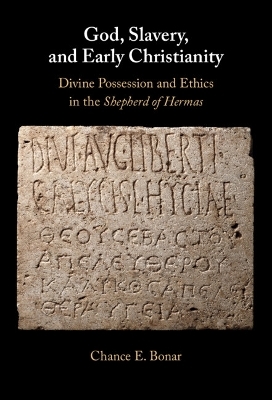
God, Slavery, and Early Christianity
Divine Possession and Ethics in the Shepherd of Hermas
Seiten
2025
Cambridge University Press (Verlag)
978-1-009-61062-9 (ISBN)
Cambridge University Press (Verlag)
978-1-009-61062-9 (ISBN)
Ancient Christians understood themselves to be enslaved to God, which affected their ethics, theology, and self-understanding. This book analyzes the Shepherd of Hermas, an overlooked early Christian text written by an enslaved person, which was nearly included in the New Testament, to map the effects of divine slavery.
Ancient Christians understood themselves to be enslaved to God, an attitude that affected their ethics, theology, and self-understanding. This widespread belief is made especially clear in the Shepherd of Hermas, an overlooked early Christian text written by an enslaved person, which was nearly included in the New Testament. In this book, Chance Bonar provides a robust analysis of the ancient discourses and practices of slavery found in the Shepherd of Hermas. He shows how the text characterizes God's enslaved persons as useful, loyal property who could be put to work, surveilled, and disciplined throughout their lives – and the afterlife. Bonar also investigates the notion that God enslaved believers, which allowed the Shepherd to theorize key early Christian concepts more deeply and in light of ancient Mediterranean slavery. Bonar's study clarifies the depth to which early Christians were entrenched – intellectually, practically, and theologically – in Roman slave society. It also demonstrates how the Shepherd offers new approaches to early Christian literary and historical interpretation.
Ancient Christians understood themselves to be enslaved to God, an attitude that affected their ethics, theology, and self-understanding. This widespread belief is made especially clear in the Shepherd of Hermas, an overlooked early Christian text written by an enslaved person, which was nearly included in the New Testament. In this book, Chance Bonar provides a robust analysis of the ancient discourses and practices of slavery found in the Shepherd of Hermas. He shows how the text characterizes God's enslaved persons as useful, loyal property who could be put to work, surveilled, and disciplined throughout their lives – and the afterlife. Bonar also investigates the notion that God enslaved believers, which allowed the Shepherd to theorize key early Christian concepts more deeply and in light of ancient Mediterranean slavery. Bonar's study clarifies the depth to which early Christians were entrenched – intellectually, practically, and theologically – in Roman slave society. It also demonstrates how the Shepherd offers new approaches to early Christian literary and historical interpretation.
Chance Bonar is a Postdoctoral Fellow at the Center for the Humanities, Tufts University.
Introduction; 1. Usefulness, loyalty, and property: characteristics of God's enslaved persons; 2. 'Give me the little book': enslaved literate labor in the Shepherd; 3. Possession and enslavement through the Holy spirit; 4. Enslaved surveillance and Spirit-flesh symbiosis; 5. Instrumental agency and ecclesiastical unity; Conclusion; Bibliography.
| Erscheinungsdatum | 30.09.2025 |
|---|---|
| Zusatzinfo | Worked examples or Exercises |
| Verlagsort | Cambridge |
| Sprache | englisch |
| Maße | 152 x 229 mm |
| Gewicht | 591 g |
| Themenwelt | Literatur ► Klassiker / Moderne Klassiker |
| Geschichte ► Teilgebiete der Geschichte ► Religionsgeschichte | |
| ISBN-10 | 1-009-61062-7 / 1009610627 |
| ISBN-13 | 978-1-009-61062-9 / 9781009610629 |
| Zustand | Neuware |
| Informationen gemäß Produktsicherheitsverordnung (GPSR) | |
| Haben Sie eine Frage zum Produkt? |
Mehr entdecken
aus dem Bereich



aus dem Bereich
von der Antike bis zur Gegenwart
Buch | Softcover (2025)
C.H.Beck (Verlag)
CHF 16,80
klassische Entwürfe von Paulus bis zur Gegenwart
Buch | Softcover (2025)
UTB (Verlag)
CHF 38,90


