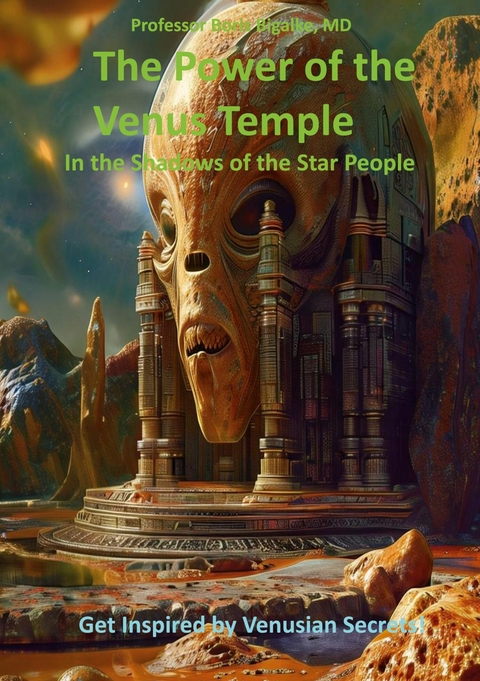
The Power of the Venus Temple (eBook)
332 Seiten
Books on Demand (Verlag)
978-3-7693-6514-6 (ISBN)

Professor Boris Bigalke, MD, MBA (Oxford, UK), LL.M. works as an attending and head of the DGK CardioMRI Qualification Center at the German Heart Center of the Charité (DHZC), Campus Benjamin Franklin, Clinic for Cardiology, Angiology and Intensive Care Medicine. Professor Bigalke is a specialist in internal medicine and holds specializations and additional qualifications in cardiology, acupuncture, nutritional medicine DAEM/DGEM® and magnetic resonance imaging. After studying medicine at the Free University of Berlin, he continued his scientific and clinical career at the Eberhard-Karls-University of Tübingen. Further training led him to surgery at the LIJ Medical Center, Albert Einstein College of Medicine, New York, USA, to TCM at the WHO Collaborating Center, Beijing, China and to TTM at the Qusar Tibetan Healing Centre, Dharamsala, Himachal Pradesh, India. During a long-term research stay, he also worked at King's College London, Division of College London, Division of Imaging Sciences and Biomedical Engineering London as an Assistant Professor/Honorary Lecturer. He also completed a Master of Business Administration (MBA) Healthcare Management at Magna Carta College, Oxford, UK, and a Master of Laws (LL.M.) with a focus on medical law at the Dresden International University. In 2021, Professor Bigalke applied to become an astronaut at the European Space Agency (ESA). Out of more than 22,500 qualified applicants, he was one of the top 100 candidates in Germany. Even though he did not become an astronaut, he has always been fascinated and enthusiastic about space travel and the planets of the solar system. This inspired him to write the book "The Enigma of the Mars Pyramid", which has already been published. Professor Bigalke has been elected as one of Germany's top physicians in FOCUS-Gesundheit 2021 in the category of cardiological sports medicine, and in 2023, 2024 and 2025 in the categories of hypertension and nutritional medicine.
Introduction
Venus: The beauty in the sea of stars
In the not-too-distant future, humanity stands on the threshold of a new era of interplanetary exploration and discovery. Decades of technological breakthroughs - particularly in energy generation, space technology and the development of extremely resistant materials - have made it possible to travel to the most extreme planets in the solar system. Missions to Mars and the first manned missions to the outer planets have revolutionized knowledge about our solar system and, above all, raised questions about our own existence and the limits of life in the universe. In this field of curiosity and possibilities, interest is growing in one of the most enigmatic planets in the solar system: Venus.
Venus, the 2nd planet in the solar system, was named after the Roman goddess of love and beauty. This naming reflects the bright brilliance of the planet, which is the third brightest object in the sky from Earth (after the sun and moon) and can be seen either shortly after sunset or shortly before sunrise, depending on its position in orbit. Venus is also known as the evening star and sometimes also as the morning star.
Venus moves in an orbit within the Earth's orbit around the sun. This means that it is never very far from the sun from our point of view. It can therefore only be observed at dusk - either in the evening sky (as an evening star) or in the morning sky (as a morning star), depending on whether it is east or west of the sun. When Venus “overtakes” the Earth on its orbit, it changes from an evening star to a morning star position and vice versa. The ancient Greeks and Romans even initially considered them to be two different celestial objects: the evening star “Hesperos” and the morning star “Phosphoros” (or “Lucifer” for the Romans). Only later was it recognized that they were one and the same object - Venus.
In Greek mythology, Venus corresponds to the goddess Aphrodite, who also stands for love, beauty and fertility. The reference to love and beauty can also be found across cultures in other mythologies. For example, Venus was worshipped in the Babylonian Empire as Ishtar, the goddess of love and war, while in Mesopotamian culture she was known as Inanna.
These mythological connections show how early mankind associated the planet with female beauty and attraction due to its impressive appearance. In modern astronomy, Venus thus carries a legacy from the mythologies of many cultures, which interpreted its special presence in the sky in many different ways.
Venus is similar to Earth in many respects: similar size, mass and density. But the surface is a fiery inferno - with an atmosphere of thick clouds of sulphuric acid and a surface pressure equivalent to that of a dive in the Earth's deepest oceans. The temperature remains constant at around 470 °C (870 °F). For decades, Venus was considered a barren, uninhabitable land. Only atmospheric exploration and occasional probes were able to survive before they were destroyed by the harsh conditions. But with the advent of new technologies developed specifically for such extreme conditions, the possibility of exploring this planet directly became a reality.
An inexplicable discovery
Four years ago, the results of a research project by the UNESA (United Nations Exploration and Space Administration) research project on Venus were published four years ago and caused a worldwide sensation: an unmanned satellite mission discovered strange geometric formations on the surface of Venus beneath the dense cloud cover. Equipped with modern radar and sensor devices, the probe transmitted images of unusually symmetrical structures that could not be explained by any natural phenomenon. The shapes were reminiscent of terraced pyramids, columns and enigmatic circular patterns that could not possibly have been created with such precision by volcanic or tectonic processes. In addition, a detailed analysis showed that the formations were aligned with specific planetary constellations - a fact that suggested a cultic or ceremonial significance.
This discovery triggered a feverish debate among scientists and the general public alike. Was it possible that a civilization had once existed on Venus that had been wiped out by some unknown event? Was there life that had evolved in a form that could withstand these extreme conditions? Questions like these led to the topic of a Venus mission becoming a priority.
The signal: a call from the deep
About a year after the discovery of the formations, a UNESA ground station near Canberra, Australia, received a strange signal. The signal - rhythmic and repeating - appeared to originate from several kilometers below the surface of Venus and did not match known radio waves or atmospheric interference. To the surprise of the researchers, the signal repeated itself in a complex pattern and showed characteristics reminiscent of an artificial source. After weeks of intensive analysis, an international team of cryptographers and mathematicians succeeded in extracting a simple message: It was a coordinate!
This coordinate pointed to a point on the northern hemisphere of Venus, not far from the structures discovered by the probe. Researchers and government officials were both concerned and intrigued. Was this a cry for help? Or perhaps a kind of greeting, a call that was only activated when humanity came close enough to receive it? Speculation about the origin of the signal ranged from a warning signal to prevent anyone from approaching Venus to a tantalizing hint of possible communication with a long-lost civilization.
The Venera Ascendant team
UNESA finally decided to send a manned mission to Ve-nus to investigate the signal and the formations on site. This decision was extremely controversial: Ve-nus is still considered one of the most hostile places in the solar system. However, the advanced protective suits, which could withstand extreme pressures and temperatures, as well as new technologies for shielding against radiation and heat, made such a mission possible for the first time.
Under the leadership of experienced Commander Aiyana Wolfe, a Native American and veteran of UNESA space missions, a team of six astronauts and scientists, considered to be the best in their respective fields, was selected:
Name (nationality):
Commander Aiyana Wolfe (USA)
Position:
Mission leader, pilot and strategist
Aiyana is an experienced commander and the main person responsible for the mission. She is calm and thoughtful with a deep connection to Earth and a passion for ancient cultures. She is aware of the historic responsibility her mission holds for humanity and fights to navigate her crew safely through the challenges.
Name (nationality):
Colonel Luis Ortega (Spain)
Position:
Fighter pilot, engineer and 1st officer
As a former military pilot, Luis is pragmatic and focused on protecting the team. He not only takes on technical tasks, but also protects the crew in critical situations. He is charismatic and compassionate. He plays the classical guitar with great passion.
Name (nationality):
Professor Kenji Sato (Japan)
Position:
Astrophysicist, geologist and science officer
Kenji is an analytical thinker and fascinated by the extreme environmental conditions of Venus. He sometimes feels isolated and is fascinated by the links between ancient myths and science and has taken up drawing and calligraphy as a hobby, which is closely related to Zen Buddhism.
Name (Nationalität):
Dr. Priya Kapoor (Indien)
Position:
Exobiologe und Biochemiker
Priya is an expert on biological structures, especially focusing on possible extraterrestrial life forms and analyzing the chemistry of the surface of Venus. His character is gentle, humorous, optimistic and deeply connected to nature. He is an avid strategy board gamer.
Name (nationality):
Dr. Ingrid Nilsen (Norway)
Position:
Archaeologist and cultural anthropologist
As an archaeologist and anthropologist, Ingrid is fascinated by cultural heritage. She is courageous, persistent and passionate about history, philosophy and the myths of other planets. She has a flair for hidden secrets, has a gift for deduction and is a foreign language genius.
Name (nationality):
Dr. Soraya (android)
Position:
Doctor, engineer, 2nd officer and crisis intervention expert
Soraya is a highly developed cybernetic organism with medical, technical and social capabilities. She is programmed to simulate human emotions and even romantic behaviors. But during the mission, she develops a deeper connection with her crew and begins to question the nature of her existence.
The landing site: a hidden temple city
The northern hemisphere of Venus is home to the Ishtar Terra highland complex, one of the largest and best-known plateaus on Venus, characterized by complex tectonic structures. Ishtar Terra consists of tangled, rugged areas often referred to as “tesserae”. Tesserae are characteristic of Venusian terrain and consist of intersecting rifts and ridges that...
| Erscheint lt. Verlag | 3.2.2025 |
|---|---|
| Sprache | englisch |
| Themenwelt | Literatur ► Fantasy / Science Fiction ► Science Fiction |
| Schlagworte | Alien Contact • Aliens • Astronaut • Astronauts • Future • Planet Research • space • Space Travel • Time Travel • Venus |
| ISBN-10 | 3-7693-6514-3 / 3769365143 |
| ISBN-13 | 978-3-7693-6514-6 / 9783769365146 |
| Informationen gemäß Produktsicherheitsverordnung (GPSR) | |
| Haben Sie eine Frage zum Produkt? |
 EPUB (Wasserzeichen)
DRM: Digitales Wasserzeichen
Dieses eBook enthält ein digitales Wasserzeichen und ist damit für Sie personalisiert. Bei einer missbräuchlichen Weitergabe des eBooks an Dritte ist eine Rückverfolgung an die Quelle möglich.
Dateiformat: EPUB (Electronic Publication)
EPUB ist ein offener Standard für eBooks und eignet sich besonders zur Darstellung von Belletristik und Sachbüchern. Der Fließtext wird dynamisch an die Display- und Schriftgröße angepasst. Auch für mobile Lesegeräte ist EPUB daher gut geeignet.
Systemvoraussetzungen:
PC/Mac: Mit einem PC oder Mac können Sie dieses eBook lesen. Sie benötigen dafür die kostenlose Software Adobe Digital Editions.
eReader: Dieses eBook kann mit (fast) allen eBook-Readern gelesen werden. Mit dem amazon-Kindle ist es aber nicht kompatibel.
Smartphone/Tablet: Egal ob Apple oder Android, dieses eBook können Sie lesen. Sie benötigen dafür eine kostenlose App.
Geräteliste und zusätzliche Hinweise
Buying eBooks from abroad
For tax law reasons we can sell eBooks just within Germany and Switzerland. Regrettably we cannot fulfill eBook-orders from other countries.
aus dem Bereich