


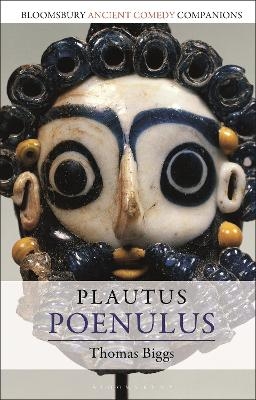
Plautus: Poenulus
Seiten
2026
Bloomsbury Academic (Verlag)
978-1-350-37906-0 (ISBN)
Bloomsbury Academic (Verlag)
978-1-350-37906-0 (ISBN)
- Noch nicht erschienen (ca. März 2027)
- Versandkostenfrei
- Auch auf Rechnung
- Artikel merken
An introduction to this comedy about family, home, displacement, and identity in a Mediterranean world transformed by Rome’s foreign wars.
Plautus’ Poenulus (Little Carthaginian) is a work of staggering literary and historical significance. Performed in the long shadow of Rome’s traumatic struggle with Hannibal’s Carthage, this play stages the restoration of a Carthaginian family divided through enslavement. Set against the backdrop of a Greece marked by comedic expectations and the geography of contemporary imperial conquest, Poenulus presents a tale of Carthaginian heartbreak and heartache to a post-war Roman audience. Populated by an intersectional cast of Carthaginians and Greeks, the comedy’s singular diversity prompts audience interaction with a wide range of socio-cultural topics relevant to Plautus’ time. Engaging weighty matters through song, slapstick, puns, and spectacle, Poenulus may appear to defang, but its bite is deep.
This book offers an innovative understanding of Poenulus’ place in Roman history and literary culture, helping readers to appreciate the play itself, the complex nature of Plautine authorship, and the cultures of performance in Republican Rome. Most of the book explores the play as a performance, from its unique and strikingly self-aware prologue to the actors' call for applause in the final line. The longest chapter examines the play’s afterlives in the Renaissance and early Modern period, including little-known revivals and adaptations in Ferrara, Rome, and Cambridge. Over the centuries, people have found in Poenulus a script well suited to active learning in the Latin classroom, a text readymade to support new political ideologies, and a dramatized vision of the world that accorded with processes of racialization in Europe as reengagement with the classical past coincided with the expansion of the slave trade and the objectification of Black Africans. That one play has been seen to support and subvert the same outlooks and practices from the third century BCE to the present is a testament to its complexity and the enduring power of Plautine verse.
Plautus’ Poenulus (Little Carthaginian) is a work of staggering literary and historical significance. Performed in the long shadow of Rome’s traumatic struggle with Hannibal’s Carthage, this play stages the restoration of a Carthaginian family divided through enslavement. Set against the backdrop of a Greece marked by comedic expectations and the geography of contemporary imperial conquest, Poenulus presents a tale of Carthaginian heartbreak and heartache to a post-war Roman audience. Populated by an intersectional cast of Carthaginians and Greeks, the comedy’s singular diversity prompts audience interaction with a wide range of socio-cultural topics relevant to Plautus’ time. Engaging weighty matters through song, slapstick, puns, and spectacle, Poenulus may appear to defang, but its bite is deep.
This book offers an innovative understanding of Poenulus’ place in Roman history and literary culture, helping readers to appreciate the play itself, the complex nature of Plautine authorship, and the cultures of performance in Republican Rome. Most of the book explores the play as a performance, from its unique and strikingly self-aware prologue to the actors' call for applause in the final line. The longest chapter examines the play’s afterlives in the Renaissance and early Modern period, including little-known revivals and adaptations in Ferrara, Rome, and Cambridge. Over the centuries, people have found in Poenulus a script well suited to active learning in the Latin classroom, a text readymade to support new political ideologies, and a dramatized vision of the world that accorded with processes of racialization in Europe as reengagement with the classical past coincided with the expansion of the slave trade and the objectification of Black Africans. That one play has been seen to support and subvert the same outlooks and practices from the third century BCE to the present is a testament to its complexity and the enduring power of Plautine verse.
Thomas Biggs is Lecturer in Latin at the University of St Andrews, UK. He is the author of Poetics of the First Punic War (2020) and co-editor of The Epic Journey in Greek and Latin Literature (2019).
Acknowledgements
Preface
Illustrations
1. Introduction
2. Prologue
3. Plots, Plots, and Characters
4. Hanno(s)
5. Reception: Ferrara, Rome, Cambridge
Epilogue
Bibliography
Notes
Index
| Erscheint lt. Verlag | 4.3.2027 |
|---|---|
| Reihe/Serie | Bloomsbury Ancient Comedy Companions |
| Zusatzinfo | 11 bw illus |
| Verlagsort | London |
| Sprache | englisch |
| Maße | 138 x 216 mm |
| Themenwelt | Literatur ► Klassiker / Moderne Klassiker |
| Literatur ► Lyrik / Dramatik ► Dramatik / Theater | |
| Kunst / Musik / Theater ► Theater / Ballett | |
| Geisteswissenschaften ► Sprach- / Literaturwissenschaft ► Anglistik / Amerikanistik | |
| Geisteswissenschaften ► Sprach- / Literaturwissenschaft ► Literaturwissenschaft | |
| ISBN-10 | 1-350-37906-9 / 1350379069 |
| ISBN-13 | 978-1-350-37906-0 / 9781350379060 |
| Zustand | Neuware |
| Informationen gemäß Produktsicherheitsverordnung (GPSR) | |
| Haben Sie eine Frage zum Produkt? |
Mehr entdecken
aus dem Bereich



aus dem Bereich


