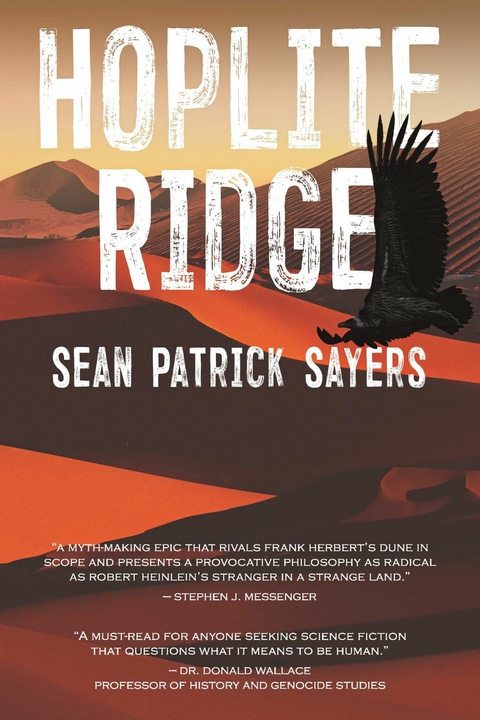
Hoplite Ridge (eBook)
532 Seiten
Bookbaby (Verlag)
979-8-3509-8648-8 (ISBN)
Sean Patrick Sayers is an acclaimed science fiction author, new build consultant for endurance yachts, educator, and former emergency management and defense professional. His work blends storytelling, service, and advocacy, drawing on history, mythology, and philosophy to explore themes of conflict, survival, and resilience. Sayers is the author of Conrad Scott, a post-apocalyptic novella examining survival and human endurance, and Hoplite Ridge, a science fiction epic praised as a masterpiece of the genre. Hoplite Ridge is a gripping tale of loyalty, power, and destiny, where ancient mythology collides with futuristic warfare in a battle for survival across the stars. His next book, Black Meridian: Piracy & Empire, is a sweeping narrative history of the Golden Age of Piracy and its role in shaping the modern world. Drawing on meticulous research and told with the pacing of an epic drama, Black Meridian reveals how outlaws, privateers, and empires fought for dominance on the high seas and how those battles changed the course of global power. With a background in emergency management, defense, and maritime consulting, Sayers brings realism and complexity to his storytelling. Beyond writing, he has served in leadership roles, advocating for resources, policy improvements, and community support. In 2022, Sayers' daughter was diagnosed with leukemia, a life-changing event that reshaped his priorities. He stepped away from other responsibilities to become her full-time caregiver and has since been an advocate for pediatric cancer awareness. In addition to pledging 100% of his royalties for the first 90 days of Hoplite Ridge sales to the Clements Cuties Foundation, Sayers continues to donate 20% of ongoing royalties from the novel to organizations that support families facing pediatric cancer. He has also donated most royalties from Conrad Scott to hospice programs, helping provide dignity and care for those facing the end of life. Through his books, advocacy, and service, Sean Patrick Sayers continues to share stories that inspire, engage, and connect, bridging literature, history, and real-world experience to offer readers narratives that are as immersive as they are meaningful.
Preface
Years ago, I published a novella while living with my wife on a small sailboat at the end of a desolate pier. It felt like the edge of the world. The once busy marina turned eerily deserted as summer gave way to winter, except for the occasional hardy waterman departing before dawn, unfazed by the weather. The transformation was striking—from a lively hub to a solitary haven. As the November gales morphed into fierce winter storms, the marina became a place of isolation. We huddled inside our boat, attempting to ward off the cold with electric heaters. Looking back, it’s astounding we survived not just one but several winters there. Those early days taught me so much. My novella emerged from that frigid season, written as our boat leaned heavily against her lines, rocked by northerly gusts, all while we lived on a meager 30 amps of electricity.
Those challenging winters aboard the sailboat were not just a test of endurance; they became a profound source of inspiration. As our boat braved the elements, so too did my imagination, leading to the creation of a story that mirrored the harshness of our surroundings. The novella I wrote was as dark as the winter itself, fitting squarely into the post-apocalyptic genre that dominated our culture at the time. It told the tale of a man waking up to a radically changed life and a transformed world. His struggle against nature and humanity was intense, and though he persevered, his journey was far from complete. This story held a special place in my heart, but I grew dissatisfied with it over time. In my eagerness to publish, I overlooked what I needed to understand. As a self-published author, I faced the prohibitively high costs of professional editing, a common barrier where the aim is often just to break even. Fortunately, I managed to do so, but this was partly because I chose to self-edit. This decision, while practical, meant my reasonably good story retained a certain roughness.
Eventually, I transitioned to writing my next book, only to find the project stalling. It became clear that my skill set wasn’t yet equipped for crafting longer narratives. Recognizing this, I shifted my approach. I started practicing more publicly, creating opportunities for others to read and comment on my work. This interactive process became a valuable learning experience, allowing me to evolve as a writer over the course of ten thousand nautical miles.
After several years, my wife and I upgraded our living situation to a Catalina 36 sailboat, a remarkable step up from our earlier maritime home. We christened her ‘Doggie Paddle,’ a name that reflected her character perfectly. We spent numerous years aboard, sailing up and down the Chesapeake Bay, enjoying the lifestyle that came with it. Once ‘Doggie Paddle’ was well-equipped and paid off, and with some savings set aside, we began to dream bigger. The idea of sailing south to explore the islands seemed within reach. But, life had other plans. Ten years into our marriage, our daughter Eleanor arrived, bringing a tide of change with her. She came home to G Dock in March, and our plans were suddenly reconsidered. Would we sail south with our baby? Should we sell the boat and buy a house? Or get a bigger boat, effectively taking on a maritime mortgage, to sail north in the summers while still living aboard.
The many questions that loomed large in our minds unexpectedly found an answer one late afternoon. A local boat broker reached out with a proposal that caught our attention. He had a 44-foot sailboat, boasting three berths and two bathrooms, and in a condition almost as good as new. This vessel had recently arrived as a trade-in. This unforeseen offer paved a new path for our expanding family, suggesting a future that we hadn’t dared to envision before.
We moved into our next chapter by purchasing the larger boat and setting sail from the Chesapeake Bay to Maine. That summer unfolded as the adventure of a lifetime, and we chronicled every step in a blog. Over the next few years, our voyages took us to summer destinations like Block Island, Cuttyhunk, Martha’s Vineyard, and along the rugged coast of Maine. The extraordinary experiences offered our daughter Eleanor a worldview few children are privileged to have. Amidst these adventures, my writing skills sharpened, igniting the desire to start a new book. Yet, something held me back. The potential I had left untapped in my first novella haunted me. While working in the cockpit at the dock during the COVID lockdown year, I decided to revisit and reshape that initial story.
During this period, as June drew near and we welcomed our son Sam—named in honor of my late father, who had recently succumbed to pancreatic cancer—my world shifted. That year was marked by profound loss as I bid farewell to family and close friends. This cascade of events steered my thoughts towards the philosophies underlying various religions. Night after night, I lay in my bunk, deeply self-reflecting and exploring fundamental ideas. These introspections gradually evolved into insights, shaping my worldview and the depth of my writing.
As winter set in, I found silence in a small camper parked on the edge of my dad’s property. It was his, a modest space without heating, yet it offered me a place to collect my thoughts and work, cocooned in a sleeping bag. This retreat echoed the days when I first penned my novella.
By the time spring was hinting its arrival, I had completed the rough draft of ‘Hoplite Ridge.’ But something was missing, a piece crucial to the story’s completion. Pursuing this elusive component, I engaged in profound philosophical discussions with friends. But, the true revelation came under the worst circumstances – sitting in a hospital room, grappling with the news of my 7-year-old daughter’s cancer diagnosis.
That devastating moment brought a seismic shift in my perspective on life and creativity. I realized that ‘Hoplite Ridge’ required a layer of depth that reflected our existence’s interwoven nature. This led to the inception of the Techno-Enlightenment Philosophy, encapsulating my feelings about life’s delicate balance.
The Techno-Enlightenment Philosophy suggests a universe where all physical, mental, and spiritual dimensions are deeply interconnected. This interconnectivity forms the foundation for understanding the cosmos and our place within it. Central to this philosophy is the belief that advancements in technology, especially in the field of nanotechnology, have the potential to expand human consciousness. This expansion isn’t limited to intellectual growth but extends into the spiritual dominion, offering new levels of awareness and comprehension.
Unlike traditional spiritual paths that focus on meditation or asceticism, the Techno-Enlightenment Philosophy sees technology as a pivotal tool in the quest for Enlightenment. It envisions a future where humans, through enhanced consciousness and technological progress, transcend the conventional constraints of time and space, thus accessing higher dimensions of existence.
A key principle of this philosophy is the ethical integration of technology and spirituality. It underscores the importance of using technological advancements in ways that develop spiritual growth and overall well-being rather than serving purely materialistic goals. It advocates for a harmonious universe where enhanced consciousness leads to a profound understanding of the interconnectedness of all life, promoting peaceful and sustainable coexistence.
This philosophy views human evolution as an ongoing biological and spiritual development journey. It encourages continuous learning and adaptation to keep pace with technological evolution and environmental changes. The philosophy also values diverse cultural, religious, and philosophical perspectives, considering them essential to the richness of human understanding and spiritual exploration.
In the Techno-Enlightenment Philosophy, adherents perceive themselves as more than mere citizens of a nation or planet; they see themselves as integral parts of a larger cosmic entity with responsibilities that transcend earthly limits. This worldview emphasizes technology’s mindful and ethical development, with an acute awareness of its potential impacts on human consciousness and the environment.
Through this lens, I found a unique platform for engaging in rich discussions at the intersection of technology, spirituality, and ethics. This philosophy offered a roadmap to craft a fictional evolution profoundly shaped by technological advancements, challenging and expanding our understanding of existence and the nature of consciousness.
As I devoted myself to being Eleanor’s full-time caregiver, this philosophy became a part of my manuscript. It transformed my story into something profoundly different and, in many ways, better. Sitting beside my daughter for that first month in the hospital, I realized that I was not just rewriting my book but reimagining the narrative of human experience and history itself. This profound integration of ideas reshaped my story into a narrative exploring the depths of the complicated relationship between technological progress and spiritual understanding.
As the seasons of life continued to turn, so too did the pages of my experiences. The hardships we faced, both at sea and in the stillness of the hospital room, became the vessel in which my worldview was forged anew. ‘Hoplite Ridge,’ once a reflection of a younger self’s vision, was infused with the ideas of the Techno-Enlightenment Philosophy.
Eleanor’s brave fight against cancer, contrasted with the serene presence of the...
| Erscheint lt. Verlag | 28.1.2025 |
|---|---|
| Sprache | englisch |
| Themenwelt | Literatur ► Fantasy / Science Fiction ► Science Fiction |
| Literatur ► Romane / Erzählungen | |
| ISBN-13 | 979-8-3509-8648-8 / 9798350986488 |
| Informationen gemäß Produktsicherheitsverordnung (GPSR) | |
| Haben Sie eine Frage zum Produkt? |
 EPUB (Ohne DRM)
Größe: 820 KB
Digital Rights Management: ohne DRM
Dieses eBook enthält kein DRM oder Kopierschutz. Eine Weitergabe an Dritte ist jedoch rechtlich nicht zulässig, weil Sie beim Kauf nur die Rechte an der persönlichen Nutzung erwerben.
Dateiformat: EPUB (Electronic Publication)
EPUB ist ein offener Standard für eBooks und eignet sich besonders zur Darstellung von Belletristik und Sachbüchern. Der Fließtext wird dynamisch an die Display- und Schriftgröße angepasst. Auch für mobile Lesegeräte ist EPUB daher gut geeignet.
Systemvoraussetzungen:
PC/Mac: Mit einem PC oder Mac können Sie dieses eBook lesen. Sie benötigen dafür die kostenlose Software Adobe Digital Editions.
eReader: Dieses eBook kann mit (fast) allen eBook-Readern gelesen werden. Mit dem amazon-Kindle ist es aber nicht kompatibel.
Smartphone/Tablet: Egal ob Apple oder Android, dieses eBook können Sie lesen. Sie benötigen dafür eine kostenlose App.
Geräteliste und zusätzliche Hinweise
Buying eBooks from abroad
For tax law reasons we can sell eBooks just within Germany and Switzerland. Regrettably we cannot fulfill eBook-orders from other countries.
aus dem Bereich