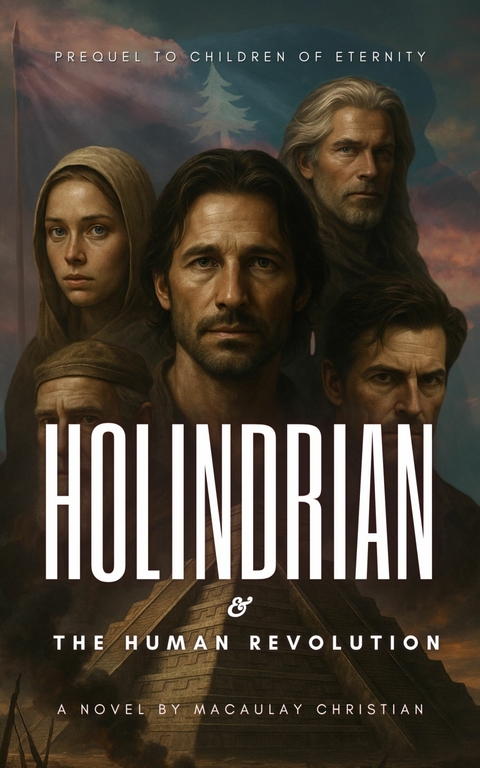
Holindrian (eBook)
318 Seiten
Crathes (Verlag)
979-8-9922357-1-5 (ISBN)
Praise for Holindrian & The Human Revolution!
Literary Titan: 'Fans of philosophical sci-fi and high fantasy like Ursula K. Le Guin or J.R.R. Tolkien will find much to admire.'
Readers' Favorite: 'Wonderfully written, and once you start reading it, there is no putting the book down.'
***
Readers who enjoyed the history and myths of The Silmarillion or long for stories that blend genres, Holindrian & The Human Revolution may be for you. Embark on a journey through humanity's ancient past, forgotten civilizations, alien visitations, and a revolution to restore the human spirit. Filled with philosophical underpinnings, Holindrian & The Human Revolution is a commentary on determinism, the nature of heroes, and the enduring desire to be free.
***
After millennia under the rule of the genetically engineered Baltutu, the humans of Eridu are ready to rise up and rebel. When one of the Baltutu, Holindrian, seeks to atone for the part he has played in subjugating humanity, stifling its creativity and passion, he ignites a revolution that will forever change humanity's destiny. Hope rises and the Human Revolution begins.
With echoes of ancient myths and cosmic forces stirring, Holindrian & The Human Revolution offers an intricate blend of science fiction and historical myth, immersing readers in a richly detailed world teeming with complex cultures, powerful revolutions, and a timeless struggle for freedom. This epic adventure challenges the boundaries between fate and free will, power, and morality, and invites readers on a journey of cosmic wonder and profound personal transformation.
PART 2
FORGIVE US, FATHER, FOR WE HAVE SINNED
2.1 THE AUDACITY OF HOPE
The Earth was cast into ruin. A great deluge of waters rose from the deep, promising to engulf the whole of the world and plunge it into an eternal night that would know no dawn. The works of men, their proud cities, their storied halls, crumbled not by foreign hands alone but by the fire born within—kindled by strife, fanned by the chaos of the flood. Civilization fell, as when the wild beast tears the lamb from the fold, and no hand of mercy could hold back the ruin. Where once men settled their quarrels with the tongue, now they brandished the sword, the sacred halls defiled with blood. The worth of life, once held high, was cheapened with each passing day, until man saw not his brother, but an enemy—a ravenous creature, willing to tear the very breath from the lips of the child, to stretch his own fleeting moments.
Fear spread like a plague, and bitterness filled the hearts of all.
There was nothing left to be done, though such knowledge availed them not. In the end, even the righteous few, who clung to the wisdom of ages and sought to die with dignity, were swept into the tide. Many abandoned hope. Most forgot their sacred oaths. Of those who yet lived, a scant number survived, scouring the wastes, betraying their kin, their friends, slaughtering for the bitter chance at life. Yet fewer still escaped the fate that hung heavy over all flesh. For none could say, none could know, how the final hour of their world would unfold. In the choking grip of smoke, the sky blackened, the breath of the world grew faint, as one by one, life was snuffed out—slowly, inexorably.
Stranger, perhaps you think this is the stuff of legend, a fable spun by trembling tongues—but every tale is bound by a thread of truth. This is ours.
Our world—my world—lay upon its deathbed. Despite all our brilliance, or perhaps because of It, we sealed our fate. Not all could be saved. Few could be saved.
I know not when your spark, your soul, shall enter the verse, but hear me now: In this world, or in any other, though we may never meet, I take comfort in knowing—you shall not walk alone. Never alone. Our exodus—an odyssey, perilous, beyond the stars—was for you. That we might endure. That our people might have a future.
Erestu—the Earth—is no more. A memory now, seared with anguish, a wound upon our hearts for all who knew its ghostly shores, now walked by shadows. But here, in a strange land beneath foreign stars, we have endured. Not for ourselves. No, we build for you, for your kind, for those yet unborn. Our dreams, our hopes—we place them in your hands.
I rest now where Margidda, our ark, lies, the cradle of this new world. And I believe—yes, I believe—that this new land, this new people, will not bear the failures of the old. My time is passed, and I leave this purpose in your care.
You shall be the light, the standard to which all men shall rally. In you, they shall see the spark of our common humanity, and in your steps, they shall seek to follow. They shall fall. They shall falter. It may seem a heavy burden but know this—destiny has favored you. You are chosen.
In time, they will stand with you.
I could not save them all—but you—you shall save all that you can.
Know this, wherever you are, whenever you are: You carry the strength of those who came before. Their love, their wisdom, their fight—they are within you. And you shall do great things.
Fight for the future. Always.
-Enkirus
2.2 THE VILLAGE OF KISH
The Margidda overshadowed the small village of Kish, nestled on a plateau at the edge of the Cliffs of Damkina where the gulls soared high above the ocean’s swells far below. With their backs to the sea, the southern horizon was a composition of water and air. A coming storm could be seen for miles before it ever gave the few villagers trouble. Before them, an expansive wilderness erupted from the gentle sloping hummocks. The trees had grown tall and strong, vacating any interruption to their sovereignty. Waves crashed upon rock. The beaches, narrow though they were, were home to smoothed black stone and never dry. Two winding paths had been carved into the grass and dirt, one primarily by the labor of the foot and the other by the wheel. A path followed the coastline, trudged by nothing more than one’s good pair of feet, skirting the cliff’s brim, up another hundred or so feet, to the ever so dilapidated celestial chariot. The other path was more a road, carts ferried by horse and ox journey every so often out of the wood, hauling wares and comestibles harvested from other towns to be traded. There used to be other paths, leading in many directions, but now, there were only the two.
Few people lived in Kish. Nearly half of the adult population were fishermen. The town’s three fishermen relied on a rickety set of wooden stairs, built by an earlier generation, zigzagging down the face of the cliff to a slip where their sole boat was tied, bobbing up and down with the tide. There was a baker, a young woman just coming of age who had inherited the position from her mother. A builder, who was the girl’s uncle on her mother’s side. He was responsible for nearly everything that was not concerned with the town’s supply of food. The oldest resident was simply known as “Pedagogue”, a rather doddery fellow. He alone among them remembered the old world. The fisherman’s wife, the only other adult woman in the town, was the de facto mistress, a sort of mother figure to everyone, especially the town’s most remarkable inhabitants.
There were six children in the village. All had lost their mothers during birth. All conceived absent a father, born from nothing more than the touch of the Anunna-Ki before their final farewell. Survivors had scattered or been scattered, but a few chose to remain close to the grave of Enkirus, accepting wardship over the children, whom they were instructed to nurture and protect until such time as the children could tend to their own needs. The eldest pair was seven, the youngest five. It was the day before birthing celebrations, or, more precisely, the day by the best recollection of the Pedagogue and the Mistress.
“Come, come, wake up, boy!”
“Ouch!” the boy said as he was prodded by the Pedagogue’s walking stick.
The Pedagogue had these foggy eyes, set deep within a heavily wrinkled face, scars of both age and toil, looking down at the boy who had been napping, laying in the sunshine on the back side of his house. “Daydreaming, again, weren’t you?”
“I wasn’t sleeping,” the boy said, holding up a hand to block out the sun’s light.
“What were you doing, then? I’ve been hobbling all over town looking for you.”
There were only three permanent structures in the village.
“I was making something,” and he held out his palm.
Grasping the wood figure with viciously trembling fingers, the Pedagogue squinted his dark eyes and held it up close to his face, the tip of his nose tickled by the fresh carved fibers. He ran the tip of his thumb and index fingers all over the figurine, when he said, “it’s a person….”
“Shi,” the boy said, defeated.
“Oh,” and the Pedagogue’s eyes popped as though everything suddenly became clearer, “I’m sure she will love it, as will the others,” and he handed the carving back to the boy, patting him on the head.
The boy took it, stuffing it into his bundle.
“It’ll be midday soon enough. Why don’t you see if anyone needs help getting ready for your party?”
Doing as he was told, the boy cinched up his hand-me-down short pants and shuffled off towards the center of town. The one he’d been whittling behind was the children’s home and school, where the Pedagogue told them stories about the worlds, old and new. Off to his right, the bakery-butchery-depository. The fishermen’s steps were just around the back. Center of town was a great large fire pit; stones had been piled around in a circular manner, building up a waist high barrier between flesh and flame. Set at somewhat of a peculiar angle was the stable, animal pens, and mill. It was arranged so that it forced visitors coming through the main gate to be funneled between it and the bakery-butchery-depository. The village’s water supply was situated adjacent to the stable, closest to the children’s house.
The young baker was crossing town from the mill, carrying a sack of freshly ground flour, and she looked like she was struggling. The sack was nearly the same size as she and probably weighed twice as much. She dragged it across the windswept ground, tracing her path back to her ovens.
“Sera! Miss Sera, do you need some help?” the boy said, hurrying up to her.
Her hair was coming undone from its tie and she had a dollop of sweat beading on her nose. “Oh, thank you, Maramurru, but I think this is too heavy, even for you.”
The boy placed his hands on his hips in a look of disbelief, then, with his tiny muscles bulging to their fullest capacity, he, with both hands digging into the sack, wrenched it up out of the dirt. Resting the bottom on the tops of his toes, he walked the sack, which had to be at least a foot taller than he, towards Sera’s bakery. She followed him, giggling...
| Erscheint lt. Verlag | 11.3.2025 |
|---|---|
| Sprache | englisch |
| Themenwelt | Literatur ► Fantasy / Science Fiction ► Fantasy |
| Schlagworte | Alien Contact • Alternative history • ancient alien • Ancient Aliens • civilization rebirth • COSMIC • Dystopia • dystopian • EPIC • evolutionary legacy • Fantasy • first contact • forgotten planet • Genetic Engineering • Hero • historical fiction • Lost World • Politics • Revolution • Science Fantasy • Science Fiction • science fiction adventure • Space Opera • Spiritual • uprising • visionary science fiction |
| ISBN-13 | 979-8-9922357-1-5 / 9798992235715 |
| Informationen gemäß Produktsicherheitsverordnung (GPSR) | |
| Haben Sie eine Frage zum Produkt? |
 EPUB (Ohne DRM)
Digital Rights Management: ohne DRM
Dieses eBook enthält kein DRM oder Kopierschutz. Eine Weitergabe an Dritte ist jedoch rechtlich nicht zulässig, weil Sie beim Kauf nur die Rechte an der persönlichen Nutzung erwerben.
Dateiformat: EPUB (Electronic Publication)
EPUB ist ein offener Standard für eBooks und eignet sich besonders zur Darstellung von Belletristik und Sachbüchern. Der Fließtext wird dynamisch an die Display- und Schriftgröße angepasst. Auch für mobile Lesegeräte ist EPUB daher gut geeignet.
Systemvoraussetzungen:
PC/Mac: Mit einem PC oder Mac können Sie dieses eBook lesen. Sie benötigen dafür die kostenlose Software Adobe Digital Editions.
eReader: Dieses eBook kann mit (fast) allen eBook-Readern gelesen werden. Mit dem amazon-Kindle ist es aber nicht kompatibel.
Smartphone/Tablet: Egal ob Apple oder Android, dieses eBook können Sie lesen. Sie benötigen dafür eine kostenlose App.
Geräteliste und zusätzliche Hinweise
Buying eBooks from abroad
For tax law reasons we can sell eBooks just within Germany and Switzerland. Regrettably we cannot fulfill eBook-orders from other countries.
aus dem Bereich