


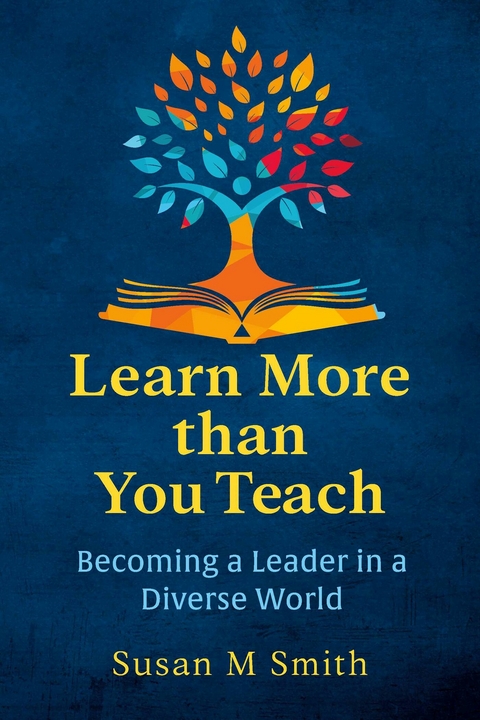
Learn More than You Teach (eBook)
388 Seiten
Bookbaby (Verlag)
979-8-3509-7995-4 (ISBN)
Susan M. Smith, Ph.D. is an educator who found fascinating challenges at the intersection of education, culture, and languages. She has traveled to twenty-two countries, including two years spent as a Peace Corps volunteer in the Central African Republic and an additional four years as education advisor for the Lutheran church in the same country. She speaks French and Spanish fluently along with bits of Sango and Portuguese. She taught elementary school for 30 years and coached other teachers. She is now a part-time interpreter, as well as an active volunteer with Pittsburgh Lutheran United Ministries, East Liberty Lutheran Church, and various organizations working for peace and justice.
Travel with veteran teacher Susan Smith as she acquires and develops leadership skills while working in a wide range of situations and cultures. Starting as an introverted child in a White suburban Pittsburgh neighborhood, she grew to love languages and exploring diverse lifestyles through them. For her, becoming a Peace Corps volunteer in the Central African Empire transformed her life and outlook as she thrived far from home. Throughout this book she has woven together seeking, learning, and growth as she recalls experiences including the time she struggled through the worst year of her life teaching first grade for the first time, lived without running water and electricity for a year, got terrified on a zipline in Nicaragua, and laughed when swallowed up by her newly made mattress. Throughout she has sought to learn more than she teaches. Learn More than You Teach: Becoming a Leader in a Diverse World explores ways of collaborating that promote dignity and respect for all. Examining humorous and unexpected life adventures, Susan interacts with others allowing them ownership of their own lives and development. Readers can recognize themselves in the text and/or learn a new approach to working with others. The stories are designed to spark conversation and reflection on the reader's own approaches to Listening and learning before teaching.
Attracted to Languages
In our suburban Pittsburgh elementary school, I caught the language bug in sixth grade. We students walked into our classroom after gym one day to see the first-grade teacher in front of the room with our teacher. We looked at each other with curiosity. We were the oldest students in the building, so why was this teacher of babies in front of us? Our buzz of interest settled as we found our seats.
“We have a guest today,” Ms. M, our teacher said. “Ms. L will be teaching us some Spanish.” The room looked the same – lines of desks, brightly colored bulletin boards, blackboard up front, all of us in our assigned seats. Once a week, though, we began learning songs and dialogues in Spanish. I don’t know about the others, but I was overjoyed when Ms. L worked with us. Spanish class provided a break from regular routines that was fun. And, a challenge. Could I pronounce the new words the way she did? Could I remember what they meant? I began to imagine what it would be like to speak to others in their language.
Some Spanish constructions sounded jarring to my English-speaker ears. I learned, Me llamo Susana. How exciting to learn the Spanish version of my name! How strange to consider the literal meaning, I call myself Susan. A couple of lessons later we were confounded to find that Tengo hambre and Tengo 11 años literally meant, I have hunger and I have 11 years. Why would one language use “to have” while the other chose “to be”?
We never became fluent in Spanish, but those outside-of-the-curriculum, informal lessons awoke the magic I still feel when communicating with someone in his/her own language.
In junior high school we could choose to study French or Latin. For me that wasn’t a choice. If I couldn’t continue with Spanish, I would take French, a language I could actually speak.
In French class the basis for every lesson was a dialogue which we were to memorize. Funny, some lines are still stuck in my head, popping up at the strangest times. Occasionally when the phone rings I feel drawn to say:
« Allo? Passy vingt-deux quinze ? » (Hello? Is this Passy 22-15?)
« Oui, qui est à l’appareil ? » (Yes, who’s speaking?)
Boring, really, but remarkably smooth and flowing in French! Occasionally when the first heavy snow comes, I am outside shoveling the walk when I hear, « Allons! Début! Ne restons pas dans la neige! » It comes from a dialogue about two skiers, “Come on! Get up! Let’s not stay in the snow!” Mundane again, but oh, so elegant in French.
When I finished tenth grade, including French 3, I went to France with International Student Exchange. I was 15, turning 16 shortly after I came home. With the confidence of my 15 years and the desire to experience Paris and French, it never occurred to me I was being thrown into the deep end.
I met Marguerite, the daughter of the host family, who was a couple of years younger than I, with her parents at the airport. The whole place shone with polish, stretching as far as my eye could see. I can’t remember much of the airport itself except that it overwhelmed me. I was nervous about finding where I needed to be. I looked all around, struggling to find the luggage area. Unused to traveling, I had also never experienced the sound of French washing over me from every direction. Fluid – but incomprehensible. After three years of good grades in French class, how could I understand so little? Uncertainty constricted my breathing, knotting my stomach.
I found my suitcase and the family. They must have had a sign with my name. They wore quality clothing, not fancy, but stylish leisurewear. Everything fit their bodies well, moving with them – très chic! I would find out later that they came from generational wealth, originally from the island of Corsica.
The father was tall with excellent posture. He greeted me first. “Tu es Sue Smith?” (Are you Sue Smith?)
“Oui.” I could understand that much. Speaking directly to someone was always easier, especially when I knew the topic. I had expected greetings. I understood the gist of the next part even though it was unexpected.
“We will not call you Sue,” he continued in French. “That is an insult. A sou is the smallest unit of French currency. We will call you Suzanne.”
How could I answer that? I managed, “C’est bien.” (That’s OK.)
Next, he looked at the Nestle candy bar earrings I wore, that I thought were charming. “Do they pay you to advertise for them?”
I said what I would say often at first, “Je ne comprends pas.” (I don’t understand.)
He repeated, and I came to understand that he was asking why I would wear the name of a company on my earrings, in essence advertising for them. He found it crude and unacceptable. I had no answer for that either – though I never wore the earrings again while I was there. To this day I think about what I advertise with my jewelry.
There wasn’t much conversation in the car on the way to the house. I sat in the backseat with Marguerite who didn’t say anything at all. The family lived in a dignified, antique row house in a suburb close to the train to the city. Its carpets were thick, everything well cared for and exquisite. By the time we got to the house, though, my brain was tired. I was wondering what I had gotten myself into. No smooth comradery, no middle-class home like the one I came from. A welcome, but not one that set me at ease.
Over the next few days, I tried to make meaning of the babble of speech around me. Gestures helped. Many people spoke looking directly at me, over-enunciating, which helped. Uncomfortable, I improved slowly.
I later met another French host family with whom I drove through France to the southern coast, to take the ferry to Corsica. During the trip, I focused on adjusting to new people as well as my continued struggles to understand and speak. This family was also made up of the parents plus a teenage girl, Therese, about my age. It turned out they were just as rich as the other family, but more modern. That is, in Paris they lived in a newly built apartment with lots of chrome and glass. Their house in Corsica was also modern with lots of lines and angles, yet at the same time, open, breezy, and comfortable. All three tall family members had lanky builds. I envied Therese’s curly hair that fell to her mid-back since mine was short, wavy, but fine. Despite the language barrier, their manner and smiles were welcoming. They explained what we were seeing, asking me questions to encourage me to speak. For example, they told me some of the history of Corsica, the island where we would be spending several weeks. I didn’t understand a lot immediately, but later they gave me a book with lots of pictures with explanations in French that helped me. Mostly, I gleaned that Corsicans were proud and independent. Also, the island was well fortified having been controlled by many, especially the French and Italians. I decided that this brief history helped explain the haughty attitudes of my first host family.
My French comprehension had improved, but beyond that, I was more willing to take chances as I spoke with this family. Once the father, Therese, and I were walking along the beach. A small child had left her bathing suit on the sand. I was able to say, in French, “Well, that could be mine. Oh, no, too small for even my foot.” A little humor – at last, some of my personality could come out. The others laughed, complimenting my use of French.
I wrote home often filling them in on my adventures. I kept asking why they didn’t write to me. For the first few weeks I got no letters. Had my family abandoned me? I was overwhelmed with loneliness. This was 1970. I was 15, after all, on my first big trip on my own. Finally, the letters started to come – usually several at one time. Mom explained that they didn’t realize that they needed to send the letters airmail, so they went by boat! She was upset when she read my letters asking why they hadn’t written since she had. She fretted and worried until she got my letter saying I was now receiving them, sometimes by the handful. When I was getting none, mom drafted everyone to write – my siblings and some friends of hers so I would get mail, to be assured that they all missed me.
As it came close to my time to return home, I had not received my plane ticket. Talking with my host family, we decided that it must be because I had been in Paris and Corsica with two families while most students had been in only one place with one family. The father smoothed out the wrinkle resulting in my ticket coming several days before I was to leave. He insisted that I call my parents to give them the arrival details. I heard 60% static on the call, perhaps because we were on an island or maybe all long-distance lines were poor at that time. Because I knew that the call was expensive, I had planned to be quick and give them the information concisely even though the family could easily afford the call. Instead, I panicked. At the time, I didn’t know why, but I couldn’t put words together into clear sentences – even in English! Finally, I did give them the specifics they needed. As we hung up, I was in...
| Erscheint lt. Verlag | 3.2.2025 |
|---|---|
| Sprache | englisch |
| Themenwelt | Literatur ► Biografien / Erfahrungsberichte |
| Sozialwissenschaften ► Pädagogik | |
| ISBN-13 | 979-8-3509-7995-4 / 9798350979954 |
| Informationen gemäß Produktsicherheitsverordnung (GPSR) | |
| Haben Sie eine Frage zum Produkt? |
 EPUB (Ohne DRM)
Größe: 3,7 MB
Digital Rights Management: ohne DRM
Dieses eBook enthält kein DRM oder Kopierschutz. Eine Weitergabe an Dritte ist jedoch rechtlich nicht zulässig, weil Sie beim Kauf nur die Rechte an der persönlichen Nutzung erwerben.
Dateiformat: EPUB (Electronic Publication)
EPUB ist ein offener Standard für eBooks und eignet sich besonders zur Darstellung von Belletristik und Sachbüchern. Der Fließtext wird dynamisch an die Display- und Schriftgröße angepasst. Auch für mobile Lesegeräte ist EPUB daher gut geeignet.
Systemvoraussetzungen:
PC/Mac: Mit einem PC oder Mac können Sie dieses eBook lesen. Sie benötigen dafür die kostenlose Software Adobe Digital Editions.
eReader: Dieses eBook kann mit (fast) allen eBook-Readern gelesen werden. Mit dem amazon-Kindle ist es aber nicht kompatibel.
Smartphone/Tablet: Egal ob Apple oder Android, dieses eBook können Sie lesen. Sie benötigen dafür eine kostenlose App.
Geräteliste und zusätzliche Hinweise
Buying eBooks from abroad
For tax law reasons we can sell eBooks just within Germany and Switzerland. Regrettably we cannot fulfill eBook-orders from other countries.
aus dem Bereich


