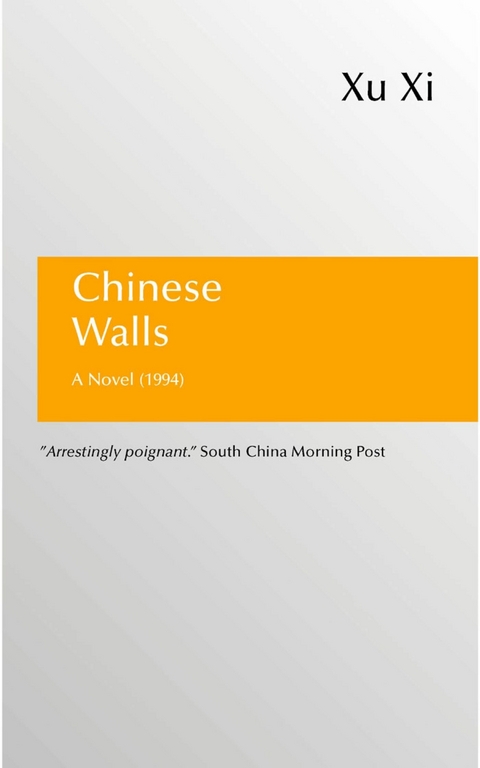
Chinese Walls (eBook)
124 Seiten
Bookbaby (Verlag)
979-8-3509-8793-5 (ISBN)
Xu Xi ??? is the author of 16 books of literary fiction and nonfiction. An Indonesian-Chinese from Hong Kong, she is one of the city's leading writers in English, and has also edited four anthologies of Hong Kong English literature. For many years, she inhabited the flight path connecting New York, Hong Kong and the South Island of New Zealand. She now resides in Northern New York State. For more information visit xuxiwriter.com or follow her on FB, Instagram, LinkedIn, Bluesky @xuxiwriter
"e;The Master said, 'Men are close to one another by nature. They diverge as a result of repeated practice."e; This epigraph by Confucius is at the heart of CHINESE WALLS, Xu Xi's controversial literary debut. This novel-in-stories was one of the first to openly address incest in an Asian family. Told by the youngest child and only daughter, Ai-Lin, the narrative begins in her childhood and wends through the stories of the men in her life: her father, brothers, former fiance and ex-husband, as the adult woman tries to come to grips with the meaning of love, sex and relationships. The title borrows the term "e;Chinese Walls"e; from Wall Street, referring to the practice used often in finance or law of erecting an invisible barrier between two teams working on opposites of a deal or case, to prevent the sharing of information. When the novel appeared in 1994, Xu was praised by the Far Eastern Economic Review as "e;a welcome new voice in the field of Asian fiction writers"e; whose "e;insights into Eastern family culture ring consistently true."e; Xu is described as "e;a skillful storyteller,"e; with an "e;impressive ability to create believable characters . . . fully human in their inner contradictions and complexity,"e; whose writing is "e;unpretentious"e; and "e;like listening to a close friend talking about her life, her family, her love and her frustrations."e; The novel was considered a breakthrough that "e;avoids the sex-and-drug-and-triad stereotypes that plague so many English language novels on Hong Kong,"e; and was an instant bestseller in Asia. This new EBook edition allows readers worldwide to once again traverse between the invisible walls of a Chinese-Indonesian family in 1960's Hong Kong. It remains a surprisingly relevant and contemporary transnational story in the 21st century.
On my ninth birthday, my mother sits me down in front of her dressing table mirror and brushes my hair. She tells me a story of Indonesia, the country of her birth.
“Before the war when I was still a little girl, no bigger than you are today, Ai-Lin, my parents had a big house in Tjilatjap. My brothers took me down to the beach and told me to be careful of the crocodiles.” She stops and laughs. “Maybe one day you will meet your uncles. They were funny, naughty boys, full of energy and life.”
I try to imagine this big country Indonesia where my mother was a girl and rode horses on the beach. My mother speaks to me only in English nowadays, a funny, musical accent that’s a bit like Chinese and a bit like Indonesian. She used to speak Indonesian to me, and even Mandarin, but stopped because Dad wants all the children to speak good English like him.
From the window of my parents’ bedroom, I can see clear across the harbor to Hong Kong side. It’s Saturday morning. I like it when my birthday falls on a weekend and I don’t have to go to school.
My mother continues. “My daddy was a very rich man, one of the richest in Tjilatjap. He used to say that the reason he was rich was because he worked hard, and because he was Chinese. Which is why, Ai-Lin, you must always be proud of being a Chinese no matter where you are. Because Chinese people are smart and successful, and don’t ever forget that.”
Yesterday, my brother Philip got slapped by Mum because he said Chinese people were dirty and afraid of the British, and that Hong Kong would always be a colony, and why couldn’t the Chinese be like the Indonesians who fought for their independence against the Dutch.
My mother brushes harder and faster now.
“My daddy was important as well as rich. In Tjilatjap, he was one of the few men that the Dutch administrator would consult on local matters. Your grandfather was never afraid of the Dutch, like some of the other Chinese, or the Indonesians. He was a tall man, and he stood tall. He knew what was right.”
In the mirror, I see my mother’s eyes shining. I like to see her smile because then she is the most beautiful woman in the world. My father is away in Indonesia today, on an important business trip. But he left me a new dress as my birthday present, and Mum gave me an extra kiss which she said was from Dad.
And then, my mother’s hand slackens, and she holds my long hair in both her hands. “I was so happy in Indonesia,” she says. “One day, I’ll go back there for good.”
I hang up my new dress and get ready to go to the comic book stand. Paul and Philip have both given me money for my birthday and told me to choose my own comics. I want to buy the new Supergirl. Philip asks why I don’t wear my new dress and I tell him, quite sternly since I think he ought to know better, that it would be silly to wear such a nice dress just to go down the street. Philip laughs and says I’m such a prim and proper little lady, and then tickles me until I laugh and cry at the same time. Paul tells Philip to leave me alone.
I take the back lifts down my building because I want to go out the side entrance through the Ambassador Hotel arcade. Nathan Road is already quite busy, even though it’s only ten o’clock. My mother doesn’t like living in Tsimshatsui; she says this area is too noisy and crowded and wants my father to buy a house in Kowloon Tong or Yau Yat Chuen where there are trees and real houses. But I like Tsimshatsui and our flat which has two floors and an interior connecting staircase. From our verandah on the seventeenth floor, I can watch the Kowloon-Canton railway trains pull into the station, and the grey U.S. battleships dock in the harbor. The sweep of the island’s hills are like a picture frame for the buildings dotting the hillside and the waterfront. At night, the neon lights go on. My favorite is the one on top of the low building in the middle - three red Japanese characters which Dad says is an advertisement for monosodium glutamate. It isn’t lonely in Tsimshatsui, or quiet and scary.
The comic book stand is down a side street a few streets away from my building. I go past Chung King Mansion’s dingy, cavernous mouth. Two American sailors are going into the building. Their white uniforms gleam like the teeth on the toothpaste commercial on TV. Aren’t they afraid of getting their uniforms dirty in there?
I find the new Supergirl issue I want, and buy an extra Batman comic for Philip. Philip pretends he’s too old for comics - he’s only thirteen - but I’ve seen him reading them when he thought no one was looking. Boys are so silly, even big boys like my brothers.
The comics tucked under my arm, I run back along Nathan Road towards Middle Road where my building is. As I near Chung King Mansion, I slow down. Coming down the steps of that building is the strangest looking person. She has orange hair, and wears a short cheongsam with a stiff high collar and very high heels. There’s something unreal about her, like she’s a doll that’s come to life. I watch her slow, uncertain progress down the steps, as if she hasn’t learnt how to walk in heels. My mother says it’s very important for a lady to know how to walk properly in high heels, with her legs straight, taking firm but graceful steps. When I grow up I will learn how to walk correctly in heels.
But this woman on the steps obviously hasn’t learnt.
“Paul,” I ask that evening, “have you ever been inside Chung King Mansion?”
My big brother looks up from his school books and his glasses slide down his nose. “Why are you asking?”
“Well, have you?” I know if I persist, he will eventually tell me. Paul is the best brother in the world.
He pushes up his glasses. “Yes.”
“Is it dangerous in there?”
“Sometimes. Now can I finish my homework?”
I think about this a moment and then give him a kiss on the cheek, which is the way I thank him, and go upstairs to find Philip.
Philip is at the piano in the bedroom of course, which is where he always is instead of doing his homework. He doesn’t like to be bothered when he’s practicing, but I can tell that he’s just fooling around and not really playing. So I sit on the bench next to him.
“How come some Chinese women have orange hair?”
He stops playing and looks at me. “Have you been dreaming?”
“You know, like the ladies outside Chung King Mansion.”
“Oh them.” My brother looks embarrassed. “They want to look Eurasian.”
“But why?”
Philip makes an impatient face and I can see he doesn’t want to tell me. My best friend Helena Choy is Eurasian, but she has black hair like me and doesn’t look one bit like the Chung King ladies at all.
My mother’s voice sails up from the living room. “Philip, can you go get my prescription?”
“Can’t Paul go?”
“He’s doing his homework, which is more than you’re doing. Now go.”
I tug my brother’s arm. “Can I go too?”
Philip grabs the back of my neck. “Okay, come along.”
My mother frowns a little when she sees me with Philip at the door. She always says that young girls shouldn’t go out too late, especially when the sailors are out. I’ve never been quite sure what she means by that, but whenever I’ve asked, she replies that I’ll find out when I’ve grown up. But she lets me go, because it’s my birthday, and warns Philip, “Don’t you two dilly dally.”
I dance alongside Philip, clutching his arm. We go down in the front lifts and walk out onto Middle Road. Across the road, I see some older kids going into the bowling alley. Paul says bowling isn’t a real sport, and a waste of money. But then, he thinks everything is a waste of money. I’m going into the bowling alley someday, when I’m older.
“Want to go over the hump?” Philip asks and I nod excitedly. The “hump” is the path next to the Royal Observatory that lets us out right in the middle of Mody Road. My mother calls it the hump because it curves uphill and down again like the hump on a camel’s back. Dad says that silly. But I like the name because it’s our family’s private name for it, which somehow makes the path our own secret, special way.
At the end of the hump, there are low buildings, only three or four stories high, on a small cul-de-sac. Its mouth is flanked by two huge trees, which my mother says have been there forever. “Concrete jungles are built around the real jungle,” she says. “In Indonesia, there’s too much foliage and jungle for the buildings. There, unlike Hong Kong, nature is stronger than the vain egos of men.” My mother says strange things sometimes. She doesn’t like buildings. I like the low buildings, but the trees and the hill of the Royal Observatory block their view. Not like my building, with its wonderful wide open view of the Hong Kong harbor, which Dad says is one of the most scenic harbors in the world, matched only by San Francisco and Rio de Janeiro. I’m going to both those harbors when I grow up to see for myself.
At the pharmacy, the store clerk says to me in Cantonese, “Muih muih yuet lai yuet dai aah. Little sister is getting bigger and bigger.”...
| Erscheint lt. Verlag | 3.1.2025 |
|---|---|
| Sprache | englisch |
| Themenwelt | Literatur ► Romane / Erzählungen |
| ISBN-13 | 979-8-3509-8793-5 / 9798350987935 |
| Informationen gemäß Produktsicherheitsverordnung (GPSR) | |
| Haben Sie eine Frage zum Produkt? |
 EPUB (Ohne DRM)
Größe: 130 KB
Digital Rights Management: ohne DRM
Dieses eBook enthält kein DRM oder Kopierschutz. Eine Weitergabe an Dritte ist jedoch rechtlich nicht zulässig, weil Sie beim Kauf nur die Rechte an der persönlichen Nutzung erwerben.
Dateiformat: EPUB (Electronic Publication)
EPUB ist ein offener Standard für eBooks und eignet sich besonders zur Darstellung von Belletristik und Sachbüchern. Der Fließtext wird dynamisch an die Display- und Schriftgröße angepasst. Auch für mobile Lesegeräte ist EPUB daher gut geeignet.
Systemvoraussetzungen:
PC/Mac: Mit einem PC oder Mac können Sie dieses eBook lesen. Sie benötigen dafür die kostenlose Software Adobe Digital Editions.
eReader: Dieses eBook kann mit (fast) allen eBook-Readern gelesen werden. Mit dem amazon-Kindle ist es aber nicht kompatibel.
Smartphone/Tablet: Egal ob Apple oder Android, dieses eBook können Sie lesen. Sie benötigen dafür eine kostenlose App.
Geräteliste und zusätzliche Hinweise
Buying eBooks from abroad
For tax law reasons we can sell eBooks just within Germany and Switzerland. Regrettably we cannot fulfill eBook-orders from other countries.
aus dem Bereich