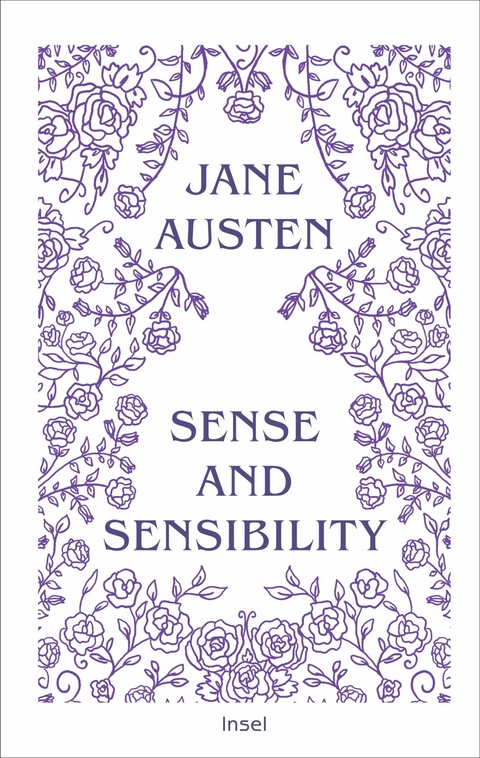
Sense and Sensibility (eBook)
360 Seiten
Insel Verlag
978-3-458-78306-0 (ISBN)
The first novel by the »Queen of Romance«
The sisters Elinor and Marianne Dashwood could hardly be more different: while Elinor embodies the intellect, self-control and reserve, Marianne is the epitome of emotion, passion and impulsiveness. When they both meet the loves of their lives, they painfully learn that happiness is not just a matter of feelings ...
Jane Austen is one of the most successful authors of all time. Ever since the publication of her first novel, Sense and Sensiblity, in 1811, she has captivated her readers, and to this day, her novels about the entanglements of love continue to inspire millions of people around the world.
<br />Jane Austen wurde am 16. Dezember 1775 in Steventon, Hampshire, als Tochter des Pfarrers George Austen geboren. Dank der umfangreichen Bibliothek ihres Vaters fand sie früh Zugang zur Literatur und begann bereits im Alter von zwölf Jahren mit dem Schreiben. 1801 zog die Familie in den Kurort Bath, den Austen später häufig zum Schauplatz ihrer Romane machte. Der Tod des Vaters zwang die Familie 1805 zum erneuten Ortswechsel. Zusammen mit ihrer Mutter und ihren Geschwistern zog die junge Jane Austen zunächst nach Southhampton, vier Jahre später dann in das Landhaus eines wohlhabenden Onkels. Sein Anwesen in Chawton, Hampshire, sollte bis kurz vor ihrem Tod (1817) die Heimat der Schriftstellerin bleiben. Sie widmete sich fortan dem Schreiben und veröffentlicht 1811 den Roman <i>Sense and Sensibility</i> (Verstand und Gefühl), gefolgt von <i>Pride and Prejudice</i> (Stolz und Vorurteil, 1813), <i>Mansfield Park</i> (1814) und <i>Emma</i> (1816). Die Werke erschienen anonym und auf ihr eigenes finanzielles Risiko. Als Autorenangabe fand sich darin nur der Hinweis: »By a Lady«. Den bis heute währenden großen Erfolg ihrer Werke erlebte Jane Austen nicht lange. Am 18. Juli 1817 verstarb sie nach kurzer, schwerer Krankheit in Winchester.
Chapter One
The family of Dashwood had been long settled in Sussex. Their estate was large, and their residence was at Norland Park, in the centre of their property, where, for many generations, they had lived in so respectable a manner, as to engage the general good opinion of their surrounding acquaintance. The late owner of this estate was a single man, who lived to a very advanced age, and who for many years of his life, had a constant companion and housekeeper in his sister. But her death, which happened ten years before his own, produced a great alteration in his home; for to supply her loss, he invited and received into his house the family of his nephew Mr Henry Dashwood, the legal inheritor of the Norland estate, and the person to whom he intended to bequeath it. In the society of his nephew and niece, and their children, the old Gentleman's days were comfortably spent. His attachment to them all increased. The constant attention of Mr and Mrs Henry Dashwood to his wishes, which proceeded not merely from interest, but from goodness of heart, gave him every degree of solid comfort which his age could receive; and the cheerfulness of the children added a relish to his existence.
By a former marriage, Mr Henry Dashwood had one son: by his present lady, three daughters. The son, a steady respectable young man, was amply provided for by the fortune of his mother, which had been large, and half of which devolved on him on his coming of age. By his own marriage, likewise, which happened soon afterwards, he added to his wealth. To him therefore the succession to the Norland estate was not so really important as to his sisters; for their fortune, independent of what might arise to them from their father's inheriting that property, could be but small. Their mother had nothing, and their father only seven thousand pounds in his own disposal; for the remaining moiety of his first wife's fortune was also secured to her child, and he had only a life interest in it.
The old Gentleman died; his will was read, and like almost every other will, gave as much disappointment as pleasure. He was neither so unjust, nor so ungrateful, as to leave his estate from his nephew; – but he left it to him on such terms as destroyed half the value of the bequest. Mr Dashwood had wished for it more for the sake of his wife and daughters than for himself or his son: – but to his son, and his son's son, a child of four years old, it was secured, in such a way, as to leave to himself no power of providing for those who were most dear to him, and who most needed a provision, by any charge on the estate, or by any sale of its valuable woods. The whole was tied up for the benefit of this child, who, in occasional visits with his father and mother at Norland, had so far gained on the affections of his uncle, by such attractions as are by no means unusual in children of two or three years old; an imperfect articulation, an earnest desire of having his own way, many cunning tricks, and a great deal of noise, as to outweigh all the value of all the attention which, for years, he had received from his niece and her daughters. He meant not to be unkind however, and, as a mark of his affection for the three girls, he left them a thousand pounds a-piece.
Mr Dashwood's disappointment was, at first, severe; but his temper was cheerful and sanguine, and he might reasonably hope to live many years, and by living economically, lay by a considerable sum from the produce of an estate already large, and capable of almost immediate improvement. But the fortune, which had been so tardy in coming, was his only one twelvemonth. He survived his uncle no longer; and ten thousand pounds, including the late legacies, was all that remained for his widow and daughters.
His son was sent for, as soon as his danger was known, and to him Mr Dashwood recommended, with all the strength and urgency which illness could command, the interest of his mother-in-law and sisters.
Mr John Dashwood had not the strong feelings of the rest of the family; but he was affected by a recommendation of such a nature at such a time, and he promised to do every thing in his power to make them comfortable. His father was rendered easy by such an assurance, and Mr John Dashwood had then leisure to consider how much there might prudently be in his power to do for them.
He was not an ill-disposed young man, unless to be rather cold hearted, and rather selfish, is to be ill-disposed: but he was, in general, well respected; for he conducted himself with propriety in the discharge of his ordinary duties. Had he married a more amiable woman, he might have been made still more respectable than he was: – he might even have been made amiable himself; for he was very young when he married, and very fond of his wife. But Mrs John Dashwood was a strong caricature of himself; – more narrow-minded and selfish.
When he gave his promise to his father, he meditated within himself to increase the fortunes of his sisters by the present of a thousand pounds a-piece. He then really thought himself equal to it. The prospect of four thousand a-year, in addition to his present income, besides the remaining half of his own mother's fortune, warmed his heart and made him feel capable of generosity. – ›Yes, he would give them three thousand pounds: it would be liberal and handsome! It would be enough to make them completely easy. Three thousand pounds! he could spare so considerable a sum with little inconvenience.‹ – He thought of it all day long, and for many days successively, and he did not repent.
No sooner was his father's funeral over, than Mrs John Dashwood, without sending any notice of her intention to her mother-in-law, arrived with her child and their attendants. No one could dispute her right to come; the house was her husband's from the moment of his father's decease; but the indelicacy of her conduct was so much the greater, and to a woman in Mrs Dashwood's situation, with only common feelings, must have been highly unpleasing; – but in her mind there was a sense of honour so keen, a generosity so romantic, that any offence of the kind, by whomsoever given or received, was to her a source of immoveable disgust. Mrs John Dashwood had never been a favourite with any of her husband's family; but she had had no opportunity, till the present, of shewing them with how little attention to the comfort of other people she could act when occasion required it.
So acutely did Mrs Dashwood feel this ungracious behaviour, and so earnestly did she despise her daughter-in-law for it, that, on the arrival of the latter, she would have quitted the house for ever, had not the entreaty of her eldest girl induced her first to reflect on the propriety of going, and her own tender love for all her three children determined her afterwards to stay, and for their sakes avoid a breach with their brother.
Elinor, this eldest daughter whose advice was so effectual, possessed a strength of understanding, and coolness of judgment, which qualified her, though only nineteen, to be the counsellor of her mother, and enabled her frequently to counteract, to the advantage of them all, that eagerness of mind in Mrs Dashwood which must generally have led to imprudence. She had an excellent heart; – her disposition was affectionate, and her feelings were strong, but she knew how to govern them: it was a knowledge which her mother had yet to learn, and which one of her sisters had resolved never to be taught.
Marianne's abilities were, in many respects, quite equal to Elinor's. She was sensible and clever; but eager in every thing; her sorrows, her joys, could have no moderation. She was generous, amiable, interesting: she was every thing but prudent. The resemblance between her and her mother was strikingly great.
Elinor saw, with concern, the excess of her sister's sensibility; but by Mrs Dashwood it was valued and cherished. They encouraged each other now in the violence of their affliction. The agony of grief which overpowered them at first, was voluntarily renewed, was sought for, was created again and again....
| Erscheint lt. Verlag | 18.6.2025 |
|---|---|
| Sprache | englisch |
| Themenwelt | Literatur ► Klassiker / Moderne Klassiker |
| Literatur ► Romane / Erzählungen | |
| Schlagworte | 19th century • aktuelles Buch • Bestseller • Bridgerton • Bücher Neuerscheinung • Classic • Disappointment • Elinor Dashwood • Emancipation • Emma • England • Englische Ausgabe • English • entanglements of love • Gift Book • Historical Romance • Inheritance dispute • insel taschenbuch 5107 • IT 5107 • IT5107 • Liebesromane historisch • Marianne Dashwood • Neuerscheinung 2025 • neues Buch • Original • Passion • Sinn und Sinnlichkeit • Sisterly Love • social conventions • Vereinigtes Königreich Großbritannien • Vernunft und Gefühl • Verstand und Gefühl • Westeuropa • Women |
| ISBN-10 | 3-458-78306-7 / 3458783067 |
| ISBN-13 | 978-3-458-78306-0 / 9783458783060 |
| Informationen gemäß Produktsicherheitsverordnung (GPSR) | |
| Haben Sie eine Frage zum Produkt? |
 EPUB (Wasserzeichen)
DRM: Digitales Wasserzeichen
Dieses eBook enthält ein digitales Wasserzeichen und ist damit für Sie personalisiert. Bei einer missbräuchlichen Weitergabe des eBooks an Dritte ist eine Rückverfolgung an die Quelle möglich.
Dateiformat: EPUB (Electronic Publication)
EPUB ist ein offener Standard für eBooks und eignet sich besonders zur Darstellung von Belletristik und Sachbüchern. Der Fließtext wird dynamisch an die Display- und Schriftgröße angepasst. Auch für mobile Lesegeräte ist EPUB daher gut geeignet.
Systemvoraussetzungen:
PC/Mac: Mit einem PC oder Mac können Sie dieses eBook lesen. Sie benötigen dafür die kostenlose Software Adobe Digital Editions.
eReader: Dieses eBook kann mit (fast) allen eBook-Readern gelesen werden. Mit dem amazon-Kindle ist es aber nicht kompatibel.
Smartphone/Tablet: Egal ob Apple oder Android, dieses eBook können Sie lesen. Sie benötigen dafür eine kostenlose App.
Geräteliste und zusätzliche Hinweise
Buying eBooks from abroad
For tax law reasons we can sell eBooks just within Germany and Switzerland. Regrettably we cannot fulfill eBook-orders from other countries.
aus dem Bereich