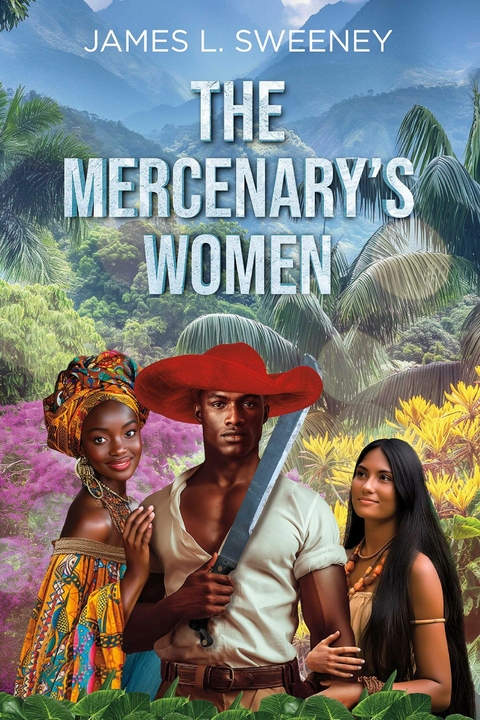
Mercenary's Women (eBook)
348 Seiten
Bookbaby (Verlag)
979-8-9864795-3-8 (ISBN)
I became interested in researching the history of the Black Caribs of St. Vincent Island while preparing for a master's thesis in history. I continued reading about the Caribs, Caribbean history, and the people brought to the Caribbean as forced labor. I wanted to depict what it must have been like for these people from their imagined point of view and how they may have contributed to the blended ethnic group, the Black Caribs or Garifuna of St. Vincent Island. I visited St. Vincent four times and the last Carib reserve on Dominica once to see their mock-up traditional village. I began writing a series about the Black Caribs ten years ago. I have been working on my writing craft by taking classes, earning a writing certificate at Stanford University, and a masters in fine arts/fiction at the University of California, Riverside. I attend writers' conferences and belong to the Historical Novel Society. My article 'Caribs, Maroons, Jacobins, Brigands, and Sugar Barons' appeared on several online scholarly websites and was published in an anthology about the Black Caribs. I published my first novel, Chatoyer: Freedom's War Chief, in 2022 via Book Baby. Education: BA Sociology, Cultural Anthropology, MAs Education/PE, Humanities/History, Anthropology, Fine Arts/fiction, Ph.D. Education. I taught college and secondary students in Panama, Japan, Italy, and Spain. Now retired, I enjoy writing and paddling Hawaiian outrigger canoes in the San Francisco Bay Area.
The Mercenary's Women consists of a Preface, Introduction, twenty-two chapters, an epilogue, an appendix with a list of historical characters and a glossary. This novel traces the growth and adventures of a starving Bantu herd boy from South Central Africa. It is a bildungsroman, a novel about the formative years of a young man, his growth, adventures, loves, and his eventual achievement of autonomy and freedom. The novel takes place in the turbulent 17th century, a time of imperialistic rivalries, warfare between the Dutch and Portuguese in both Africa and Brazil, and the influence of the slave trade in both Africa and the Americas. The protagonist, Khumbi, is caught up in the turmoil of those times and has to adjust to different roles he is forced into by others. He is sold away from his famine ravaged family in South Central Africa, taken to a new family and traded as a servant. He adapts and has a relationship with the family's daughter, until he is sold again and taken way. He is captured by raiders, and must adapt to being a child soldier or face being killed and eaten. He does well, becomes a senior warrior and acquires two women concubines, but loses both. He fights on the side of Africa's most famous warrior queen, Nzinga, and her allies, the Catholic Kongolese, and the soldiers of the Dutch West India Company, against the Portuguese and their African allies. He is later captured and forced to join the Portuguese forces in Brazil, where he fights against the Dutch to remove them from their holdings in sugar rich Pernambuco. He joins Bandierante slave catchers and is wounded in a skirmish with Maroons from the largest community of escaped slaves in the Americas. He is mistaken as a Maroon and accepted into their capital town with the help of a Tupi Indian trader. When his role as a slave catcher is discovered he joins the Tupi trader's family in an epic journey by canoe across the length of Brazil toward El Dorado in search of the Tupi's Dutch partner in the Guianas. Along the way he falls in love with the Tupi's daughter. They have more adventures and eventually leave the South American coast for St. Vincent Island, where they settle among the Carib Indians. Khumbi is now a free man, master of his own family and life, on an island where he is free to choose the way he wants to live. This historical novel is based on careful historical research, mixed with the author imagining what it may have been like in those times, told from the point of view of a protagonist representing people who are not usually depicted as the main characters in stories of those times. If you enjoy the historical novels of Allende and Follett, or read Edugyan's Washington Black, are curious about African and Brazilian 17th century history and the people who experienced those times, are interested in stories depicting indigenous people, the African diaspora, and the rivalry between European imperialistic powers, you may well enjoy my novel. It also includes a young man's quest for belonging, identity, autonomy, and love. It is an adventure story, depicting historically significant conflicts, and the various peoples and cultures of the times.
Remembering
Khumbi squinted into the night from the bow of the large Carib dugout canoe. The dark mound of the island lay ahead, blocking out the star-filled Caribbean horizon. He reached for the loaded musket resting on his lap and blew on the glowing slowmatch.
“Father, if you get that wet, it won’t be worth carrying,” said Khumbi’s oldest son.
“Just point us to the cove you told me about, and I’ll worry about my musket. The English may have muskets, and I want to be ready.”
“It’s ahead, Father,” said son number two. “This is where we landed when we rescued Erei. It’s a safe landing beach.”
“If you’d also rescued Nisani, we wouldn’t have had to come here,” said Khumbi as the canoe approached the cove. “I warned you, trading with these bakra settlers is dangerous.”
“Father, it was just Barana and me,” said son number one. “We went back twice to look for him after Erei got away. They must have had Nisani someplace else, and we worried the plantation’s men would be out looking for Erei.”
Khumbi looked back at the twenty warriors working their paddles. “Well, we have plenty of men tonight.” All were either Khumbi’s sons, sons-in-law, or close friends. Khumbi would be leading this raid. If all went as planned, they would rescue Khumbi’s youngest son, punish the English for daring to enslave a member of his family, and collect loot and a few captives of their own. “Erei, you’re sure you know where they keep your brother?”
“Yes, Father. They locked us in the third hut past the barn. I can find it.”
The dugout ground to a stop. Khumbi’s sons jumped out, joined by the other warriors. They pulled the long vessel up higher onto the shore. They carried cutlasses, bows and arrows, and clubs. Khumbi held their only musket high, keeping the slowmatch dry as his feet hit the sand in the shallows. He also had a cutlass tucked into his belt. Erei led the men toward the plantation. They climbed a hill from the beach to the jungle, then walked beside fields filled with green sugarcane.
“We’ll follow the canes. The hut with Nisani is beyond the barn and corral. There are dogs. Have your bows ready,” said Erei.
Khumbi breathed in the familiar smell of cattle as they approached the corral. The men crept along the fence line, heads down, Erei in the lead.
A dog began barking, then stopped with a whine. “Good shooting,” said Barana. When they passed, the dog had four arrows sticking out of its body.
“There it is.” Erei pointed to the hut where he believed his brother was being held. “They lock up the servants they think will run each night.”
“Erei, you and I will find Nisani. The rest,” Khumbi nodded at his men, “you watch the plantation house and have your fire arrows ready.” The men nodded and turned toward the large, stone, great house. While the walls wouldn’t burn, the shingled roof would. “Wait for my signal.”
Khumbi and his son reached the locked door of the cabin that held Nisani. Erei pounded on the door. Nisani, it’s me and Father. We’re here to free you.”
“Erei, Father. We’re locked in.”
Khumbi took the stock of his musket and slammed it against the lock until he broke it off. He opened the door. Nisani stepped out and into his father’s arms. Khumbi embraced his son, and Erei reached over to pat his brother on the back.
“Who are these others?” asked Khumbi.
“They’re new. The big one is called Cudjoe. I don’t know the name of the other one. He doesn’t speak any language I understand.” Nisani motioned to Cudjoe to follow them, which he did, but the other man shook his head and sat down. “Leave him if he doesn’t want to follow. He may not trust us,” said Erei.
“Father, I know the shed where they keep their tools,” said Nisani.
“Good. You, Erei, and your friend see if you can break in and collect whatever useful things you can, axes, machetes, hoes, shovels, and take them to the canoe. I’m going to the main house. We’ll let these people see what retribution they face if they capture members of my family. Go.”
Khumbi walked over in the dark toward the looming stone structure of the main house. His warriors already had a small fire lit. They nocked their bowstrings with arrows, their tips wrapped in rum-soaked cotton. “Light your arrows. Shoot for the roof, windows, and door. They should catch fire.”
They held their arrow tips over the flames until the cotton caught fire. Altogether, they pulled back their bowstrings and let fly at the house. Dozens of fire arrows landed on the shingles, stuck into the thick wooden front door and into the louvered window coverings. The shingles caught fire first, then the window coverings, lighting up the spacious lawn in front of the mansion. It took several minutes before the people inside became aware of the fires. They first opened the smoldering window coverings and stared out at the archers, who shot more flaming arrows through the open windows. The occupants quickly backed away, but not before shouting toward the cottages where their servants and slaves slept.
Slave men and white servants opened the doors to their cabins, still wearing their night clothing. They stumbled outside and stared at the flames lighting up the yard in front of their master’s house. Shouts roused more men. Several white servants went back inside and emerged, holding pistols or cutlasses. Khumbi directed his archers to aim their arrows at these men, driving them back into their cabins. Those with pistols began firing wild shots at their attackers.
Khumbi spotted a white servant in a nightshirt, taking aim with his musket from the entrance to his cabin. Khumbi swung around, put his own musket to his shoulder, took aim, and pulled the trigger. The slow match’s glowing end touched off the powder in the pan and sent a ball flying toward the servant. Khumbi couldn’t be sure if he hit his mark, but the man’s image at the door disappeared.
Khumbi knelt to reload his weapon. Shots came from inside the burning house. His warriors returned fire at the open windows. Slaves and white servants emerged from their cabins and fled into the canes. The fire arrows began to do their work. Yellow flames appeared through the windows of one of the second-story rooms. Screams came from inside the house.
Gunshots sounded from behind the massed Caribs. One of Khumbi’s men staggered over to him, holding his bleeding arm.
“Where did the shot come from?”
The man next to the wounded warrior pointed. “I think it came from up in that windmill?”
Khumbi squinted toward the tall outline of the windmill, which powered the device that crushed the canes to yield their sweet juices. It became just discernable in the firelight coming from the house. A flash and loud report of a musket came from a window at the top of the windmill. “Yes, he’s there. I’ll keep him busy. Pile that cane trash at the base and light it on fire. That’ll give him something to consider.”
Khumbi aimed at the window. At the next flash of musket fire, Khumbi returned fire and knelt to reload. The wounded Carib, his mate, and two others ran to the side of the windmill, piled up the dried trash canes at the base, and used a torch to light them on fire. The canes caught, and the fire spread to the windmill itself. Another shot came from the top of the structure, which Khumbi answered with a shot of his own. Smoke emerged from the open window, and the musket fire ceased.
Khumbi returned his attention to the Englishman’s burning house. A desperate group of occupants escaped from ground floor windows. The flaming front door opened, and a fat white man in a long nightshirt burst out. He held two pistols. Cowering behind him were his women, children, and house servants. The man aimed his pistols at the Caribs and fired. His people ran toward the canes, and he followed, but not before two arrows found their mark in his bulk. It didn’t stop him from joining his household to hide among the canes. Two desperate inhabitants jumped from the second floor and limped away.
Khumbi scanned the scene as he reloaded his musket. He heard horses neighing. Two men rode off down the road away from the conflagration.
“Men, take what you can and meet back at the canoe,” shouted Khumbi. “Those men will likely sound the alarm, and we may soon have to confront militia. Get going.”
They began to loot the abandoned cabins and enter the burning house, coming away with armfuls of pillage to take to the canoe. Several men led a group of five young African women toward the landing. Most lowered their heads in fear, but two held their heads high, smiling. A warrior pushed two young women out of the door of the burning house, a tall mulatta wearing the same type of nightgown worn by the master’s women and a blond-headed servant girl of perhaps twelve in a ragged shift. The girl clung to the older servant as if her very life depended on it. The smiling Carib warrior pushed his two captives forward with the back of his...
| Erscheint lt. Verlag | 15.6.2024 |
|---|---|
| Sprache | englisch |
| Themenwelt | Literatur ► Historische Romane |
| ISBN-13 | 979-8-9864795-3-8 / 9798986479538 |
| Informationen gemäß Produktsicherheitsverordnung (GPSR) | |
| Haben Sie eine Frage zum Produkt? |
 EPUB (Ohne DRM)
Größe: 3,3 MB
Digital Rights Management: ohne DRM
Dieses eBook enthält kein DRM oder Kopierschutz. Eine Weitergabe an Dritte ist jedoch rechtlich nicht zulässig, weil Sie beim Kauf nur die Rechte an der persönlichen Nutzung erwerben.
Dateiformat: EPUB (Electronic Publication)
EPUB ist ein offener Standard für eBooks und eignet sich besonders zur Darstellung von Belletristik und Sachbüchern. Der Fließtext wird dynamisch an die Display- und Schriftgröße angepasst. Auch für mobile Lesegeräte ist EPUB daher gut geeignet.
Systemvoraussetzungen:
PC/Mac: Mit einem PC oder Mac können Sie dieses eBook lesen. Sie benötigen dafür die kostenlose Software Adobe Digital Editions.
eReader: Dieses eBook kann mit (fast) allen eBook-Readern gelesen werden. Mit dem amazon-Kindle ist es aber nicht kompatibel.
Smartphone/Tablet: Egal ob Apple oder Android, dieses eBook können Sie lesen. Sie benötigen dafür eine kostenlose App.
Geräteliste und zusätzliche Hinweise
Buying eBooks from abroad
For tax law reasons we can sell eBooks just within Germany and Switzerland. Regrettably we cannot fulfill eBook-orders from other countries.
aus dem Bereich