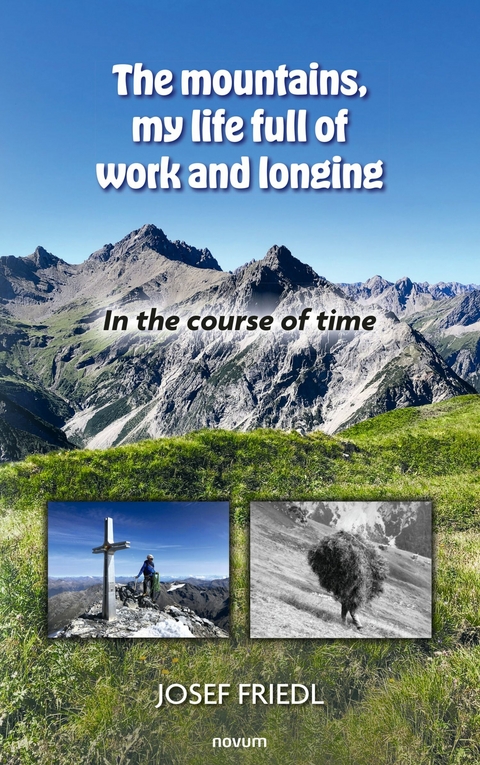
The mountains, my life full of work and longing (eBook)
586 Seiten
novum publishing (Verlag)
978-1-64268-375-2 (ISBN)
3 How I Experienced My Childhood
I, Josef Alfons, have been a very shy, quiet, sensitive, and reserved child, having great respect for or was even afraid of many grown-up people. That's why I avoided contact with teachers, priests, mayors and doctors unless it was absolutely necessary. I tried to avoid these and other authority figures as much as possible and tried not to draw their attention towards me. I often played and occupied myself for hours, creating my own ideal world in my thoughts, fantasies and dreams.
I am the eldest child in the family with four siblings whom I had to look after and take responsibility for when we weren't under the care of our mom and dad. As our parents took us along for all the work on the farm and outdoors whenever possible and involved us in everything, we were usually within their sight. I found my dad, in particular, to be very strict, which was often unpleasant.
Apart from elementary school, there was no crèche or kindergarten, no music lessons, or organized ski training. Thus, there were no other opportunities for parents to leave their children to other people. This meant that we were almost constantly involved in life on the farm and in the village. As a result, we experienced the various jobs and customs of all the local farmers firsthand and heard all kinds of stories from the old days.
On a beautiful autumn day when I was five years old and not yet at school, my mom packed a few "Eisahoangå" into my little backpack and sent me from the old wooden house in Pfafflar to my dad on our “Heuberg”. Dad had tied the hay from our Schober (19.6) in the "garden" to "Bürd" (3.6.2) and needed the extra iron hooks to be able to fixate the hay rope. During my ascent, I hid in a hollow from a passing eagle at the "Hühnerspiel", where the narrow path branches in steep terrain to the mountain meadows in the "Garten". I can still remember it very well. My father was delighted and praised me highly when I arrived at his house and took the necessary equipment out of my backpack. It was very exciting when ad sent the tightly tied bundles of hay, "coiffed" with a small wooden rake, with the "hoangå", which I had carried up, along the hay rope into the valley, where they were received by my Mum.
It would be unthinkable today to let a child, who was not of school age yet, set off alone on such a big mountain tour through steep grassy terrain interspersed with rocks over 500 meters in altitude. Nevertheless, I was very proud at the time.
Until I was seven years old, my dad, Uncle Anton (6.7), and Helmut Lechleitner, 24- to 36-year-old men, had to serve in the church because there were no other suitable "boys" in the village. In the spring of 1963, Monsignor Dr. Paul Adenauer, the son of the former German Chancellor, was on vacation in Boden. During his residence, he taught me the prayers in Latin required for the office of an altar boy. Because I learned these eagerly, I soon mastered them and was able to serve as an altar boy before he left, he sent me a beautiful icon with St. Martin and his dedication a few days later. Unfortunately, this precious gift hanging in my room was destroyed in the fire of November 1989.
As children, we were not amused by the many church visits we were obliged to make. There were many Holy Masses that we had to attend, even if they were read by visiting priests who were often present. Every Sunday afternoon, all year round, there was the rosary, which I had to lead at the age of twelve because Benedikt Perl, the sacristan, could no longer see enough to read the litany. During Lent, i.e. from Ash Wednesday to Easter, there were Stations of the Cross every Monday, Wednesday, and Friday and in May there were May devotions in the church every evening. Staying away from church events was not tolerated by the parents.
It was the teacher Johann Ostermann (6.4) who immediately recognized my talent for singing in elementary school in Bschlabs. When I sang the scale "Do re mi fa so", the musical virtuoso kept interrupting and correcting me. The teacher soon lost his nerve and said angrily: "Josef, you're a musical wild boar!" Since then, I've only sung to myself, in the car, on the mountain or anywhere else I felt like singing. I also enjoyed singing in church, but only as long as the singing seemed stable. Before I became the leading voice during a "crashing" song due to the sparse presence of singers, I wanted to have withdrawn in good time. Although I just cannot hit the right notes when I sing, I really enjoy music of all kinds.
In the summer of 1966, commercial artist Horst Klotz from Landsberg am Lech shot a 16-mm short black and white film in our valley. In this film, "The Shepherds of Pfafflar", I was called "Franzl, the son of the mountains". As a ten-year-old, I acted in a small episode about the life of mountain farmers. I never wanted to get into the film crew's car because I was worried that I might be kidnapped. A few years before, individual scenes from this film were shown in a "Bergauf-Bergab" program, where I accompanied the film crew from Bavarian television to the Dremelspitze near the Hanauer Hütte in the Lechtal Alps.
Back then, in the 1960s, the life of mountain farmers was very hard and extremely labor-intensive, but compared to today, it was incomparably diverse, varied, and full of abundance: mowing with a scythe, putting up countless haystacks, carrying haystacks on their backs, erecting stacks, pulling hay, acclimatizing cattle to pasture in spring, herding young cattle, stable work, milking cows by hand, centrifuging milk and churning butter, straightening wood, cutting and chopping firewood, pulling and spreading manure, building fences, grazing, clearing fields and mountain pastures, planting potatoes, weeding, hoeing and digging, lighting potato fires, growing, tending, harvesting and eating beans, gardening, chopping and tamping cabbage, baking bread, butchering, souring, smoking meat, eating bacon together after butchering, shearing sheep, washing wool, spinning and knitting, building roads and water pipes. Leo Lechleitner (6.1) forged and made wooden containers.
In my childhood, I once walked over the Hahntennjoch to the cattle market in Imst with my dad and our three calves as well as other farmers and their animals.
There were many cozy evenings – TVs and computers were still a long way off – where the neighbors met in the living room and told all kinds of stories that I listened to in silence.
On the one hand, I found this multifaceted life in the mountains exciting, interesting, and sometimes even thrilling. On the other hand, probably because of the many stories told by adults, I had many worries and depressing fears about illnesses, disasters, and war already as a child. During my time at primary school, World War II had only been over for twenty years. World War I and the difficult interwar period were still omnipresent among the older farmers as well.
I heard tragic war stories about the wounded, the fallen, invalids returning home, those who had been taken prisoner, tortured, spied on, betrayed, deserters, and refugees. As a soldier on a mountain near Cortina d'Ampezzo, great-uncle Gottlieb was trapped for 24 hours in a rocky niche by an avalanche. Another one of my great-uncles had his eye shot. As he was lying helplessly in the ditch, a passer-by hit him on the head with the stock of his rifle to put an end to his misery. Being abandoned by the others would have hurt even more than the bullet wound to his face. Nevertheless, he survived and reached a satisfactory old age at home as a one-eyed man. All these fates cut deep, created horrible images in my bizarre world of thoughts, and caused a burdening fear of war inside me.
I felt the perseverance and seriousness with which our parents worked until they were exhausted, along with their constant concern to do the best for the children, the animals, and the farm. When my parents, especially my mother, were in great distress because of a sick or even dead calf or another animal, I suffered with them. The responsibility I was repeatedly burdened with towards my younger siblings also weighed heavily on me. I rarely experienced my childhood as carefree, idyllic, happy, and joyful, although we felt very safe and protected, in general.
Over time, I found peace with the extremely intense years I spent at home and am very grateful to my parents for their successful efforts to shape us children into people who can survive on their own.
The enormous physical strain we were exposed to during the hard work, on the way to school, herding cattle on the Hahntennjoch, milking several cows by hand, and treading a slope in deep snow for skiing, or anywhere else, made our growing bodies strong and resilient.
Frugality, obedience, modesty, and contentment were instilled in us by the simple and modest rural life within our extended family.
Tiredness caused by work and outdoor exercise should never be an excuse for not doing homework in the evening or neglecting to study for school.
Our parents' upbringing methods, which motivated us to perform at our best with clear guidance and recognition, made everything that came my way later in life seem simpler and easier compared to my childhood and teenage years.
In the course of a seminar on the development of junior managers, which I was thankfully allowed to attend as an employee at the metal plant, a psychologist determined that I had received far more strokes for "doing" than for "being". Consequently, I would only be able to stand up to myself if I performed. People shaped in this way, want and need to work autonomously and not need someone who is constantly pushing them, according to this trainer.
The drive for efficiency that our...
| Erscheint lt. Verlag | 13.12.2024 |
|---|---|
| Verlagsort | Neckenmarkt |
| Sprache | englisch |
| Themenwelt | Literatur ► Romane / Erzählungen |
| Schlagworte | Biografie • Geschichte • Josef Friedl |
| ISBN-10 | 1-64268-375-2 / 1642683752 |
| ISBN-13 | 978-1-64268-375-2 / 9781642683752 |
| Informationen gemäß Produktsicherheitsverordnung (GPSR) | |
| Haben Sie eine Frage zum Produkt? |
 EPUB (Wasserzeichen)
DRM: Digitales Wasserzeichen
Dieses eBook enthält ein digitales Wasserzeichen und ist damit für Sie personalisiert. Bei einer missbräuchlichen Weitergabe des eBooks an Dritte ist eine Rückverfolgung an die Quelle möglich.
Dateiformat: EPUB (Electronic Publication)
EPUB ist ein offener Standard für eBooks und eignet sich besonders zur Darstellung von Belletristik und Sachbüchern. Der Fließtext wird dynamisch an die Display- und Schriftgröße angepasst. Auch für mobile Lesegeräte ist EPUB daher gut geeignet.
Systemvoraussetzungen:
PC/Mac: Mit einem PC oder Mac können Sie dieses eBook lesen. Sie benötigen dafür die kostenlose Software Adobe Digital Editions.
eReader: Dieses eBook kann mit (fast) allen eBook-Readern gelesen werden. Mit dem amazon-Kindle ist es aber nicht kompatibel.
Smartphone/Tablet: Egal ob Apple oder Android, dieses eBook können Sie lesen. Sie benötigen dafür eine kostenlose App.
Geräteliste und zusätzliche Hinweise
Buying eBooks from abroad
For tax law reasons we can sell eBooks just within Germany and Switzerland. Regrettably we cannot fulfill eBook-orders from other countries.
aus dem Bereich