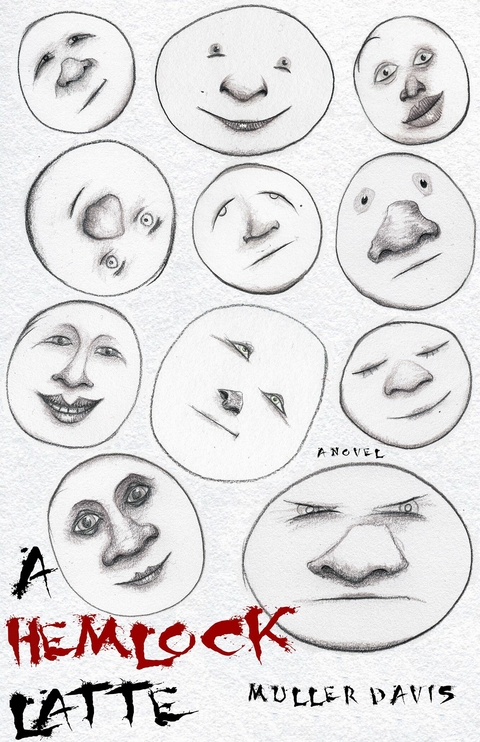
Hemlock Latte (eBook)
308 Seiten
Bookbaby (Verlag)
978-1-7336270-2-3 (ISBN)
A visual artist, Muller Davis lives in Santa Fe, NM, where he taught language arts in the public schools for five years. His two previous books-Drag Her Out Into the Light: Art and Poems and Always Us Embracing: Poems & Drawings-are filled with weirdness and available on his website: monkeymonkeylove.com.
Fifty percent of all new teachers, within three years, quit and become insurance adjusters. Wal-Mart greeters. Trader Joes cashiers. Considering the disrespect teachers experience in a public high school classroom we may wonder why more teachers don't go full-blown crazy. This is not your typical inspirational teacher story-this is a real-life view of what it's like to be a neophyte in the lion's den. An idealistic first-year teacher storms into the classroom ready to change the world only to smack into a wave of student contempt, parental apathy, and administrative aggression. Gabriel, the teacher, pushes back. His angst as rampant as his students, he draws the wrath of the other teachers, the principal, as well as the local weekly, but in the process, he gains the admiration of his students. And then, at the height of his power and at the pinnacle of controversy, he vanishes, leaving his students in the midst of a tempest.
Mr. Gabriel Abrams
A steady edge of sunlight pierced through the wide window. On the first day of school a breeze slipped in but couldn’t sweep away the aroma of detergent that had been used to scrub the classroom clean. The students stared at their new teacher—this oddity—with his untucked shirt and messy black hair pointing skyward. He stood perched at the front of the room ready to say something, yet saying nothing.
New to the teaching profession, the teacher swallowed a mouthful of saliva that barely forged its way down his throat. He inhaled the chemical detergent aroma that burned in his nose, sunk down into his stomach, and burned there too. This was how he imagined teaching would be: a classroom filled with young students poised to ingest his every syllable—he just never imagined freezing up.
He had planned on what to say. For at least a year, he knew exactly what he would say on that first day. No introductions. No meet and greet. Just down to the foundation of what the students needed to know now.
He swallowed his twisted gob down his resistant throat, and a word dribbled out:
“Be …”
Someone giggled.
“Be,” the teacher repeated, this time raising his palms with his fingers outstretched. “Be happy with who you are.”
More giggles. But the teacher had gained momentum.
“Be happy with who you are because you can be nobody else. You are yourself, you can’t trade yourself in. You can’t make yourself vanish.”
He prowled around the room and the students twisted in their seats to watch him.
“I don’t know what I can teach you, what you can learn, but this truth you can’t make go away. Be happy with who you are, be ecstatic with who you are, be inspired and do amazing things with what you were given on the day you were born.”
Words spiraled out of his mouth. His nervousness melted away in a lubricated flow of the exact ideas of his life articulated. He could spin no bad phrase, he burned with perfection. And this without a script, with only a desire to be a fire-breathing perfect picture of what a teacher could be—should be. In that moment he was the embodiment. He was Adam. He was Aristotle. He was Dionysus. Beowulf. Alexander the Great. Bruce Lee.
Satisfied, he stood in the back corner of the classroom, his energy settling into dramatic waves around him. His voice grew as soft as a cloud, and the students leaned in closer.
“This is it, this is your life. It has begun.”
The teacher’s head drifted down, his chin almost touching his chest.
This was the moment when the applause should burst up off the audience.
But the teacher smelt smoke. He looked over and saw a student with a Bic lighter clandestinely setting fire to another student’s shoelace.
When the New Mexico State Highway Patrol called, I was watching TV, flicking through five hundred channels of nothing. The state trooper claimed they had found my brother’s car abandoned in the lava tubes parking lot in Grants, New Mexico. My brother might be dead, the trooper suggested, though there were tell-all signs of an intentional vehicular abandonment. No perishables in the car. No regular stuff like a knife or a sunglass case or coins. No water. Little gas. The car seemed cleaned out, zipped up, intentionally forsaken. In the lava tubes, they don’t send out search parties for missing hikers without permits, he said, because these caves, made a million years ago from retreating lava that are hundreds of miles long, tend to collapse in on themselves and no one ever knows. In one of the uncharted underground passageways, a ceiling falls and it affects not one soul; no one ever notices. It happens all the time. This fact makes the lava tubes a perfect place for fleeing individuals to ditch their vehicles, which might not be noticed for several days, and the authorities figure they were lost in a collapsed cave. No search. No record. No body.
“Do you know how many people used 9-11 as an opportunity to fake their own deaths?” The full voice on the other end of the phone commanded authority. “Did your brother have any reason to flee his life—a bad marriage, a thing for exotic lands, criminal activity, trouble at work? It says here he was a teacher.”
I could see my brother shirking all responsibility in a desperate attempt to cling to his past shreds of freedom, to his glory days as a finely tuned and tanned man/child skittering the globe in search of adventure. Gabriel had finally settled down with a real job. And as a teacher! Our mother’s endless hole of worry in regards to Gabriel’s well-being had begun to dissipate. But no more. Here you go mom—open wide, here comes more stress. Gabriel’s off again. And this time he’s leaving in the lurch a classroom crammed with eager students. Maybe he’ll call, maybe he won’t. Maybe he’ll drop us one of his cryptic postcards, maybe we won’t hear from him for a year. Or two. Or five. I can see him lounging on a beach in southern Thailand, sipping a banana lassi, smoking a local dubber, chattering up the young hotties as if he were the king of the expats—going by some nickname like Saddhu or Slate or Pineapple or by nothing at all. Just dude. Mystery dude.
Asshole.
Typical Gabriel.
Maybe rummaging for adventure he’s dropped himself in the middle of some South American rainforest in order to fight his way out. Maybe without a dime he flew to Buenos Aires. So often I’ve heard his diatribe about how one of the worst aspects of our isolated society is our lack of need to learn another language. In India, he’s said, even the illiterate speak three languages as opposed to an American with a PhD who knows only English and an hola or two.
Twenty-seven years old, knowing only English, teaching at a school where many of the families came from Spanish backgrounds and some spoke only Spanish, Gabriel felt ill-equipped. Los Pinos High School had few Spanish-speaking teachers, and the administration encouraged none of their teachers to learn Spanish; in fact, when Gabriel was hired, they didn’t even ask if he spoke Spanish.
Lacking the gift of a second (or third) language, Gabriel felt the best way he could learn another language—the only way, he feared—was to be dumped somewhere where he had no friends, no money, where no one spoke English, and from where he could not escape. Learn to communicate or starve.
If Gabriel split town—leaving his first real job incomplete, leaving his students with a string of disconnected substitutes—I don’t know where he would go. Maybe back to India, not just to blow his mind on so different a culture, but to blow his spirit in some desperate attempt to lose himself, his culture, his family, his friends, his brother.
Write a motto for your life,” Gabriel said to his class on the second day of school.
When Gabriel discovered himself as a teacher, all his arrogance gained purpose and weight. He had thought he had found his calling before, but when he started teaching he knew—he knew like the bright sun in the morning can promise a perfect day. The warmth filled in where he hadn’t known he was cold, and when it hit it elevated him.
“Write a motto for your life,” he repeated, pointing to the dry erase board where he had written the same.
No one was writing. Nothing but bulking bags—book bags and backpacks and purses—sat on the desktops.
Gabriel glared at a girl in the front. “Take your purse off your desk.”
And she did.
“Take your packs off your desks.”
And they did.
“Now take out your notebooks, take out your pencils, take out your pens.”
“I don’t have a notebook.”
“I don’t have a pen.”
The chorus rose up like a swell.
“I don’t have a pencil.”
“I don’t have a notebook.”
“Borrow one, borrow some, tear sheets in half.” Gabriel pranced around the room. “Use a pen, use each other’s pens, use your blood. Write a motto for your life and write it from your soul—”
“What’s a motto?”
Gabriel stopped. He glanced at the girl who was staring up over her round glasses.
“A motto,” Gabriel began, now pausing, thinking. In his belly the butterflies fluttered anew. What is a motto? He glanced around at the anxious faces. He swallowed. His second day as a teacher and he stumbled.
“A motto is something … a motto is—let’s look it up.”
Gabriel went for the red Webster’s Dictionary. He flicked it open and landed on the right page.
“‘Motto: a short saying that expresses a rule to live by.’ Perfect.”
“I don’t get it.”
“What don’t you get?”
“We have to make one up?”
“That’s right.”
“I don’t understand.”
“It’s a saying that defines you, that you live by, that, that—”
“What’s...
| Erscheint lt. Verlag | 9.12.2024 |
|---|---|
| Sprache | englisch |
| Themenwelt | Literatur ► Romane / Erzählungen |
| ISBN-10 | 1-7336270-2-2 / 1733627022 |
| ISBN-13 | 978-1-7336270-2-3 / 9781733627023 |
| Informationen gemäß Produktsicherheitsverordnung (GPSR) | |
| Haben Sie eine Frage zum Produkt? |
 EPUB (Ohne DRM)
Größe: 4,8 MB
Digital Rights Management: ohne DRM
Dieses eBook enthält kein DRM oder Kopierschutz. Eine Weitergabe an Dritte ist jedoch rechtlich nicht zulässig, weil Sie beim Kauf nur die Rechte an der persönlichen Nutzung erwerben.
Dateiformat: EPUB (Electronic Publication)
EPUB ist ein offener Standard für eBooks und eignet sich besonders zur Darstellung von Belletristik und Sachbüchern. Der Fließtext wird dynamisch an die Display- und Schriftgröße angepasst. Auch für mobile Lesegeräte ist EPUB daher gut geeignet.
Systemvoraussetzungen:
PC/Mac: Mit einem PC oder Mac können Sie dieses eBook lesen. Sie benötigen dafür die kostenlose Software Adobe Digital Editions.
eReader: Dieses eBook kann mit (fast) allen eBook-Readern gelesen werden. Mit dem amazon-Kindle ist es aber nicht kompatibel.
Smartphone/Tablet: Egal ob Apple oder Android, dieses eBook können Sie lesen. Sie benötigen dafür eine kostenlose App.
Geräteliste und zusätzliche Hinweise
Buying eBooks from abroad
For tax law reasons we can sell eBooks just within Germany and Switzerland. Regrettably we cannot fulfill eBook-orders from other countries.
aus dem Bereich