


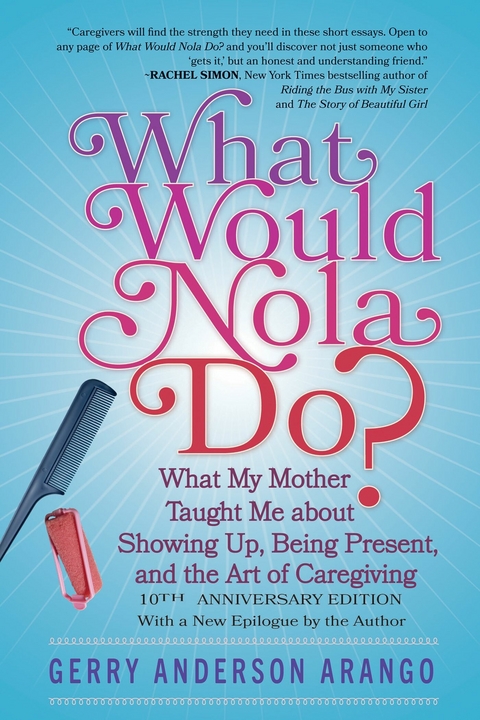
What Would Nola Do? (eBook)
224 Seiten
Bookbaby (Verlag)
979-8-3509-8243-5 (ISBN)
Always mom first, now a grandmother as well, Dr. Geralyn Anderson Arango is a Professor of Education, Emerita at Holy Family University in Philadelphia, PA. Gerry writes, teaches and consults on topics pertaining to intellectual disability across all phases of life. She is the host of 'Our Parallel Paths: A Future for My Loved One with a Disability... and For Me!' a podcast produced by Networks for Training and Development. Gerry lives in Wilmington, Delaware with her husband Michael, and hopes that their imminent retirement won't make them weirder than their cats.
Meet Gerry, wife and working mom - in her own words "e;not so much a person who is a failure, as a person who is fundamentally intolerant of, and disappoined in, my lack of superpowers."e; But more than superpowers are needed as Gerry navigates her roles as parent of a teenager with Down syndrome, as friend to a priest derailed by traumatic brain injury, and as daughter to charming, wise, always-in-control Nola, who is beginning a heartbreaking descent into dementia. Throughout Gerry's journey with mother, son and friend, and sprinkled with the ups and downs of everyday life, Gerry learns lessons each has to teach us all, finds spiritual resilience and a gentle dose of humor as she endeavors to answer the question she always relied on; What Would Nola Do?Always mom first, now a grandmother as well, Dr. Geralyn Anderson Arango is a Professor of Education, Emerita at Holy Family University in Philadelphia, PA. Gerry writes, teaches and consults on topics pertaining to intellectual disability across all phases of life. She is the host of "e;Our Parallel Paths: A Future for My Loved One with a Disability and For Me!"e; a podcast produced by Networks for Training and Development. Gerry lives in Wilmington, Delaware with her husband Michael, and hopes that their imminent retirement won't make them weirder than their cats.
James, 1992
I recently made a new friend who looks exactly like an old friend of mine from several years ago. This friend, James, and I had known each other for a total of 14 years, but we didn’t speak much for the second seven. We met in the sacristy of the suburban Philadelphia church where he was stationed as an associate pastor. And for a short while, before starting a family, I made my small contribution to our parish as an alto in the choir and as a lector for Sunday Mass. I had lots more time back then.
James was hard to miss; six feet of blue-eyed prematurely gray Irishman with a husky build that seemed to challenge the seams of his graceful clerical vestments. I still clearly remember my reaction as Al and I laid eyes on him for the first time at the end of the procession of the altar server, lector, and celebrant at St. Theresa’s, the parish we had only recently joined.
I leaned over to my husband that day, trying to not look as inattentive to ritual as I found myself at that moment, and I whispered, “Yikes, that’s not a priest, that’s a Teamster.”
James took his place on the altar as the Mass began, and his soft deep baritone greeted the congregation.
“The Lord be with…” brief pause… “all of you,” he said. The all was not the usual script.
Al and I exchanged surprised looks – James exuded none of the roughness his burly appearance intimated. We would listen to him preach again and again in the gentlest and warmest of baritones, and with the most meaningful of words; heartfelt, insightful, and reflective of a deep understanding and devotion to the faith. And sometimes, for better or worse, those words could be directly reflective of his mood that day.
A good day” “The Mass has ended. Go in peace.”
A bad day: “The Mass has ended.”
What? No peace? Oh, fine. Be like that.
Still, the altar seemed to be James’s canvas and his craft, the Mass, his preferred medium. His sermons seemed to speak to his congregation right where we were today, no vague or lofty references to put us ill at ease. Well-prepared, but not recited, often shared off the pulpit, as he stood right down among us on the church floor. There were occasional surprises like the envelope containing his monthly stipend handed off to someone in the congregation who volunteered to do some good with the money. And there was the sermon called “Don’t Let Anybody Should on You.” Clever and true, with an intimation of the vulgar, just for fun. I remember thinking, “Wait. What did he say?”
The stoles of James’s vestments were often handmade – my favorite was the macramé – and each one had a story behind it. He delighted in the music that elevated each service, though he struggled to carry a High Mass or any other tune himself. James knew from the age of ten that he wanted to be a priest. Gosh, the only thing I knew at the age of 10 was that I was ten.
My early experiences of speaking with James one-on-one, however, often felt like being guest on a talk show. He was the host and I was this evening’s special guest. I was peppered with questions wherever we met.
“So, you’re not from around here?”
“What nationality are you?”
“Do you have brothers and sisters?”
“How long have you been working on your doctorate?”
“What’s your real hair color?”
And of course, “How old are you?” a question I was much more willing to answer back then.
Eventually, I became a bit sensitive to the one-sidedness of our conversations and my growing discomfort with the, uh, hot seat. So realizing I wasn’t fascinating enough to dominate the conversation forever, I began asking questions back.
“So, you’re from around here?”
“How many siblings do you have?”
“What do you guys do around here when you’re not saying Mass?”
“What color was your hair before it turned gray?””
And eventually, “How old are you?”
James seemed hesitant to answer at first, taken aback by the sudden switch of the hot seat perhaps, but I persisted and he responded. It only took a few chats to learn about his sibling-filled Irish family and his position in it as the eldest of eight; the stint in the Navy where he refused to carry a gun and had to fake-shoot with a broom; his world travels, including the severe sunburning of that Celtic skin when he was in the Vatican at Saint Peter’s Square; why he chose the priesthood (a question he said he didn’t answer for just anyone); and about anything else I thought to ask. It seemed like he was surprised at being questioned about himself, like that wasn’t the point of a conversation with a priest. I enjoyed listening to his stories, and especially the little parish gossip and cigarette smoke, as we chatted in the small yard between the church and the rectory. Eventually, the feeling of I’m being interviewed gave way to something more like a normal dialogue between two people, which worked for me. But sometimes normal dialogue could get a little misplaced, because like one Saturday I decided to have James hear my confession, but spent 45 minutes in the confessional having a chat instead. (I never did get absolved of my sins, and a very long line of sinners awaited him when I left the confessional. They must’ve thought I was in need of some major redemption. God certainly didn’t find out that day. Plus, I emerged a little stiff from kneeling that long.)
Spending as much time as we did in service to the parish, James and I became more like friends than coworkers. We occasionally took our relationship out for a spin, passing time together out in the “real world,” mostly in restaurants, as I think back. One afternoon, as he peppered me with questions over lunch yet again, I apparently impressed him with the fact that my sister, Gail, was the design director of a major music magazine. Just for fun, I began to slip him copies of the magazine she gave me, after I finished reading them. The first issue I gave him featured a topless Janet Jackson on the cover, with only her hands covering her breasts. And it was probably not the most appropriate magazine to slip a priest after Mass, but James liked keeping up with the music world, and perhaps his indirect connection to it as a friend of the sister of a very successful New York graphic designer. I smiled that day after church, slightly embarrassed for James as he stood in clerical garb, greeting parishioners after Mass with that racy magazine cover rolled up tightly in his non-handshaking hand.
This practice later evolved into the exchange of novels and music CDs. James loved music, bragging that he owned every Motown album ever made. He reminisced fondly about going with his friends down to broadcasts of the TV show, American Bandstand, at the studio not far from his high school, and escaping from Philadelphia to New York with his best friend to hear the popular music acts of the day. I envied his passion for music.
It was about a year later, after 6:30 AM Mass, as I prepared to leave for work, that I heard a flurry of surprised voices coming from the sacristy. Distracted from my own thoughts, I listened closer but could not clearly discern the words. Moments later, a woman came out and rushed over to me, the last person left in that corner of the church.
“Father is transferring,” she exclaimed.
“Really.” I said.
I thought back to a conversation that Al and I had with James one evening at dinner, where he casually asked me if I knew anything about Haitians, which I did not. He mentioned an interest in working with that community, but said no more that day. But now, there it was.
Curious, I stepped into the sacristy as he was leaving. Behind James were two of the women I came to think of as “the regulars,” older ladies who always went to Mass, who set up the altar, who fussed over the priests like handmaids. From where I stood, they seemed a little flustered and weepy. I turned back from the sacristy to walk in James’s direction.
“Ah, leaving us for Haitians?” I asked as we exited together. He confirmed that, yeah, this was to be his transfer, just like that.
“So aren’t you gonna cry too?” He asked, as we slipped through the side door into the little yard of our many conversations. I wasn’t sure if he was joking or not.
“Well, you’re just being transferred,” I said. “It’s not like you’re dying or something.”
Which I don’t suppose was the most sensitive way to say that.
James and I kept the chats going on even after he was transferred that summer, but I don’t think he assumed such continuity would happen. Catholic priests who work for a diocese, as James did, seemed to me to be discouraged from getting too attached to people or places. Sounds like a safety measure, but feels like a sad one. Like it or not, you go where they tell you. Sitting in his living room one evening, James commented that he “didn’t put nails in the walls,” as Al and I admired some photographs hanging by the door. It’s a transient lifestyle sometimes, I guess, the priesthood. In some ways, perhaps this detachment worked for such a life choice, leading men to focus inward, and to be able to give of themselves in personalized but emotionally removed ways.
But what does that detachment do for relationships? Does it keep you in the role of caregiver, always ministering and expecting nothing in return? Does it ask that you try not to get any more deeply involved?
Perhaps that leaves some men lonely.
James’s new parish was as convenient to my work as a doctoral student at Temple University as his...
| Erscheint lt. Verlag | 15.1.2025 |
|---|---|
| Sprache | englisch |
| Themenwelt | Literatur ► Biografien / Erfahrungsberichte |
| ISBN-13 | 979-8-3509-8243-5 / 9798350982435 |
| Informationen gemäß Produktsicherheitsverordnung (GPSR) | |
| Haben Sie eine Frage zum Produkt? |
 EPUB (Ohne DRM)
Größe: 3,3 MB
Digital Rights Management: ohne DRM
Dieses eBook enthält kein DRM oder Kopierschutz. Eine Weitergabe an Dritte ist jedoch rechtlich nicht zulässig, weil Sie beim Kauf nur die Rechte an der persönlichen Nutzung erwerben.
Dateiformat: EPUB (Electronic Publication)
EPUB ist ein offener Standard für eBooks und eignet sich besonders zur Darstellung von Belletristik und Sachbüchern. Der Fließtext wird dynamisch an die Display- und Schriftgröße angepasst. Auch für mobile Lesegeräte ist EPUB daher gut geeignet.
Systemvoraussetzungen:
PC/Mac: Mit einem PC oder Mac können Sie dieses eBook lesen. Sie benötigen dafür die kostenlose Software Adobe Digital Editions.
eReader: Dieses eBook kann mit (fast) allen eBook-Readern gelesen werden. Mit dem amazon-Kindle ist es aber nicht kompatibel.
Smartphone/Tablet: Egal ob Apple oder Android, dieses eBook können Sie lesen. Sie benötigen dafür eine kostenlose App.
Geräteliste und zusätzliche Hinweise
Buying eBooks from abroad
For tax law reasons we can sell eBooks just within Germany and Switzerland. Regrettably we cannot fulfill eBook-orders from other countries.
aus dem Bereich


