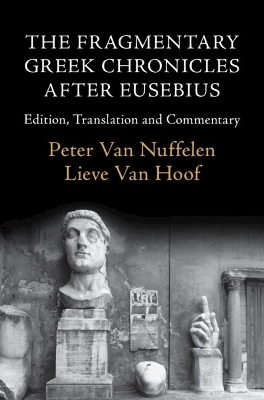
The Fragmentary Greek Chronicles after Eusebius
Cambridge University Press (Verlag)
978-1-108-42028-0 (ISBN)
This is the first systematic collection of the remains of the lost Greek chronicles from the period AD 350–650 and provides an edition and translation of and commentary on the fragments. Introducing neglected authors and proposing new interpretations, it reveals the diversity of the genre and revises traditional views about its development, nuancing in particular the role usually attributed to Eusebius of Caesarea. It shows how the writing of chronicles was deeply entangled in controversies about exegesis and liturgy, especially the dates of Christmas and Easter. Drawing from Latin, Armenian, Syriac and Arabic sources besides Greek ones, the book also studies how chronographic material travelled across linguistic and cultural boundaries. In this way, it sheds a profoundly new light on historiography in transition from Antiquity to the Middle Ages.
Peter Van Nuffelen is Professor of Ancient History at Ghent University. His further publications include Orosius and the Rhetoric of History (Oxford, 2012) and Penser la tolerance durant l'Antiquité tardive (Paris, 2018). Together with Lieve Van Hoof, he authored the Clavis Historicorum Antiquitatis Posterioris (Turnhout, 2020), The Fragmentary Latin Histories of Late Antiquity (Cambridge, 2020), and Jordanes: Getica and Romana (Liverpool, 2020). He is the recipient of several prizes and major grants, including a Starting Grant and an Advanced Grant from the European Research Council. Lieve van Hoof is Professor of Ancient History & Classics at Ghent University. Her publications include a monograph on Plutarch (Oxford, 2010) and an edited volume on Libanius (Cambridge, 2014). A former President of the Young Academy, she was distinguished as Laureate of the Royal Academy of Flanders for the Sciences and the Arts, and is currently Professor Extraordinary at the University of Stellenbosch.
Introduction; 100. Andreas, brother of Magnus, Chronography; 101. Diodore of Tarsus, Chronicon; 102. Heliconius, Chronological epitome; 103. Metrodorus, Chronicle and Easter cycle; 104. Panodorus, Chronography; 105. Annianus of Alexandria, Chronography; 106. Pseudo-Eusebius, son of Pamphilus, Chronicle; 107. Clement of Antioch, Chronicle; 108. Timothy of Apamea, Chronography; 109. Theophilus, the chronicler of Alexandria, Chronography; 110. Eustathius of Epiphania, Chronological epitome; 111. Pseudo-Epiphanius of Salamis, Chronicle; 112. Heron, Chronography; 113. Isidore the Deacon, Chronography; 114. Pyrrho, Chronicle; Dubia; 115. Itios, Chronicle?; 116. Irenaeus, Chronicle?; 117. John Chrysostom, Letter to Acacius of Melitene; 118. Anonymous, Book of consuls; 119. Pseudo-Jacob of Nisibis, Chronicon.
| Erscheinungsdatum | 25.07.2025 |
|---|---|
| Mitarbeit |
Assistent: Maria Conterno, Lorenzo Focanti, Andy Hilkens |
| Übersetzer | Peter Van Nuffelen, Lieve Van Hoof |
| Zusatzinfo | Worked examples or Exercises |
| Verlagsort | Cambridge |
| Sprache | englisch |
| Maße | 161 x 235 mm |
| Gewicht | 1210 g |
| Themenwelt | Literatur ► Klassiker / Moderne Klassiker |
| Geschichte ► Allgemeine Geschichte ► Vor- und Frühgeschichte | |
| Geisteswissenschaften ► Geschichte ► Regional- / Ländergeschichte | |
| ISBN-10 | 1-108-42028-1 / 1108420281 |
| ISBN-13 | 978-1-108-42028-0 / 9781108420280 |
| Zustand | Neuware |
| Informationen gemäß Produktsicherheitsverordnung (GPSR) | |
| Haben Sie eine Frage zum Produkt? |
aus dem Bereich