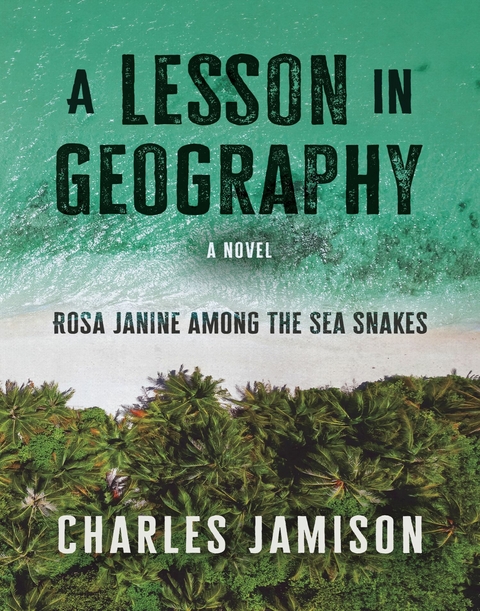
Lesson in Geography (eBook)
296 Seiten
Bookbaby (Verlag)
979-8-3509-7298-6 (ISBN)
Charles Jamison has been a naval officer and a diplomat, and has lived in Kenya and Brazil, among other countries.
It is 1979 and Argus Morrison is a consular officer at the American Embassy in Nairobi. Without warning, a seemingly routine task for him spins wildly out of control. He is propelled from East Africa halfway around the world to Bahia, in Brazil, and his life is changed forever. This is his story, told forty years later. A novel rooted firmly in its two geographical locations: Kenya and Bahia, in Brazil, with a plot driven by events in the Angolan civil war. The principal theme of the novel is the personal cost to the individual, and to others, of acting on an impulse to "e;live life to the fullest"e;.
JAMBA
I am walking slowly across the hard dry ground. The afternoon sun presses on my neck and shoulders with physical force. My shirt seems glued to me, and is stained dark under the arms and down the center of the back. My boots stir the thick layer of dust and my footsteps are silent.
A truck drives past me, filled with laughing Black soldiers clutching FN assault rifles between their knees. They leave a billowing cloud behind them, some of which finds its way into my mouth. I try to spit, but I’m short on saliva and the hot grit stays where I can feel it between my teeth.
It is always the same. I am walking toward a small unpainted wooden building which sits under a large thorn tree. Its corrugated metal roof is shaded, and through the open door and windows the interior looks dark and cool. As I approach I notice that the planks of the outside walls are rough and weathered. This and the way small tufts of grass are growing at the base of the walls makes me think this hut has been here for some time. Perhaps it was one of the first to be built at Jamba.
I step up the one or two wooden steps to the door and peer inside. I can see immediately that the coolness I had anticipated was an illusion. Here there is relief from the searing sun, but the heat is undiminished. The air in the small room embraces the occupants more like a liquid than a gas. There are two men there, leaning over a table covered with maps and papers. They look up and straighten themselves when they hear my boots on the threshold.
Most of what I know about Thomas Morgan came from a Rhodesian pilot named Brooks who beat me in a card game in Loyangalani and then flew me to Juba in his old DC-3. While I had three, perhaps four, encounters with Morgan himself, they weren’t the kind of situations where you learn much about the other person.
I know that Morgan was in Jamba two years before our lives crossed. This is one of the things I learned from Brooks, sitting next to him in his cockpit, straining to hear over the roar of the two big radial engines. But at that time I wasn’t as curious about Morgan as I am now. So I didn’t ask as many questions as I might have.
For those questions I didn’t ask Brooks, the ones I would ask now if I had the chance, I have formed my own answers in a kind of self-indulgent arrogance, like a writer who takes liberties with his characters.
Brooks was flying supplies for Jonas Savimbi when he knew Morgan. That was back when UNITA had only recently arrived in Southeastern Angola, that part of the country which the Portuguese called o fim do mundo because it literally is the end of the world. Savimbi set Jamba there because that vast region of Cuando Cubango, with its dry sandy floodplains spotted with sparse scrubby forests and occasional grass, was virtually inaccessible to the MPLA forces which had taken control in Luanda. The other advantage to the place was its proximity to the South African Defence Force in Namibia. By that time Savimbi was forced to rely on the SADF for nearly everything. It was a time of survival For UNITA, and of waiting, and Morgan was a part of that.
For some reason I always imagine him at Jamba. It’s unclear to me why this should be so, because I have never been there. But I have spent enough time in Africa to have an idea what it looked like. The low buildings and sheds are scattered among trees growing on the banks of one of the major rivers; barracks and workshops and supply sheds and armories built on the hard-packed sandy clay. The trees give some shade from the African sun, but more importantly from the eyes of the MPLA air force. But Savimbi doesn’t put all his faith in trees, and there are sandbagged anti-aircraft guns out in the open places.
Because he is at Jamba, Morgan is in uniform. I never saw him dressed that way, but I know how he would look. Unlike most men, who wear army uniforms in a way intended for comfort rather than style, Morgan looks both comfortable and well-tailored. Even in combat dress there is an air of elegance about him which makes him seem out of place here. I think perhaps it is his moustache which does it. It is small and well-trimmed, in contrast to mine, which tended to be a bit unruly and too large for my face. His light brown hair is cut a little longer than I would have expected for the military, not unlike my own. I can see why others might see a physical similarity between us. He is slightly heavier now than he will be two years later, but he is clearly in good physical condition.
Morgan turns and speaks to the other man. “Give us a half hour, will you sergeant? We can pick this up again later.”
The sergeant nods mutely and turns to leave the hut. He glances at me as he walks past me toward the door. I feel out of place in my civilian clothes.
After he leaves I walk over to the table and reach across to shake hands. “I’m Argus Morrison.”
He grips my hand, and his eyes are steady and clear. “I know. I was told you had come to Jamba to see me.”
“Yes.”
“Why? I can’t think why anyone would travel all this way to meet an ordinary army captain. Is there something in particular that you want from me?”
“Yes. I need to know what kind of a person you are. You see, we won’t have time for that later. When events start moving us at their own pace we won’t be able to stop and find out about those things.”
“Why is that important to you? We all have our roles to play, some forced on us and others taken more or less voluntarily. But we have to play them. There’s not much we can do about it, and in any case it’s not often that someone else really affects how we behave.”
“I suppose that’s generally true. But there are times when the other person does make a difference. Haven’t you ever met someone to whom you took an immediate dislike, but who eventually became a good friend? That has happened to me more than once.”
“You’ll have to forgive me,” he says, rubbing his chin. “But I’m finding this a bit difficult to follow. If we’re going to discuss philosophy I think we should have something to drink.”
He disappears into another room, and I hear him opening what I take to be two bottles of beer. He comes back, hands me one, and pulls a straight-backed chair up to the table. I do the same.
“Cheers.” We raise our bottles across the maps and I let the warm liquid wash around my mouth before swallowing. In those years Jamba had fewer amenities than it would have later, and a warm beer was much appreciated.
Morgan rests his beer bottle on the Benguela Railroad, which stretches across the map in front of him, and picks up the conversation again. “So what does all this have to do with me? It sounds as if you think we have something in common. Is that it?”
“Not necessarily. But the thought has occurred to me. It bothers me that I have no way of knowing. I want to know for sure.”
“In this case I doubt if that’s possible. You’re probably going to have to reconcile yourself to that. But if it makes you feel better, I don’t mind telling you what I think.”
“All right. I have only one question: Why are you here?”
“Here?” He motions around the room. “Because it’s a job that needs to be done, nothing more than that.” He looks at me over his beer bottle as he takes a swig. “Oh, I get it. You want to know if I subscribe to the ideology of the whole thing. Well I can tell you I don’t give a damn for the bloody ideology of apartheid. I’m a pragmatist. I’ll give you no ‘sons of Ham’ bullshit from the Old Testament.
“What I will tell you is that I enjoy making life difficult for the Soviets and the Cubans and all the other meddling bastards who’re trying to stir things up in this part of the world. But that’s not ideology either. I don’t delude myself into thinking we’re holding the line against Marxism or anything like that. There isn’t a Marxist government in Africa that knows or cares a thing about ideology. All it has to do with is power, pure and simple. There are those who have it and those who don’t, and I intend to be on the side of those who do.”
“So there’s no commitment to anything beyond what you want for yourself?”
“I’m not sure I see what you’re getting at. I’ve just told you I can’t justify what I’m doing on the basis of philosophy.” He hesitates. “But I can see you aren’t happy with that explanation either.”
“No. I guess I want to believe there’s more to it than that.”
“Well, if it makes you happier, you can consider self-interest a perfectly valid philosophy. And there are any number of variations to it. Power and money and pleasure are only three of them.”
“By that standard, the man who is driven to climb mountains is, in fact, selfish.”
“Absolutely. In whose interest is he acting other than his own?”
“Then there is hope after all.”
Morgan stares at me, uncomprehending, a look of irritation on his face. The warm beer tastes...
| Erscheint lt. Verlag | 15.10.2024 |
|---|---|
| Sprache | englisch |
| Themenwelt | Literatur ► Romane / Erzählungen |
| ISBN-13 | 979-8-3509-7298-6 / 9798350972986 |
| Informationen gemäß Produktsicherheitsverordnung (GPSR) | |
| Haben Sie eine Frage zum Produkt? |
 EPUB (Ohne DRM)
Größe: 4,6 MB
Digital Rights Management: ohne DRM
Dieses eBook enthält kein DRM oder Kopierschutz. Eine Weitergabe an Dritte ist jedoch rechtlich nicht zulässig, weil Sie beim Kauf nur die Rechte an der persönlichen Nutzung erwerben.
Dateiformat: EPUB (Electronic Publication)
EPUB ist ein offener Standard für eBooks und eignet sich besonders zur Darstellung von Belletristik und Sachbüchern. Der Fließtext wird dynamisch an die Display- und Schriftgröße angepasst. Auch für mobile Lesegeräte ist EPUB daher gut geeignet.
Systemvoraussetzungen:
PC/Mac: Mit einem PC oder Mac können Sie dieses eBook lesen. Sie benötigen dafür die kostenlose Software Adobe Digital Editions.
eReader: Dieses eBook kann mit (fast) allen eBook-Readern gelesen werden. Mit dem amazon-Kindle ist es aber nicht kompatibel.
Smartphone/Tablet: Egal ob Apple oder Android, dieses eBook können Sie lesen. Sie benötigen dafür eine kostenlose App.
Geräteliste und zusätzliche Hinweise
Buying eBooks from abroad
For tax law reasons we can sell eBooks just within Germany and Switzerland. Regrettably we cannot fulfill eBook-orders from other countries.
aus dem Bereich