Frame Of Dreams (eBook)
390 Seiten
Barbara Cartland eBooks Ltd (Verlag)
9781788678193 (ISBN)
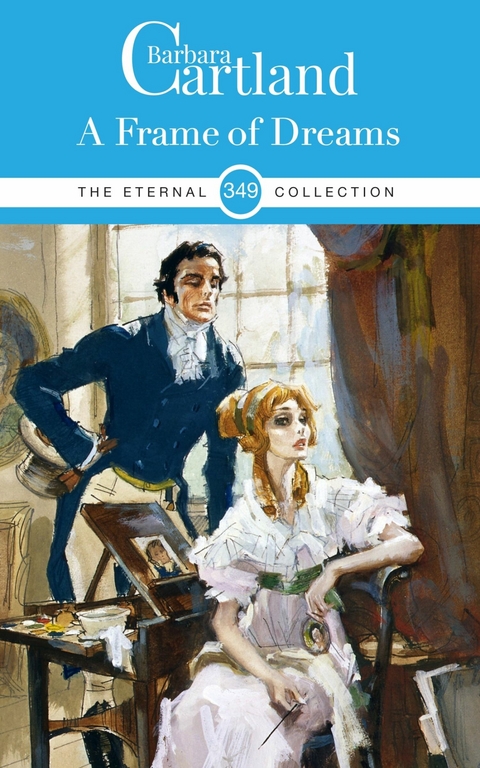
The impoverished daughter of a renowned artist, Vanessa was making ends meet by restoring the delicate miniatures that her father was so famous for. Whilst travelling to a commission she is saved from the clutches of the odious Sir Julius Stone by the dashing, but confirmed batchelor, the Marquis of Ruckford. Ruckford is quite taken by Vanessas exquisite beauty and resolves to help and protect her in any way he can as he said, 'lovely women often quite unconsciously court danger'. As his words come true and Vanessa foils a Napoleonic plot, he realises his protection has turned into something more. But the Marquis has no plans for marriage. Torn between love and a shameful proposal Vanessa must make a choice. What she chooses and how this changes both their lives, are told in this beautifully visual story, set in Georgian London.
The impoverished daughter of a renowned artist, Vanessa was making ends meet by restoring the delicate miniatures that her father was so famous for. Whilst travelling to a commission she is saved from the clutches of the odious Sir Julius Stone by the dashing, but confirmed batchelor, the Marquis of Ruckford. Ruckford is quite taken by Vanessas exquisite beauty and resolves to help and protect her in any way he can as he said, "e;lovely women often quite unconsciously court danger"e;. As his words come true and Vanessa foils a Napoleonic plot, he realises his protection has turned into something more. But the Marquis has no plans for marriage. Torn between love and a shameful proposal Vanessa must make a choice. What she chooses and how this changes both their lives, are told in this beautifully visual story, set in Georgian London.
CHAPTER ONE 1804
The Marquis of Ruckford permitted his valet to assist him out of his evening coat. It was exquisitely cut by Weston and fitted without a wrinkle. At the same time, because the Marquis disliked feeling confined, it was slightly looser than those the same tailor cut for the Prince of Wales.
The bedchamber, being the best in the posting inn, was large, and despite its low ceilings, exceedingly comfortable. Although it was now early May, there was a fire burning brightly in the grate and His Lordship noted with satisfaction that the oak four-poster bed was wide and its deep mattress should ensure his comfort.
There was however a slight frown on the Marquis’s handsome face, as in the distance there could be heard the noise of voices and laughter, a sound that had continued all through the evening and had been louder still in the private parlour where he had eaten his dinner.
“I have never known the place so noisy,” the Marquis remarked to his valet. “Perhaps we would have been better advised to stay with Lord Lincoln.”
“It is unfortunate, My Lord,” the valet replied, “that there should have been a mill taking place in the vicinity on the very day of our arrival. ’Tis said the purse exceeded two thousand guineas and a large amount of money was laid on the local man.”
“Did he win?” the Marquis asked somewhat indifferently.
An amateur boxer himself of some distinction, he found it a bore to watch a mill unless the very finest champions had been matched. There were, in his opinion, far too many over-boosted fights in country areas, which were usually organised by local innkeepers to bring money into the vicinity.
“I believe, My Lord,” the valet replied, “that the fight was in fact disappointing. Despite the much-vaunted qualities of the local man’s opponent, he was floored in under half an hour and with such ease that the majority of the spectators are complaining they had come a long way for nothing.”
“That is what I expected,” the Marquis remarked laconically. “At the same time there are too many guests in the inn and they are far too loud-mouthed for my comfort.”
“They’re drinking themselves under the table, My Lord,” the valet replied. “The landlord’s never had such a harvest!”
The Marquis did not reply. He did not like gossiping with his servants, and anyway he was tired, having travelled since early in the morning from Lord Hargrave’s castle in Huntingdonshire.
As his valet assisted him to remove the rest of his garments and he washed in the warm water to which a few drops of eau-de-cologne had been added, he thought that the Prince of Wales should be grateful that he had undertaken this journey on his behalf. It had in fact given the Marquis an opportunity for trying out his new team of perfectly matched chestnuts, which he had purchased two months before at Tattersalls and which he had not previously taken further than Hyde Park. But the whole trip had taken a lot of planning.
Lord Hargrave’s Castle was off the main roads, and twisting, dusty lanes did not make for pleasant driving. What was more, it meant that His Lordship had to spend two nights on the journey, one between London and the castle, and one on his return.
The two nights he had spent in the castle had been somewhat rewarding in that he had acquired an interesting find to show the Prince of Wales. He had also brought a picture back with him that he knew would delight His Royal Highness.
At the same time he had not been in the castle for more than half an hour before he understood Lord Hargrave’s disinclination to come to London. Also, his suggestion that the Marquis of Ruckford should be sent to inspect his treasures had been inspired by a very different motive from what had appeared in his well expressed letter to the Prince.
Lord Hargrave had produced his daughter with the air of a magician bringing an unexpected rabbit out of a hat. The Marquis, who was used to such wiles, was irritated to find himself once more in the uncomfortable position of making it absolutely clear that his interest was in paintings and not in marriage.
The Honourable Emily, aged nineteen, had a pleasing countenance. In fact the Marquis was sure that Lord Hargrave would find it quite easy to procure for her a husband of sufficient wealth and importance to match her dark-eyed attractions. At the same time he made it very clear that he was not available in the marriage market.
It was not surprising, as he would have been frank enough to admit to himself, that Lord Hargrave, in aspiring for the best for his daughter, should consider him as a suitable son-in-law. The Marquis had been pursued by every matchmaking father and mother in the length and breadth of Great Britain since the time he had left Eton. He was not only immensely wealthy and his house, like his estates, the finest in the land. He was also an extremely attractive man. So handsome that only with the greatest dexterity and a certain amount of disagreeableness had he prevented himself from being nicknamed ‘Beau Ruckford’.
He was also an outstanding sportsman and as such was almost unique in being admired and liked by his own sex as much as by the lovely ladies who sought his favours. A noted Corinthian and undoubtedly the finest whip in the ‘Four-in-Hand’ Club, he had made his mark as a duellist not only with swords but also with pistols and was undoubtedly one of the greatest amateur riders that ever carried his own horses past the winning post.
Besides all this he played his part in the House of Lords, and Statesmen valued his opinion and support.
The Prince of Wales not only called the Marquis his friend with an undeniable sincerity, but he also found him an invaluable source of information and discrimination where works of art were concerned. The Prince’s predilection for paintings, furniture and everything else that added to the glory of Carlton House supplied the cartoonists with an endless stream of ammunition against him.
He had incurred debts, which had infuriated the people and Parliament, but the treasures on which he spent such vast sums were in fact the envy of every connoisseur.
There was no doubt that Carlton House was magnificent! It had been granted to the Prince by the King as his London residence, provided that he did not give away any of the land and took upon himself “all the repairs, taxes, and the keeping up of the gardens”.
The house, which had been built at the beginning of the eighteenth century and had formerly been inhabited by the Dowager Princess of Wales, the Prince’s grandmother, was unremarkable. But the Prince employed Holland, the architect of Brook’s Club, and by 1783 he had moved into Carlton House to live there as the work went on around him.
It was a delight to the Prince to be able to exercise his excellent taste in decorating the rooms and collecting the furniture. The objets d’art, pictures, looking-glasses, bronzes, Sèvres china, Gobelin tapestries and countless other treasures that enriched this ‘Palace’ were to stand comparison with Versailles and even the Palace of St. Petersburg. He himself scoured the salerooms and dealers’ shops of London, buying objects week after week, which he carefully arranged in the various rooms of Carlton House.
Although there was a difference of twelve years in their ages, the Prince counted the Marquis as one of his closest friends, and that he should both encourage and assist him was a continual delight. The Prince found the majority of his friends were uninterested in his expensive but rewarding hobby, or pretended to appreciate what they did not understand.
The two men were opposites in most other regards. Both were outstandingly handsome, but while the Prince was growing fatter every year from over-indulgence, the Marquis became, if anything, slightly slimmer.
Despite his broad shoulders, his hips were narrow and, as his tailor often told him, there was not a spare ounce of flesh on his whole body. This accentuated the bone structure of his face and threw into prominence his high cheekbones and the sharpness of his jaw.
The Prince in his youth had been what was called a “pretty boy”, while the Marquis was clear-cut with a jauntiness – or perhaps the right word was raffishness – about him that was very different. He had, as more than one woman had told him, the face of a buccaneer, and his behaviour, where women were concerned, warranted this description.
But while the Prince drifted through life indulging his fancies, being at times outrageously uncontrolled, the Marquis was not only well organised but also had a very clear idea of what he desired both now and, in the future.
On one point he was completely determined, and that was he did not intend to marry until it suited him. He was well aware that with his historic name, his great possessions and a social position that was second to none, he must eventually beget an heir to carry on the family. He had in fact, although he had not mentioned it to anyone, already selected his bride, the daughter of the Duke of Tealby, whose lands marched with his.
Lady Adelaide Wilmott was exactly the type of wife that the Marquis visualised at the top of his table. She was quiet, well mannered and, while not a striking beauty, had undoubtedly a pleasing face. With her aristocratic features, her straight nose and proudly held head, which showed good breeding, the Marquis was aware that she would carry the fabulous Ruckford jewels with an air of distinction.
Lady Adelaide was at present a Lady-in-Waiting to the Queen, and the Marquis felt that such...
| Erscheint lt. Verlag | 14.9.2024 |
|---|---|
| Reihe/Serie | The Eternal Collection |
| Verlagsort | Hatfield |
| Sprache | englisch |
| Themenwelt | Literatur ► Historische Romane |
| Literatur ► Romane / Erzählungen | |
| Schlagworte | Napoleon wars • Waterloo • Wellington |
| ISBN-13 | 9781788678193 / 9781788678193 |
| Informationen gemäß Produktsicherheitsverordnung (GPSR) | |
| Haben Sie eine Frage zum Produkt? |
 EPUB (Adobe DRM)
Kopierschutz: Adobe-DRM
Adobe-DRM ist ein Kopierschutz, der das eBook vor Mißbrauch schützen soll. Dabei wird das eBook bereits beim Download auf Ihre persönliche Adobe-ID autorisiert. Lesen können Sie das eBook dann nur auf den Geräten, welche ebenfalls auf Ihre Adobe-ID registriert sind.
Details zum Adobe-DRM
Dateiformat: EPUB (Electronic Publication)
EPUB ist ein offener Standard für eBooks und eignet sich besonders zur Darstellung von Belletristik und Sachbüchern. Der Fließtext wird dynamisch an die Display- und Schriftgröße angepasst. Auch für mobile Lesegeräte ist EPUB daher gut geeignet.
Systemvoraussetzungen:
PC/Mac: Mit einem PC oder Mac können Sie dieses eBook lesen. Sie benötigen eine
eReader: Dieses eBook kann mit (fast) allen eBook-Readern gelesen werden. Mit dem amazon-Kindle ist es aber nicht kompatibel.
Smartphone/Tablet: Egal ob Apple oder Android, dieses eBook können Sie lesen. Sie benötigen eine
Geräteliste und zusätzliche Hinweise
Buying eBooks from abroad
For tax law reasons we can sell eBooks just within Germany and Switzerland. Regrettably we cannot fulfill eBook-orders from other countries.
aus dem Bereich