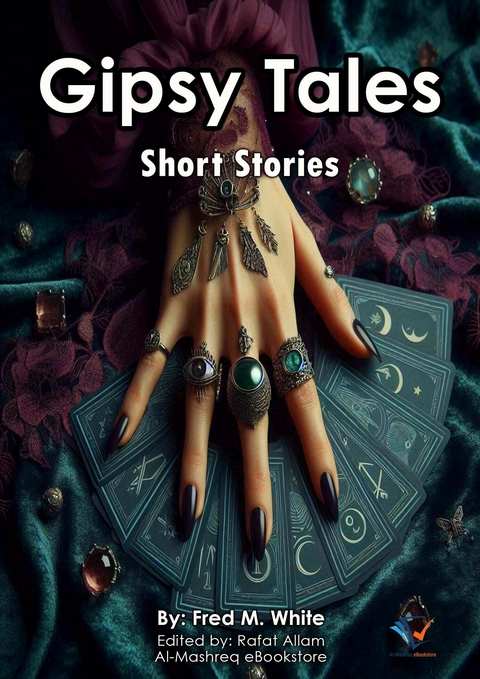
Gipsy Tales (eBook)
280 Seiten
Al-Mashreq Ebookstore (Verlag)
978-0-552-47854-0 (ISBN)

Fred M. White (1859-1935) was a British author known for his prolific output of mystery, adventure, and speculative fiction. He is most famous for his early science fiction disaster novels, particularly 'The Doom of London' series, which depicted catastrophic events befalling the city. White wrote hundreds of short stories and serialized works, which were popular in magazines during the late 19th and early 20th centuries. His works contributed significantly to the development of early science fiction and thriller genres.
Fred M. White (1859–1935) was a British author known for his prolific output of mystery, adventure, and speculative fiction. He is most famous for his early science fiction disaster novels, particularly "The Doom of London" series, which depicted catastrophic events befalling the city. White wrote hundreds of short stories and serialized works, which were popular in magazines during the late 19th and early 20th centuries. His works contributed significantly to the development of early science fiction and thriller genres.
A LIBERAL EDUCATION
A "GIPSY" STORY
ILLUSTRATED BY L. RAVEN-HILL
Published in The Windsor Magazine, Vol. XVIII, Nov 1903, pp 657-666
GIPSY removed his cigarette and glanced at the stranger. He was a small man, with garb reminiscent of towns—a frock-coat struggling with adversity, a glossy top-hat, owing its refulgent rays to benzoline. For the rest, the man was red, and had sanguine eyes behind glasses. He carried a big portfolio under his arm.
A small man, with garb reminiscent of towns
"If it ain't a rude question," Gipsy said blandly, "what the dickens are you after, mate?"
This was the dinner interlude. The clink of pick and the rattle of drill had ceased, and gang B14 were feeding, for the most part, out of red bandana handkerchiefs. Gipsy's cigarettes gained flavour from curiosity. Antiquarians and archaeologists he knew, but the specimen before him was quite new. He had never seen a book-agent before.
The small man, wandering into the big engineering camp high up the Valley of Sweet Waters, needed no more cordial greeting. The tiniest spark of curiosity blew up the floodgates of his loquacity. The glib words flowed on.
"'Arf time," Gipsy cut in. "The mate what shares my 'ut 'as got a parrot. Maybe as you might teach him to say a few words."
The little man smiled, nothing abashed. He spread out before Gipsy's admiring eyes a series of illustrations, views of the world at large, maps, sections of the human form divine, models of more or less up-to-date steam-engines—the whole pictorial art as applied to the "Universal Compendium Encyclopsedia," complete in twelve monthly parts at seventeen and sixpence per volume, first instalment down, the balance on faith. The book-agent is childlike and trusting, possibly because the seventeen and six down covers any predatory leaning on the part of the thirsty knowledge-seeker.
"That's what you want," said the little man, with fine insight. "This dictionary in itself, sir, is a liberal education. There's nothing—nothing that you won't find in it."
"Think so?" Gipsy asked doubtfully. "Anything about prizefights, mister?"
The little man pointed to a full-page drawing of a Roman gladiator, obviously pirated from one of the late Lord Leighton's drawings. He would like very much to know what Gipsy thought of that. The navvy was properly impressed. He regarded the gladiator's biceps critically. With a fund of knowledge like that, he would be uplifted over his fellows. Seventeen and sixpence was not much whereby he might be placed intellectually on a level with the resident engineers at Cwm House. Besides, when the thirst for knowledge played subordinate to thirst of a more commonplace character, and the exchequer was low, the volume would pawn in Rhayader for the requisite silver.
Gipsy rattled some money in his pocket. They were a sporting lot up the valley, and Gipsy's second in the Derby "sweep" had brought in a matter of over six pounds. He hesitated; seventeen and sixpence was not so much to a bachelor sharing a hut and drawing thirty-two shillings a week.
"I'll take it," he said. "And 'ere's the first money down."
"Then I'll book your order, sir," the little man said. Gipsy swelled with pride. His vivid imagination was running ahead of the present; there were reminiscences of the Industrious Apprentice in his mind.
"Perhaps your other volumes may come a little under the month, in which case—"
"Oh, I shan't mind that," Gipsy said largely. "You make out the paper."
"Certainly, sir. In that case, Form B is the one for you to sign. Your name, sir, please? Gipsy? Very good. And your Christian name, sir?"
All this with a humility that filled Gipsy with a pleased sense of importance. But as to the Christian name, there was a hitch. Did he possess one, it was lost in the backwash of boyish memories. He had never been called anything but Gipsy. At his feet lay a fine, florid drawing of Hercules. Gipsy spelt out the word slowly—his infinite resource came back to him.
"Rum thing," he said. "My Christian name's the same as that knobby bloke with the belt round his waist. H-e-r-c-u-l-e-s. Call it Herkules Gipsy, and you've got it first pop. What yer laughin' at?"
The little man explained that he wasn't laughing at all, it was merely a chronic catarrh, from which he had been a victim from boyhood. Gipsy scratched a pleasing hieroglyphic at the foot of a long, blue form, the benzoline-glossy hat was lifted with a flourish, and Gipsy was alone with the key of knowledge in his grasp—cheap at seventeen and sixpence.
The publishers of the "Universal Compendium Encyclopaedia" were less trustful than a first casual glance would have disclosed. But then Gipsy knew nothing about "remainders" or the fact that many old works of this nature—fruits of failure and bankruptcy of bygone publishers—are sold as so much waste-paper, the body or corpse being subsequently clothed in new outer garments and peddled to a confiding public through the medium of many little men with dilapidated frock-coats and hats resplendent of benzoline. As a matter of fact, had no further payment been made, the Universal Compendium Publishing Company would have lost nothing—which fact Gipsy did not grasp, as also he had no idea that he had signed a form consenting to receive the balance of the volumes monthly, or more frequently should the publisher deem the latter course expedient. Within a month the rest of the volumes did arrive, carriage paid, in a neat box, plus an invoice for something over £10, with a footnote to the effect that if the balance were not paid within fourteen days, proceedings for its recovery would be taken without further notice.
All this, however, escaped the usually sharp eye of the seeker after knowledge. It was very good of these people to send on the books which need not be paid for yet. Meanwhile, Gipsy was progressing with his liberal education. He knew something about Adam, who seemed to be mixed up in some way with a peculiar kind of fireplace; he gained some new information about Africa; of Agriculture he hoped presently to speak with authority; Algebra he was forced to ignore altogether. But the greatest delight lay in the pictures—twenty in each volume, harnessed to the text in the most indiscriminate fashion, but there they were.
It was not to be supposed that so fine a sportsman as Gipsy could have kept his new possessions a secret. There were those who scoffed, but others who firmly believed. Mothers came to know if the big book had any hints as to the teething of children, or the proper treatment of warts, whilst a third desired information as to the best way to boil cabbages; young navvies, with an eye to a hut of their own, asked Gipsy quietly if the book had any hints as to good, plain furniture, and the best way to get it on the instalment plan.
"I'm doing my best for the settlement," Gipsy replied. "It's a tough job, this 'ere liberal education, and apt to get confusing. I can't quite make out where I am sometimes. There's Anatomy. Now, is it a new kind of metal or a Colony in South Africa? But it'll all come right in time. Only I ain't found anythink about warts or furniture in the book as yet."
"Look the warts up under 'Antibilious,'" Mitchell, the painter, suggested. Mitchell was a man who had bid fair for fame as an artist at one time, only he could never keep sober for more than a week at a time. He had a fine, cynical humour of his own, a keen eye for character-study, and Gipsy, with his dramatic instincts, fairly fascinated him. "You've got the chance of becoming a great force here, old man."
Gipsy growled uneasily. He had a vague feeling that Mitchell had once been a gentleman. He was a master of phrases, too. But amongst the ten thousand navvies working, there were many who could have told lurid life-stories besides Mitchell, the painter. Dandy, standing by, sneered openly.
"What's the good on it," he asked, "when you can get Reynolds's every week for a brown? There ain't a good rattlin' bloomin' murder in all this volume what Gipsy's so set up about."
Gipsy smiled in a superior manner. Dandy eyed him with disfavour—he seemed to be on a different plane to his old mate now.
"Canteen's open," Mitchell suggested. "Come along. In the full flush of newly acquired knowledge, Gipsy ought to be able to tell us something about beer. Letter B, all in Volume I. of the Compendium."
"If you only knew what it was made of," Gipsy said in his most superior manner. All the same, he was moving towards the canteen with the rest. "There's a thing called quashyer—"
"If it was made o' mud flavoured with rotten eggs an' ditch-water," Dandy said vehemently, "it 'ud be all the same to me. Beer's beer. Been fond of it all my life, and ain't going to turn from it for all the Compendiums as was ever wrote."
A murmur of applause followed. Gipsy so far bent to popular opinion as to take a pint of the amber fluid himself. Sooth to say, he was a little tired of the Compendium. It was beginning to dawn before him that he could not live up to it. For the last month he and Dandy and Gammon had not had one poaching excursion together.
"I don't want to keep that book to myself," he said. "I'm all for public spirit. I'm going to turn it into a free...
| Erscheint lt. Verlag | 12.9.2024 |
|---|---|
| Verlagsort | London |
| Sprache | englisch |
| Themenwelt | Literatur ► Romane / Erzählungen |
| Schlagworte | Adventure • enigmatic • Escape • Folklore • Magic • Mystical • Nomadic • Romance • Romani • Traditions |
| ISBN-10 | 0-552-47854-7 / 0552478547 |
| ISBN-13 | 978-0-552-47854-0 / 9780552478540 |
| Informationen gemäß Produktsicherheitsverordnung (GPSR) | |
| Haben Sie eine Frage zum Produkt? |
 EPUB (Adobe DRM)
Kopierschutz: Adobe-DRM
Adobe-DRM ist ein Kopierschutz, der das eBook vor Mißbrauch schützen soll. Dabei wird das eBook bereits beim Download auf Ihre persönliche Adobe-ID autorisiert. Lesen können Sie das eBook dann nur auf den Geräten, welche ebenfalls auf Ihre Adobe-ID registriert sind.
Details zum Adobe-DRM
Dateiformat: EPUB (Electronic Publication)
EPUB ist ein offener Standard für eBooks und eignet sich besonders zur Darstellung von Belletristik und Sachbüchern. Der Fließtext wird dynamisch an die Display- und Schriftgröße angepasst. Auch für mobile Lesegeräte ist EPUB daher gut geeignet.
Systemvoraussetzungen:
PC/Mac: Mit einem PC oder Mac können Sie dieses eBook lesen. Sie benötigen eine
eReader: Dieses eBook kann mit (fast) allen eBook-Readern gelesen werden. Mit dem amazon-Kindle ist es aber nicht kompatibel.
Smartphone/Tablet: Egal ob Apple oder Android, dieses eBook können Sie lesen. Sie benötigen eine
Geräteliste und zusätzliche Hinweise
Buying eBooks from abroad
For tax law reasons we can sell eBooks just within Germany and Switzerland. Regrettably we cannot fulfill eBook-orders from other countries.
aus dem Bereich